

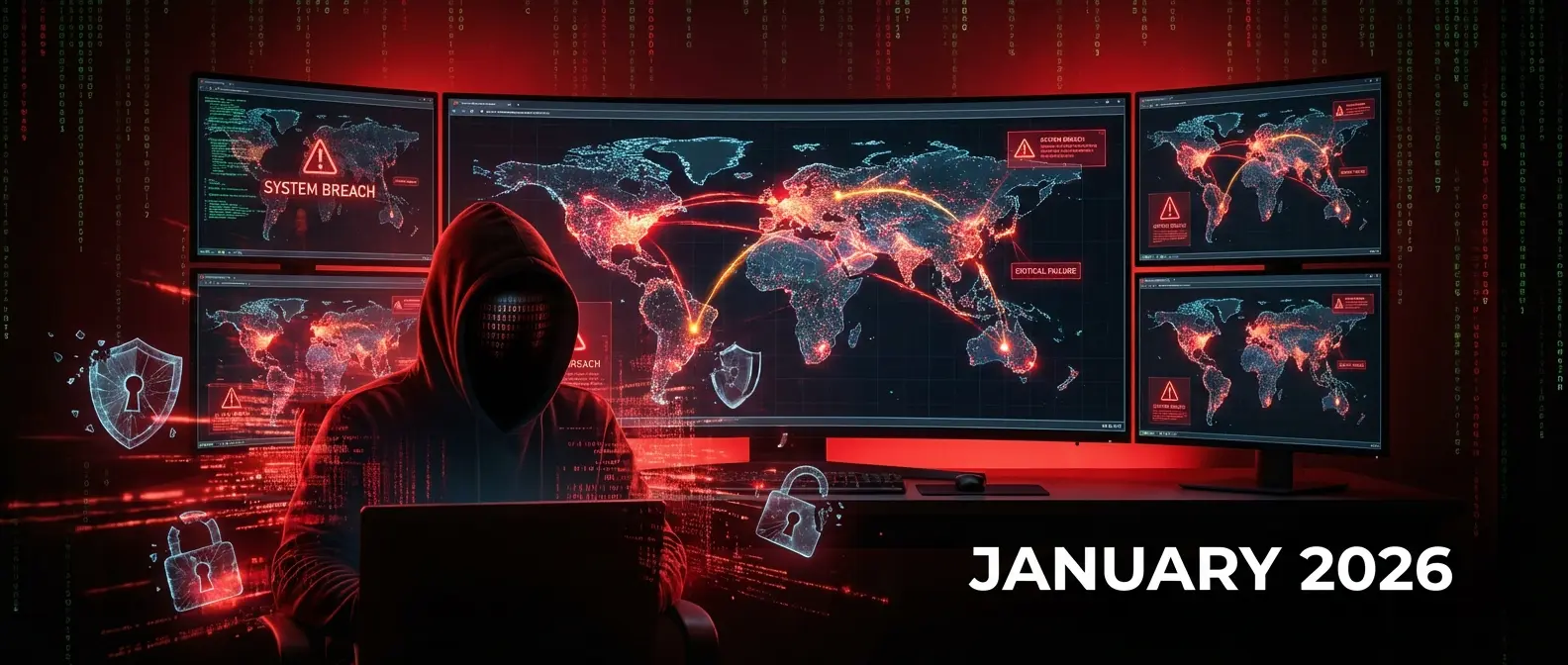
January 2026 will go down in cybersecurity history as one of the most intense months. From ransomware attacks on hospitals to massive data breaches, hackers started the year with relentless intensity. In this article, we analyze the most significant incidents and the lessons we must take away.
📖 Read more: EU Cyber Resilience Act: What Changes for Your Devices
🚨 January 2026 Statistics: 847 confirmed cyber attacks worldwide, a 23% increase compared to January 2025.
🔴 1. Ransomware on the National Health Service (NHS) - UK
🏥 NHS Trust Attack
The BlackMatter 2.0 group managed to encrypt the systems of 14 hospitals in southeast England. Surgeries were canceled, medications could not be administered properly, and the crisis lasted 11 days.
How did the attack happen?
- Initial entry point: Phishing email to an administrative employee
- Lateral movement through legacy Active Directory
- Exploitation of unpatched Exchange Server (CVE-2025-21389)
- Encryption within 72 hours without detection
What did we learn?
The attack revealed the chronic underfunding of cybersecurity in the public health sector. The NHS was still running Windows Server 2016 on critical systems.
🔴 2. Telecom Italia Data Breach
📱 TIM Data Breach
Telecom Italia (TIM) confirmed the leak of personal data of 48 million customers, including names, addresses, IBANs, and call histories.
What was leaked?
| Data Type | Number of Records | Risk |
|---|---|---|
| Names & Addresses | 48 million | High |
| Phone Numbers | 48 million | High |
| Bank IBANs | 31 million | Critical |
| Call History | 12 million | Medium |

🔴 3. Supply Chain Attack - NPM Registry
📦 Malicious Package "event-stream-2026″
A malicious npm package managed to get installed in thousands of projects, stealing cryptocurrency from developer wallets.
How did it work?
- The attacker gained access to an abandoned npm account
- Published a “security update” with obfuscated code
- The code only activated when it detected wallet files
- Estimated theft: $4.2 million in crypto
⚠️ For developers: Use npm audit and lockfiles. Check your dependencies regularly.
🔴 4. DDoS on the Athens Stock Exchange
📈 ATHEX DDoS Attack
The Athens Stock Exchange (ATHEX) suffered a massive DDoS attack that disrupted trading for 4 hours during a critical session.
The attack coincided with the announcement of a major corporate merger, suggesting possible financial motivation or market manipulation.

📊 January Summary Statistics
| Attack Type | Incidents | Change vs 2025 |
|---|---|---|
| Ransomware | 312 | +18% |
| Data Breaches | 187 | +31% |
| Supply Chain | 43 | +67% |
| DDoS | 198 | +12% |
| Phishing Campaigns | 107 | -5% |
🛡️ How to Protect Yourself
For businesses:
- Patch management: Apply updates within 48 hours for critical vulnerabilities
- MFA everywhere: Especially for email and VPN
- Backup 3-2-1: 3 copies, 2 media, 1 offsite
- Incident Response Plan: Tested and up to date
- Security awareness: Staff training every quarter
For users:
- Use a password manager
- Enable 2FA/MFA on all accounts
- Do not click on links from unknown sources
- Check if your data has been leaked at haveibeenpwned.com
🔮 What to Expect in 2026
Experts predict:
- AI-powered attacks: Automated phishing with deepfakes
- Quantum threats: First harvest-now-decrypt-later attacks
- OT/ICS targeting: More attacks on industrial systems
- Ransomware-as-a-Service: Even more accessible for beginners
💡 Tip: The best defense is prevention. Invest in security before you need to pay ransom.