

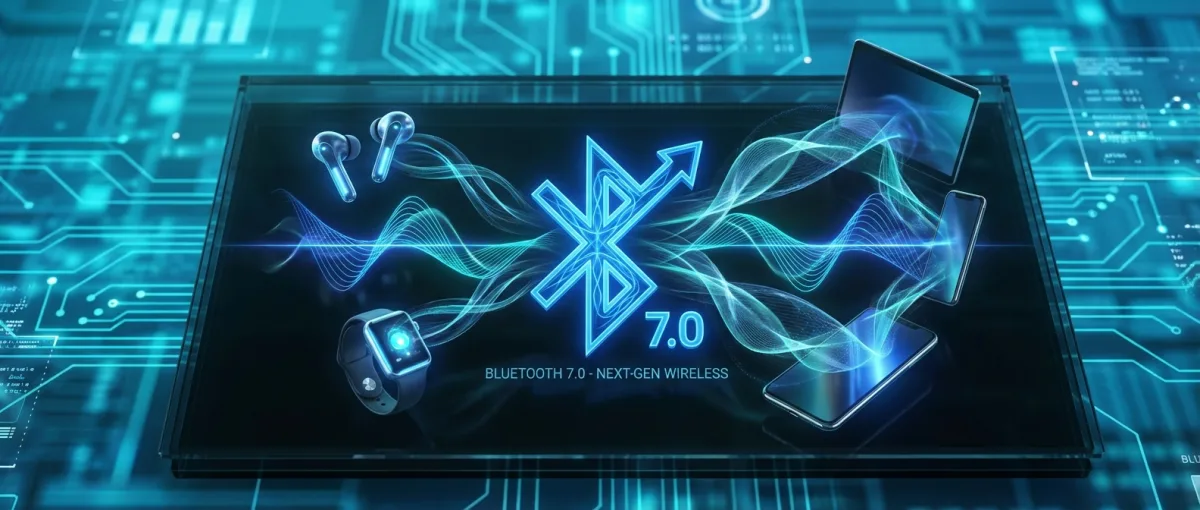
Every Bluetooth generation promises “faster connection, less power consumption.” And every generation does improve something. But Bluetooth 7, announced in 2025 and rolling into hardware in 2026, makes a genuine leap.
📖 Read more: Wi-Fi 8: Qualcomm Races Ahead of the Standard
⚡ What Changes
The biggest shift is unified BR/EDR and Low Energy channel support. Until now, Bluetooth Classic (music, calls) and BLE (IoT, trackers) operated separately. Bluetooth 7 merges them, allowing a device to simultaneously do high-quality audio streaming AND low-power sensor communication.
Other features:
- Speed: Up to 8 Mbps (double BT 5.4)
- Range: Improved indoors with new modulation
- Auracast: Full broadcast audio support — one phone, unlimited listeners
- Positioning: Centimeter-level accuracy (like UWB, but over Bluetooth)
- Power: 40% less consumption in BLE mode vs BT 5.4
📖 Read more: USB4 2.0 & Thunderbolt 5: 80Gbps Speeds Coming in 2026
🎧 Headphones and Wearables
Wireless earbuds will see the biggest benefit. LE Audio goes fully mainstream: better sound quality at lower bitrate, multipoint connection to multiple devices, and Auracast — the ability to share music or TV audio with anyone nearby. Smartwatches will achieve longer battery life thanks to reduced power draw.

📖 Read more: Qualcomm X105 5G Modem: Next-Gen Speeds
🏠 At Home
Centimeter-level positioning transforms smart homes entirely. The lock knows whether you're 2 meters away or 20 centimeters. Lights turn on only in the room you're actually in — not approximately. The thermostat adjusts based on which room you're using. UWB-level accuracy in Bluetooth means no separate UWB chip needed — cost savings for manufacturers.
📅 When
First Bluetooth 7 chips ship within 2026. Smartphones and earbuds with BT 7 are expected in 2027 flagships. Mainstream adoption in mid-range devices: 2028. Until then, Bluetooth 5.3/5.4 remain perfectly capable.
📖 Read more: Wi-Fi 7: Why 2026 Is the Year It Goes Mainstream