


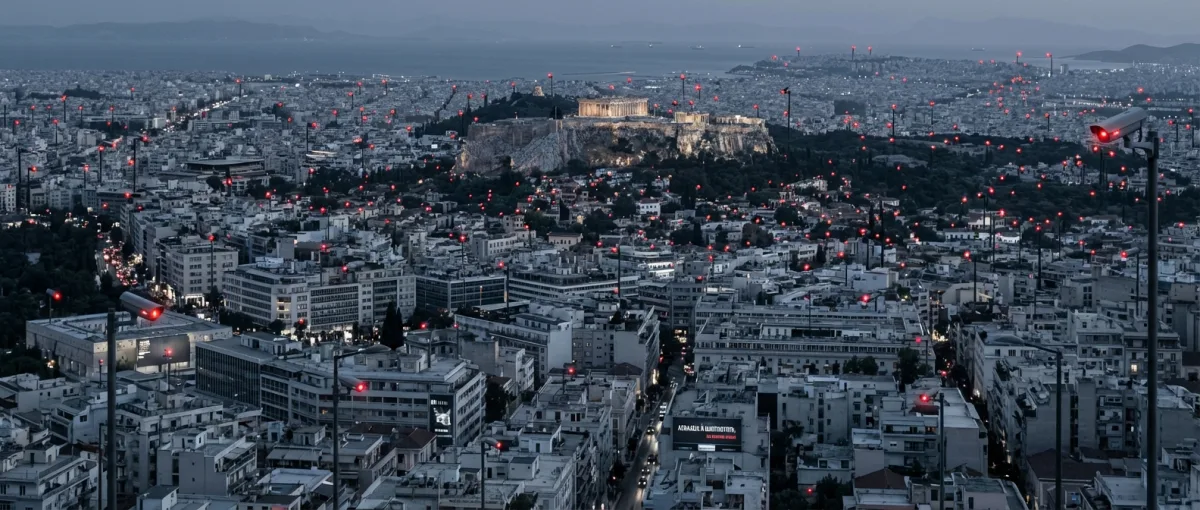
Saturday night, Omonoia Square. You walk past the new streetlights, the renovated storefronts, the crowds slowly reclaiming downtown Athens. Somewhere overhead, tucked into a corner you don't notice, a small dome with a lens watches you. You're not a suspect. You just happen to be there — and that's enough.
📖 Read more: Athens: The Greek Institute of Human Genomics Launches
📋 The Plan: 1,000 Eyes in the Heart of Athens
The Municipality of Athens, in partnership with the Hellenic Police (ELAS), has announced the installation of over 1,000 closed-circuit cameras across the city center. Omonoia, Syntagma, Exarchia, Psyrri, Plaka — the busiest neighborhoods and, simultaneously, the most historically charged when it comes to crime and social tension.
This isn't just about mounting standard cameras on poles. AI-powered capabilities are on the table: facial recognition, “suspicious behavior” detection, automatic alerts to patrol cars. Technology that sounds like a movie plot — but is being installed right now, on streets you walk every day.
Installation will proceed in three phases. First, the major transport hubs — metro stations, bus stops, pedestrian zones. Then tourist hotspots and commercial streets. Final phase: neighborhoods with the highest crime rates. Each camera will feed into a centralized monitoring system staffed 24/7 by trained operators. Phase one is expected to be completed by the end of 2026.
What exactly do these cameras “see”?
These aren't the grainy, blurry cameras of the 1990s. The new systems include 4K high-resolution cameras with zoom capability, infrared night vision, and — here's where the debate begins — AI software capable of analyzing behavior in real time. A person running? A scuffle? An abandoned object? The system will alert automatically. The question: how many false alarms will it trigger every single day?
🔒 The Security Argument: Why They Say “Yes”
The numbers make a partial case for cameras. In Athens neighborhoods where pilot CCTV systems were deployed, petty crime dropped by 12%. Bag snatching, car break-ins, vandalism — all saw measurable declines. For residents who've spent years avoiding certain streets after dark, those numbers carry real weight.
Police argue that cameras serve more than just deterrence. They enable rapid identification of perpetrators, better coordination during protests and large events, and a restored sense of safety among residents and tourists alike.
Greece's private security industry, growing at 12% annually, sees cameras as an integral component of a modern safety grid. It's no coincidence that body camera pilot programs for police officers are already running in parallel.
There's another argument, more pragmatic: tourism. Athens welcomes millions of visitors every year, and the perception of safety matters. A CCTV network in the city center sends a signal — both to potential criminals and to tourists seeking a trustworthy destination. Barcelona and Rome, cities with similar tourist profiles, invested earlier in downtown cameras and report positive results in visitor satisfaction surveys.
📖 Read more: Europe's $47B Semiconductor Push: New Factories Coming

🔒 The Privacy Argument: Why They Say “No”
The pushback is equally forceful. Civil liberties organizations point out that mass surveillance of public spaces turns every citizen into a potential suspect. You're no longer walking freely — you're walking while being watched.
The Hellenic Data Protection Authority (HDPA) has raised concerns about proportionality. Are 1,000 cameras “proportional” to the problem? Or is this an excessive response to issues that could be addressed with more officers on the streets?
The EU AI Act classifies real-time biometric identification in public spaces as a "prohibited" AI application — with narrow exceptions exclusively for law enforcement investigating serious crimes. GDPR, meanwhile, sets strict criteria for processing biometric data in public areas.
The question isn't only legal — it's cultural. Greece, a country that lived through dictatorship and years of state surveillance, carries a particular sensitivity toward government oversight. Cameras aren't just technology. They're a symbol.
Beyond the emotional dimension, there are practical concerns. Who has access to the footage? How much data gets stored and for how long? What happens if the database is breached? In a country where cyberattacks on public institutions aren't uncommon, the security of the data itself raises questions. A leak of footage combined with facial recognition data isn't a theoretical scenario — it has already happened in cities across Asia and Latin America.
🇪🇺 The European Landscape: Where Athens Stands
Athens isn't operating in a vacuum. London has over 700,000 cameras, making it the most surveilled city in Europe. China has surpassed 600 million cameras nationwide. Portugal and Spain are rolling out similar programs in tourist areas.
The difference? Scale and safeguards. Countries like Germany and Austria enforce stricter rules, requiring clear justification for every public-space camera, regular audits by independent authorities, and automatic deletion of footage after a set period.
Take London as an example. Despite its 700,000 cameras, the UK government acknowledges that their effectiveness in preventing crime is not clear-cut. A study by the College of Policing found that cameras reduce crime in parking areas, but their impact on violent crime remains contested. Technology is not a panacea — and Athens needs to weigh that before spending €15 million.

💰 The Money: Who Pays the €15 Million
Full deployment is estimated at €15 million. That's not just cameras — it covers command centers, network infrastructure, AI software, maintenance, and staff training. Funding is expected from both national budgets and EU security grants.
📖 Read more: DAEDALUS: Greece's National Supercomputer Goes Live
Critics wonder: will 1,000 cameras solve what thousands of police officers couldn't? Or is this a technological showcase that looks impressive without changing the fundamentals?
One detail often overlooked: costs don't stop at installation. Annual maintenance, software upgrades, salaries for technicians and operators add millions every year. If the municipality fails to secure long-term funding, Athens risks ending up with a camera network that's obsolete or non-functional within five years — as has happened in dozens of cities worldwide.
💡 The Balance: Is There a Middle Ground?
The “security versus privacy” standoff doesn't have to be a zero-sum game. Other cities, like Amsterdam and Copenhagen, have shown it's possible to use cameras with strong safeguards: public accountability, parliamentary oversight, annual transparency reports. Many experts propose a framework that includes:
- Strict legislation governing data use and storage
- Independent oversight by the HDPA with real-time access
- Automatic deletion of footage after 7–30 days (unless tied to an investigation)
- No facial recognition without a court order
- Public consultation before every expansion phase
Technology isn't the enemy. But it isn't a savior either. It becomes dangerous when deployed without rules, without checks, without the right to challenge.
As the first cameras climb the poles of Omonoia Square, the real debate isn't whether they'll go up. It's who watches the watcher. And if the answer to that question doesn't come before the cameras do, then the problem won't be crime — it'll be democracy.
📌 Sources:
astynomia.gr — Hellenic Police
dpa.gr — Hellenic Data Protection Authority
ec.europa.eu — EU AI Act
reuters.com — European Surveillance Reports