


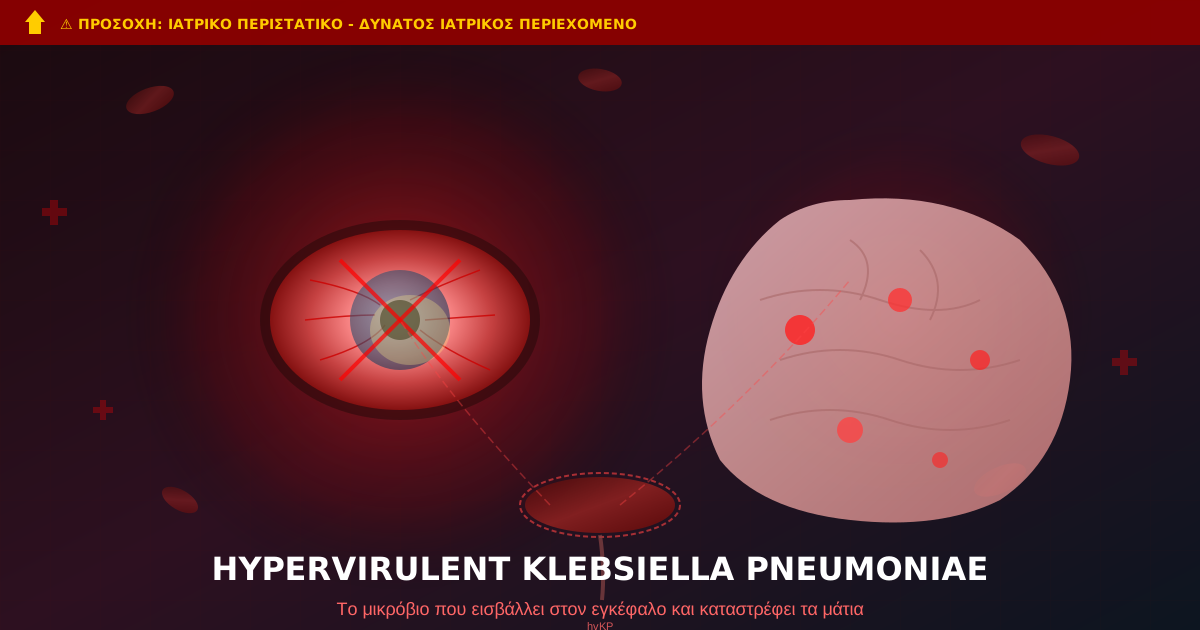
Hypervirulent Superbug Invades Brain and Forces Eye Removal in Devastating Medical Case
🔬 The most terrifying medical case of the year - Published in the New England Journal of Medicine
A hypervirulent bacterium spreading worldwide nearly killed an otherwise healthy 63-year-old man in New England. The microbe invaded his brain, created abscesses in his liver and lungs, and ultimately damaged his right eye so badly that it had to be surgically removed.
The case was published this week in the prestigious scientific journal New England Journal of Medicine, revealing the terrifying power of hypervirulent Klebsiella pneumoniae (hvKP) - a microbe that is increasing rapidly worldwide.
A 63-year-old man, with no significant medical history, presented to hospital with fever, cough, and vision problems in his right eye. What followed shocked even the most experienced doctors.
🦠 What Is Hypervirulent Klebsiella pneumoniae?
The classic Klebsiella pneumoniae is a bacterium that lives in our intestines and is well known to doctors. It typically causes infections in hospital patients - pneumonia or urinary tract infections.
But hvKP is completely different. By comparison, it is a “supercharged” bacterium with breathtaking aggressiveness. It was discovered for the first time in the 1980s in Taiwan - not because it attacks weak hospital patients, but because it destroys healthy people in their everyday lives.
| Characteristic | Classic K. pneumoniae | Hypervirulent K. pneumoniae (hvKP) |
|---|---|---|
| Target | Hospital patients, immunocompromised | Healthy people in the community |
| Spread | Local infection (lungs, urinary tract) | Metastatic - spreads throughout the body |
| Target Organs | Usually one organ | Liver, lungs, brain, eyes, skin |
| Mortality | 5-10% | Up to 50%+ (with antibiotic resistance) |
| Characteristic | Normal texture | Extremely sticky/mucoid |
📋 The Timeline of a Nightmare

🎯 Organs Under Attack
🔬 How Was It Diagnosed?
A simple but effective way to identify hvKP is the “string test”. Clinicians culture the bacterium in a Petri dish, then touch the colony with a tool and pull upward.
If the mucous string that forms stretches more than 5 millimetres, it is considered positive for hvKP. In this patient's case, the test was positive.
The key to the correct diagnosis was the eye. The patient appeared to have endophthalmitis - an infection inside the eyeball. The most common cause is trauma or previous surgery - but the patient had neither.
In reality, he had something worse: panophthalmitis - a rare, extremely serious and rapidly progressing condition where every part of the eye becomes infected. The infection had arrived via the blood, from the liver.

⚠️ The Global Threat of hvKP
Health authorities have raised the alarm not only about the global increase in hvKP cases, but also about the rise in cases that are resistant to critical antibiotics, specifically to carbapenems or extended-spectrum β-lactamases.
These resistant forms can have a mortality rate exceeding 50%.
💪 The Recovery
The doctors noted that the patient was lucky to have had a strain of hvKP without significant antibiotic resistance. The antibiotics he was given were able to kill the microbe.
In such cases, liver abscess drainage and surgical removal of brain lesions are sometimes recommended. However, the doctors ruled out both options:
- Liver abscess: It was too dispersed for simple drainage
- Brain lesions: They were too small and too numerous for safe surgery
Instead, the patient underwent intensive antibiotic therapy that lasted nine months. Fortunately, by the end, imaging confirmed:
- ✅ The liver abscess had disappeared
- ✅ The lung nodules had nearly disappeared
- ✅ The brain lesions had significantly shrunk or disappeared
📚 What You Need to Know
Infection with hvKP usually begins with:
- High fever that does not subside
- Severe abdominal pain (due to liver abscess)
- Persistent cough
- Sudden vision problems
- Confusion or neurological symptoms (if the brain is affected)
"hvKP doesn't hunt weak patients in hospitals - it destroys healthy people in the community. That's what makes it so terrifying."
— From the publication in the New England Journal of Medicine
🌐 Why Is It Increasing Globally?
Researchers identified five different virulence genes on plasmids (small circular DNA segments that can replicate independently and be shared between bacteria) that make hvKP so dangerous.
The problem is that these genes can be transferred to other bacteria, creating new dangerous strains. Combined with antibiotic resistance, this creates a potentially deadly situation.