

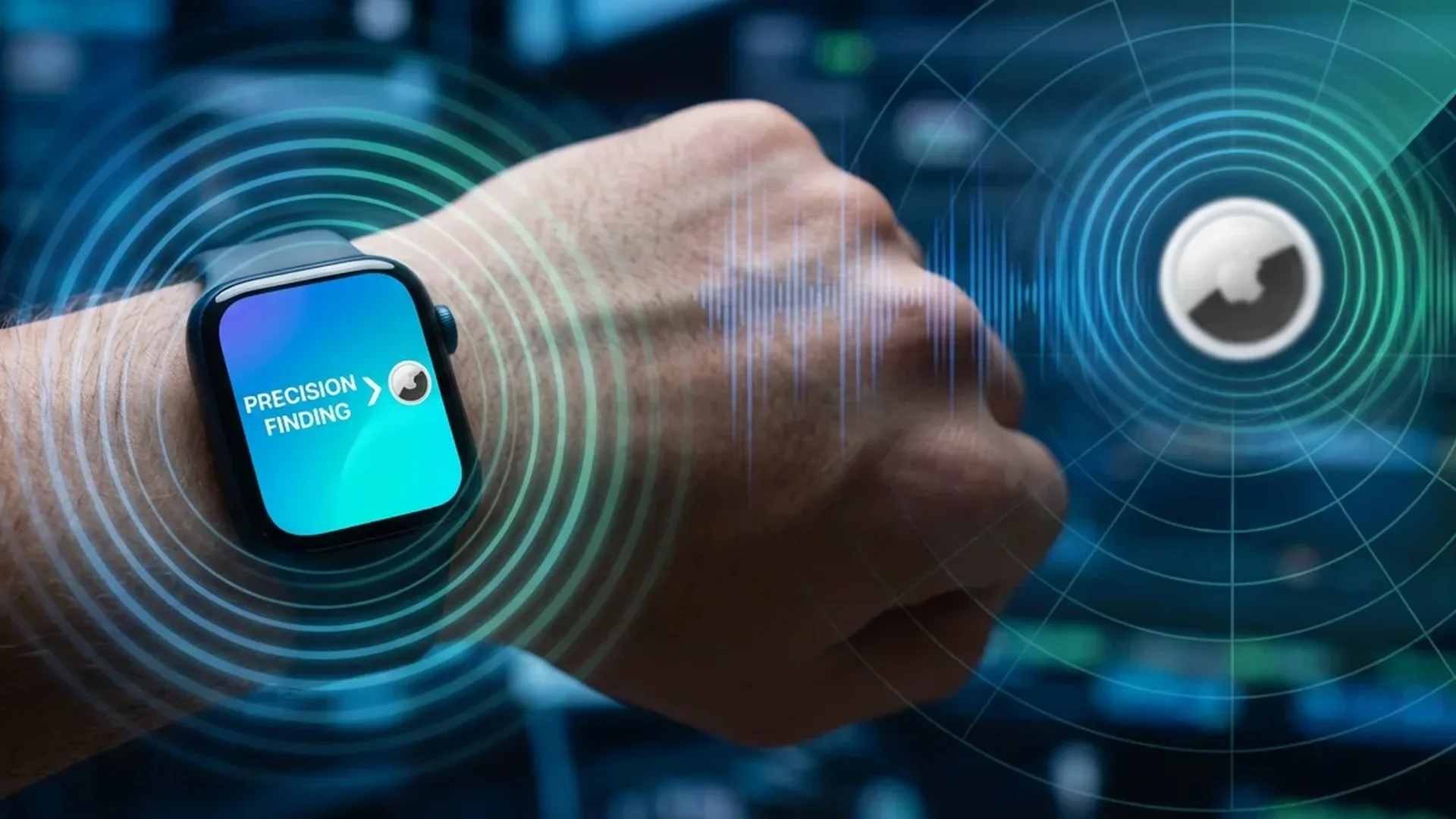
Ultra Wideband (UWB) is one of the most underrated technologies in the Apple Watch. Built into Apple's U1 and U2 chips, it delivers centimeter-level positioning accuracy and enables features that Bluetooth and NFC simply cannot match. From locating a lost AirTag to unlocking your car, UWB is quietly transforming how we interact with the devices around us.
📖 Read more: Apple Watch Series 12: Rumors and Expectations
What Exactly Is Ultra Wideband
Ultra Wideband, commonly known as UWB, is a short-range wireless communication technology that transmits very low-energy radio pulses across a wide frequency spectrum. Unlike Bluetooth, which simply tells you a device is “nearby,” UWB can determine the precise position of a device in space — both distance and direction.
The technology is based on the IEEE 802.15.4z standard, specifically designed for secure ranging. It works by sending radio pulses across an extremely wide bandwidth (typically > 500 MHz), enabling Time of Flight measurements with centimeter-level accuracy. Essentially, it's like having a miniature radar inside your watch.
Apple first introduced UWB technology in the iPhone 11 in 2019 through the U1 chip. On the Apple Watch, UWB made its debut with Series 6 in 2020, and has since become a standard feature across all newer models. The second-generation chip, the U2, brought significant improvements in power consumption and accuracy when it arrived later.
The U1 and U2 Chips: The Heart of UWB
The U1 chip was Apple's first foray into UWB. Designed in-house, it incorporated spatial awareness technology that allowed Apple devices to “know” exactly where they were in relation to each other. Think of it as an indoor GPS, but for very short distances.
The U2 chip that followed brought several improvements. First, lower power consumption — critical for a device as small as the Apple Watch. It also offered a wider detection range, faster inter-device connections, and enhanced communication security. The U2 is what makes the most modern UWB features possible on newer Apple Watch models.
Why Does It Need a Separate Chip?
UWB is not simply a software upgrade. It requires dedicated hardware to handle radio pulses and Time of Flight calculations. That's why only Apple Watch Series 6 and later can fully utilize Precision Finding. If you have an older model, you unfortunately cannot add UWB through a software update.
Precision Finding for AirTags
The most visible use of UWB on the Apple Watch is the Precision Finding feature for AirTags. When you're searching for a lost item with an AirTag, your watch uses the UWB chip to show you the exact direction and distance. The screen displays an arrow that guides you step by step, while haptic feedback grows stronger as you get closer to the object.
This wouldn't be possible with Bluetooth alone. BLE (Bluetooth Low Energy) can tell you that something is “near” or “far” based on signal strength, but it cannot determine direction. UWB, on the other hand, calculates both Angle of Arrival and Time of Flight, giving you accuracy down to a few centimeters.
In practice, this means you can find your keys behind the couch, your wallet under a cushion, or your suitcase in a crowded airport. The experience is delightfully precise and reliable.
📖 Read more: Apple Watch Ultra 4: What's Coming This Fall 2026
Digital Car Keys
Another impressive application of UWB is digital car keys (Digital Car Keys). Apple partners with several car manufacturers so you can unlock and start your car using just your Apple Watch.
The advantage of UWB here is security. Unlike traditional proximity keys that use Bluetooth or NFC, UWB is practically immune to relay attacks — where malicious third parties retransmit the signal from a distance. The car knows exactly how far away your watch is, so it cannot be fooled by fake signals. Compatible manufacturers include BMW, Hyundai, Genesis, and others, with the list growing continuously.
HomePod Handoff and Sharing
Another use case that leverages UWB is music Handoff with HomePod. Bring your Apple Watch close to a HomePod, and music automatically transfers from one to the other. No need to open any app, no Bluetooth pairing required. UWB detects the proximity and executes the transfer seamlessly.
The same technology is used during AirDrop between Apple devices. When two iPhones or an iPhone and an Apple Watch are nearby, UWB prioritizes which device appears first in the sharing list based on distance and direction.
"Ultra Wideband doesn't replace Bluetooth or Wi-Fi. It adds a layer of spatial intelligence that makes all other wireless technologies smarter."
— Hardware Engineering Team, AppleUWB vs Bluetooth vs NFC: Comparison
To understand why UWB matters, it's worth comparing it to the other two wireless technologies already present in the Apple Watch.
Bluetooth Low Energy (BLE)
Range up to ~100 meters, but without directional accuracy. Ideal for audio streaming, accessory pairing, and fitness tracking. Power consumption is very low, but position detection is imprecise — it only works at a “near” or “far” level.
NFC (Near Field Communication)
Range of just ~4 centimeters. Primarily used for contactless payments (Apple Pay) and reading NFC tags. Extremely secure due to its short range, but useless for anything beyond face-to-face contact.
UWB (Ultra Wideband)
Range up to ~30 meters with centimeter accuracy and directional tracking capability. Superior security for location and digital key applications. Power consumption is moderate, but the chip activates only when needed, so the daily battery impact is minimal.
Security Advantage: Why UWB Prevails
Relay attacks are a serious threat to Bluetooth car keys. An attacker can retransmit a BLE signal over a long distance. UWB prevents this because it measures signal flight time with nanosecond precision. Any retransmission introduces a measurable delay that immediately reveals the deception.
📖 Read more: Apple Watch vs AliveCor: What Apple's Court Victory Means
Privacy and UWB
Apple has designed UWB usage on the Apple Watch with privacy as a guiding principle. The UWB signal does not transmit personal data and cannot be used for tracking without the user's knowledge. The identifiers exchanged between devices change continuously (rotating identifiers), preventing third parties from tracking your movements.
Apple also gives users full control. You can disable UWB at any time through Settings, and every third-party app that wants access to UWB data must request explicit permission. No UWB location data is stored on Apple's servers.
The Future: Indoor Navigation and Smart Home
The most exciting part of UWB is what's coming next. Apple is investing heavily in indoor navigation technology that will allow the Apple Watch to guide you inside buildings, shopping malls, airports, and hospitals with meter-level accuracy. Unlike GPS, which loses signal indoors, UWB can function flawlessly anywhere.
Even more interesting is the potential for smart home triggers. Imagine the living room light turning on automatically as you walk in, the temperature adjusting based on which room you're in, or music following you from speaker to speaker. This isn't science fiction — the technology already exists, and Apple is gradually integrating these capabilities through HomeKit.
In healthcare, UWB could be used for precise patient tracking in hospitals, fall notifications with accurate indoor positioning, and faster emergency response. Room-level location capability gives first responders information that could save lives.
Frequently Asked Questions (FAQ)
Which Apple Watch models support UWB?
Apple Watch Series 6, Series 7, Series 8, Series 9, Series 10, Series 11, Ultra, and Ultra 2 all have a built-in UWB chip. Older models (first-generation SE, Series 5 and below) do not support UWB. The second-generation Apple Watch SE also lacks a UWB chip.
Does UWB affect Apple Watch battery life?
Barely. The UWB chip activates only when actively in use — for example, during Precision Finding or when unlocking a car. In daily use, the impact on battery life is negligible, under 2% daily under normal conditions.
Can I use UWB without an iPhone?
Some UWB features work independently on the Apple Watch, such as digital car keys. Others, like Precision Finding for AirTags, may require initial setup through an iPhone. Generally, on-device UWB functions autonomously once the initial pairing is complete.
Is UWB safe for health?
Absolutely. UWB uses extremely low-power radio waves — far lower than Wi-Fi or even Bluetooth. The emission intensity is so low it falls below environmental noise thresholds. It meets all international safety standards (FCC, CE) and there is no evidence of any health risk.
What is IEEE 802.15.4z?
It is the international standard that defines how UWB technology operates for secure ranging. It specifies how signals are exchanged, how distance is measured, and which cryptographic methods are used to prevent spoofing. Apple strictly follows this standard across all its UWB chips.
Do other smartwatches support UWB?
As of February 2026, Samsung has integrated UWB in some Galaxy Watch models, but the app ecosystem is much more limited compared to Apple's. Google is also exploring UWB integration in Pixel Watch, but full support is not yet available.
How much does UWB technology cost the consumer?
UWB is not a separate cost. It's built into the models that support it. An Apple Watch Series 10 starts at approximately 450 EUR, while the Ultra 2 costs around 900 EUR. There is no additional fee or subscription for using UWB capabilities.