

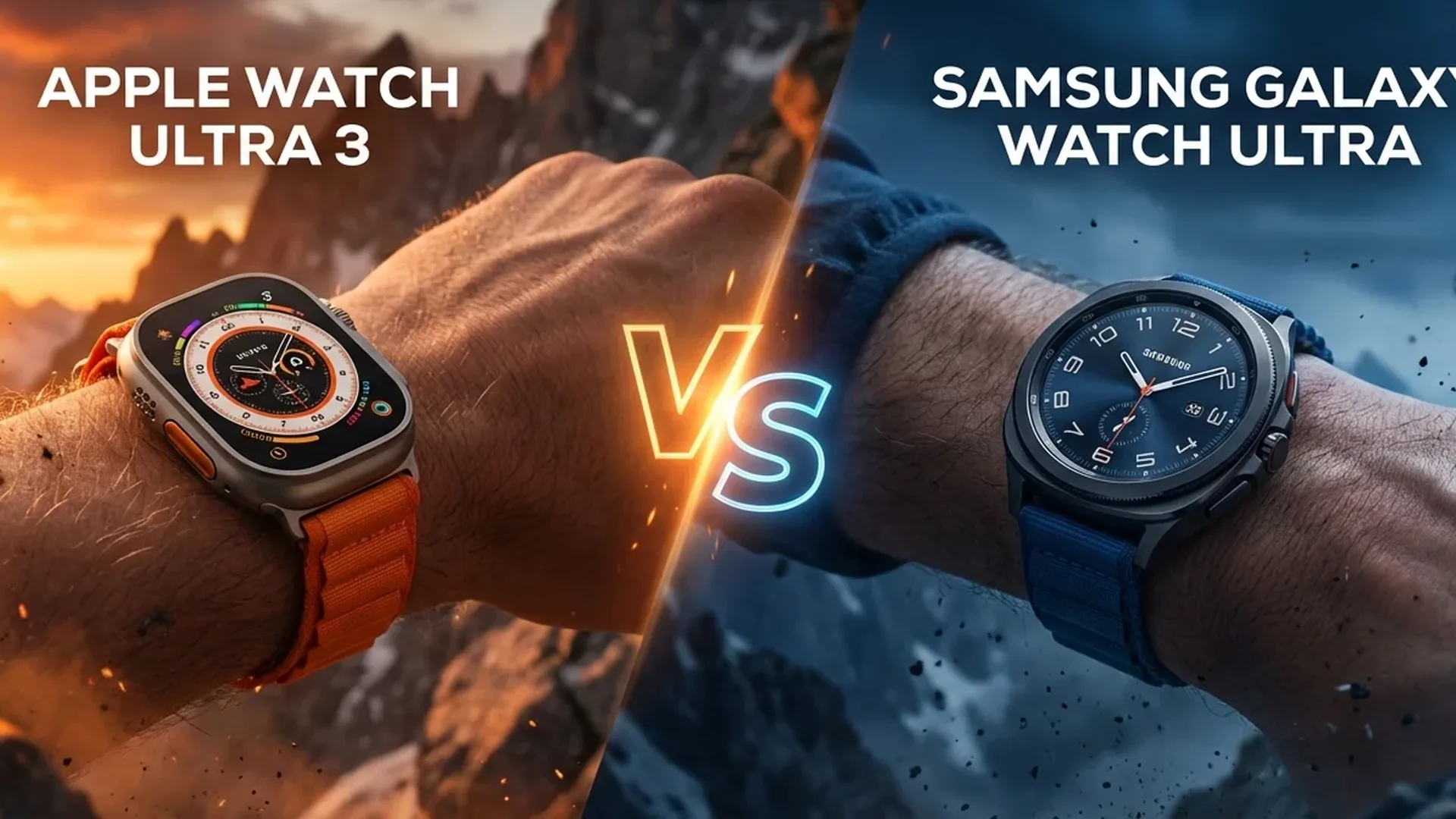
The two toughest smartwatches on the planet go head to head: Apple Watch Ultra 3 versus Samsung Galaxy Watch Ultra. Both built from titanium, both MIL-STD-810H certified, yet built on completely different philosophies. If you want a watch that can handle anything, this guide shows you which one truly fits your life.
Design and Build Quality
The Apple Watch Ultra 3 keeps the signature rectangular form factor Apple is known for, crafted from Grade 5 titanium with a flat sapphire crystal display. The Action Button on the left side remains one of the most practical design elements in any smartwatch — you can trigger actions without looking at the screen. The 49mm case makes a statement without being excessive, and the weight (~60g without the band) is surprisingly low for titanium of this size. Water resistance reaches 100 meters, with a built-in depth gauge and an 86 dB siren for emergency situations.
The Samsung Galaxy Watch Ultra takes a different approach with a circular display housed inside a square titanium case, creating a distinctive aesthetic. At 47mm, it is slightly smaller but equally impressive in person. Samsung opted for sapphire crystal and water resistance up to 100 meters, with IP68 certification. The physical bezel does not rotate, but the digital touch bezel works surprisingly well. Both watches handle extreme temperatures, from -20°C to +55°C, without issue.
Titanium on Both
Both Apple and Samsung use aerospace-grade titanium. The material provides outstanding resistance to scratches and impacts while being lighter than stainless steel. The MIL-STD-810H certification means both can handle extreme conditions — temperature shocks, humidity, drops, and vibrations.
Display and Visibility
The Apple Watch Ultra 3 sports an LTPO3 OLED panel measuring 1.93 inches with a peak brightness of <3000 nits. That means perfect readability even under the harshest sunlight. The always-on display drops to 2 nits at night, saving battery without disturbing you in the dark. Resolution is high enough for a smartwatch that text and graphics appear remarkably sharp, especially on watch faces packed with complications.
The Galaxy Watch Ultra counters with a Super AMOLED display measuring 1.47 inches, also reaching <3000 nits of peak brightness — equally impressive. The always-on display performs well, though Samsung strips color in standby mode, which might not satisfy the most demanding users. The screen is smaller but very crisp, and unless you place them side by side, you will not feel like you are missing real estate.
Operating System
This is where the gap becomes apparent. The Apple Watch Ultra 3 runs watchOS 12, a platform that has matured over a full decade. Integration with iPhone is seamless — Apple Pay, Siri, iMessage, and AirDrop all work flawlessly. The Double Tap gesture (pinching your fingers together) lets you control the watch without touching the screen, which is particularly useful when wearing gloves. The App Store library includes thousands of specialized applications, from dive computers to music composition tools.
The Galaxy Watch Ultra runs Wear OS 5 with One UI Watch 6, Samsung's overlay on top of Google's operating system. This means access to Google Maps, Google Assistant, and the Google Play Store. Integration with Samsung Galaxy phones is excellent, but it also works with any Android phone — unlike Apple, which requires an iPhone. The Wear OS app library has grown significantly, though it still lags behind watchOS in terms of third-party app quality and variety.
Health Sensors
Both watches have made enormous strides in health monitoring, but with different focal points. The Apple Watch Ultra 3 includes SpO2 (blood oxygen), ECG (electrocardiogram), a temperature sensor, a depth gauge for dives up to 40 meters, and sleep tracking with REM phase detection. The fall detection and Crash Detection features can literally save lives — the watch automatically calls emergency services if you do not respond within <60 seconds after a detected incident.
The Galaxy Watch Ultra, beyond SpO2, ECG, and temperature, offers something unique: body composition analysis via BIA (Bioelectrical Impedance Analysis). You place two fingers on the side buttons and within <15 seconds receive measurements of body fat, muscle mass, skeletal muscle, and body water. Accuracy does not replace a DEXA scan, but for daily trend tracking it is remarkably useful — especially if you train regularly and want to see weekly changes in composition.
BIA vs Depth Gauge: Two Philosophies
Apple chose a depth gauge and a built-in dive app for outdoor enthusiasts. Samsung went with BIA for users who want a complete picture of their physical condition. Neither replaces medical equipment, but both clearly show where each company focuses its innovation.
Battery Life
Battery endurance is a department where Samsung traditionally excels. The Galaxy Watch Ultra promises up to <60 hours in normal use and approximately <100 hours in power saving mode. The massive 590 mAh battery takes roughly 2 hours to fully charge. In practice, with the always-on display active, GPS enabled during workouts, and notifications flowing, you will comfortably get about <2 days of real-world use.
The Apple Watch Ultra 3 offers up to <36 hours in normal use and up to <72 hours in low power mode. Apple has significantly improved power management compared to the original Ultra, with the new S10 chip being more efficient. In reality, if you disable always-on display and limit background app refreshes, you can stretch it to about <48 hours. Charging happens via MagSafe and takes approximately 90 minutes from empty to full.
Durability and Endurance
MIL-STD-810H certification is common to both watches, meaning resistance to thermal shock, humidity, vibrations, and drops. In practice, both perform excellently in tough conditions — mountain hiking, ocean swimming, running in heavy rain. The difference lies in specialized capabilities. The Apple Watch Ultra 3 with its depth gauge and the Oceanic+ app is suitable for recreational diving up to 40 meters, something no other smartwatch offers. The Action Button gives you physical control even with wet hands or gloves on.
The Galaxy Watch Ultra lacks a depth gauge but its water resistance is equally reliable for swimming and snorkeling. Its design with the slightly recessed GPS antenna offers better signal reception in forested areas. Both watches feature dual-frequency GPS (L1+L5) for more accurate positioning in cities with tall buildings and narrow streets.
Ecosystem and Platform Lock-In
Here lies the most important decision. The Apple Watch Ultra 3 works exclusively with iPhone. There is no way to use it with Android — this is non-negotiable. If you own an iPhone, the experience is unmatched. If you are considering switching to Android in the future, this purchase becomes a risk worth weighing carefully.
The Galaxy Watch Ultra works with any Android smartphone, although the full experience unlocks with a Samsung Galaxy device. Certain features like BIA body composition and full camera control require a Samsung phone. If you use a Google Pixel or Xiaomi, you will get roughly 85% of the capabilities — more than enough for an excellent experience.
Pricing and Value
Pricing clearly reveals each company's priorities. The Apple Watch Ultra 3 starts at <€899 — a premium price tag that reflects both the brand and unique features like the depth gauge. The Galaxy Watch Ultra costs approximately <€699, offering outstanding value for money with BIA analysis as a bonus.
The <€200 difference is not trivial. It is enough for a quality accessory or several premium bands. However, if the question is which delivers more for your money, the answer depends entirely on the phone you carry. An iPhone user has no alternative at this level, while an Android user finds everything they need in the Galaxy Watch Ultra at a lower cost.
Frequently Asked Questions (FAQ)
Can I use the Apple Watch Ultra 3 with Android?
No. The Apple Watch requires an iPhone 8 or newer running iOS 17 or later. There is no official or unofficial way to pair it with an Android device. If you use an Android phone, the Galaxy Watch Ultra or another Wear OS watch is your best option.
Which one has better battery life?
The Galaxy Watch Ultra wins clearly. With its 590 mAh battery, it delivers up to <60 hours, while the Apple Watch Ultra 3 reaches about <36 hours in normal use. If battery endurance is a priority, Samsung takes the crown.
Which is better for diving?
The Apple Watch Ultra 3. It includes a built-in depth gauge, a water temperature sensor, and supports the Oceanic+ app for recreational dives down to 40 meters. The Galaxy Watch Ultra does not have a depth gauge.
Is Samsung's BIA body composition measurement accurate?
For general trend tracking, yes. Accuracy sits at roughly 85-90% compared to professional equipment. It does not replace a DEXA scan or hydrostatic weighing, but it is excellent for weekly progress comparisons if you train consistently.
Is the Apple Watch Ultra 3 worth the price difference?
If you are an iPhone user who enjoys water sports or diving, absolutely. The depth gauge, siren, and dive app are exclusive. If you want a general-purpose athletic smartwatch, the Galaxy Watch Ultra's price point makes more sense.
Which do you recommend for running and gym workouts?
Both are outstanding. The Apple Watch Ultra 3 has better integration with third-party apps like Strava and Nike Run Club. The Galaxy Watch Ultra offers BIA analysis showing muscle mass — ideal if you lift weights and want metrics beyond heart rate.