

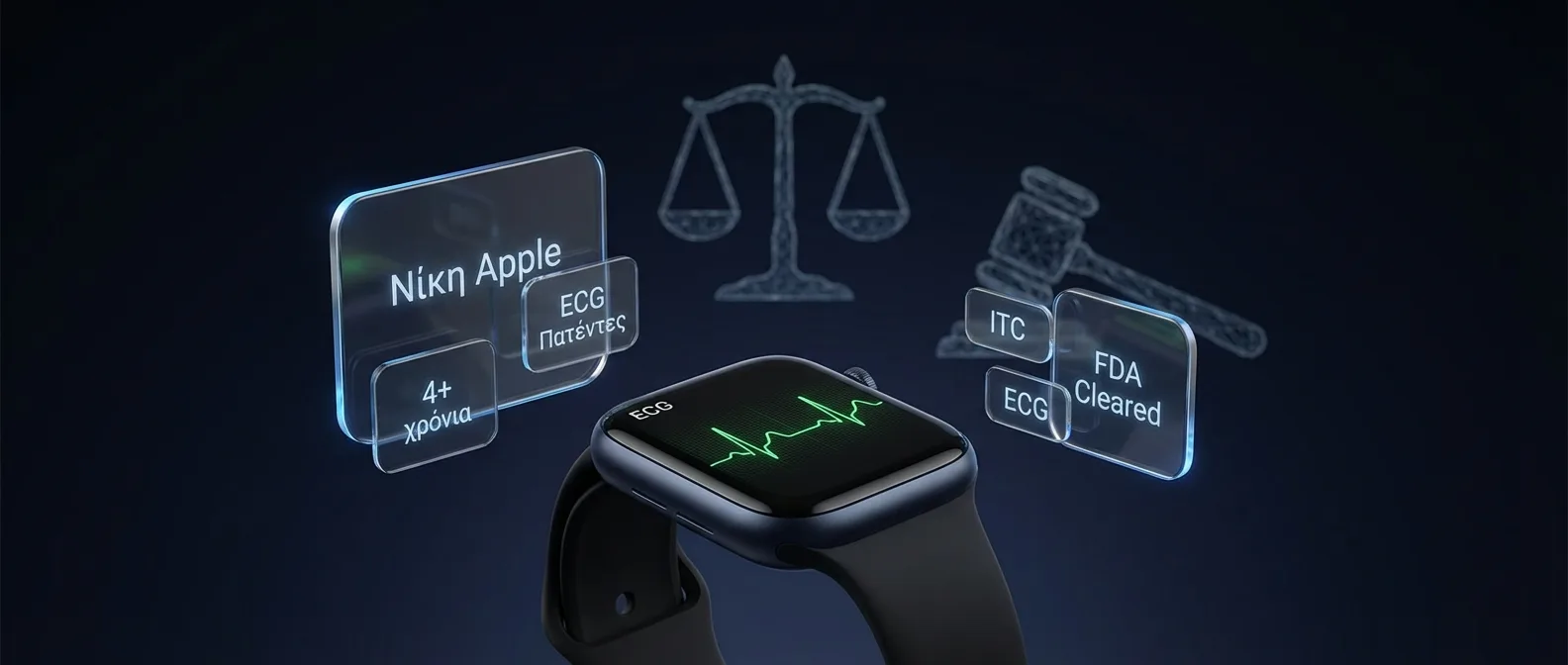
Apple won a years-long legal battle against AliveCor — a case that literally threatened to ban Apple Watch imports into the United States.
The dispute began in December 2020 with a lawsuit over three ECG patents, went through the ITC, PTAB, federal courts, and President Biden, and ultimately concluded in Apple's favor. Let's take a detailed look at what happened — and why it matters.
The Apple vs. AliveCor case was no ordinary corporate lawsuit. It was a real threat that the ECG feature — used daily by millions of Apple Watch users — could be removed, or the watch itself could be banned from sale in the U.S. Ultimately, after 4+ years of legal battles, Apple prevailed. Let's break down what happened step by step.
Who Is AliveCor
AliveCor is an American medical technology company co-founded in 2011 by David Albert — a physician and former Chief Clinical Scientist in cardiology at General Electric — along with Bruce Satchwell and Kim Barnett. Albert had been working on ECG technology for portable devices since 1990, when Hewlett-Packard released its first palm top computer.
In December 2010, Albert published a YouTube video demonstrating a prototype iPhone ECG. The video caught the attention of venture capitalists and funding soon followed. The company is headquartered in Mountain View, California — just a few miles from Apple's offices in Cupertino.
KardiaMobile
The first FDA-cleared personal ECG device (2012). Gum-stick sized, it records a single-lead ECG in 30 seconds. Communicates with the smartphone via ultrasound — no Bluetooth needed.
KardiaBand
An Apple Watch band with a built-in ECG sensor. FDA-cleared in late 2017 — the first medical device as an Apple Watch accessory. Discontinued in 2019.
KardiaMobile 6L & Kardia 12L
6-lead ECG (2019) and 12-lead ECG with AI (2024). Clinical-grade recording with 35 automated cardiac assessments.
The Cleveland Clinic's REHEARSE-AF study showed that KardiaBand detected atrial fibrillation with 93% sensitivity and 94% specificity. When Apple announced in September 2018 that the Apple Watch Series 4 would feature its own built-in ECG sensor, AliveCor suddenly found itself competing against the world's largest smartwatch maker — on its own turf. That same year, watchOS changes made KardiaBand incompatible, and AliveCor discontinued it in 2019.
The Legal Battle: Three Simultaneous Fronts
AliveCor launched legal action against Apple on three separate fronts, creating one of the most complex legal cases in the health technology space:
Apple's Counterattack
Apple didn't settle for defense alone. In December 2022, Apple went on offense with its own lawsuit against AliveCor, claiming that AliveCor had copied technologies Apple developed as early as 2008 — two years before AliveCor was even founded.
At the same time, Apple requested an inter partes review (IPR) at the Patent Trial and Appeal Board (PTAB) of the USPTO, challenging the validity of all three AliveCor patents.
Timeline: How the Case Unfolded
The case went through multiple stages across different courts and agencies. Here's the full breakdown:
AliveCor Files Patent Lawsuit
Claiming that Apple Watch Series 4, 5, and 6 infringe three ECG technology patents.
Apple Counterattacks · USPTO Invalidates Patents · ITC Rules
Dec 2: Apple files a counter-lawsuit. Dec 6: The USPTO invalidates all three AliveCor patents. Dec 22: The ITC rules that Apple Watch infringes 2 of 3 patents and orders an import ban — but stays enforcement pending PTAB appeals. Bond: $2 per unit.
President Biden Upholds the ITC Ruling
Notably, Biden did not exercise a veto — the first time an ITC ruling against Apple passed presidential review without a veto. However, enforcement remained stayed.
Antitrust Lawsuit Dismissed
June '23: Judge dismisses the antitrust claims (but leaves one unfair competition claim open). February '24: The federal judge rules definitively in Apple's favor and closes the antitrust case. AliveCor announces it will appeal.
U.S. Customs: New Apple Watch Does Not Infringe Patents
U.S. Customs and Border Protection finds that newer Apple Watch models do not infringe any of the AliveCor patents. The case is effectively closed.
What This Means for Users
The ECG feature on Apple Watch remains fully active and is no longer at risk. U.S. Customs confirmed that newer models do not infringe any patents. Sales were never interrupted.
The Antitrust Side: Why AliveCor Accused Apple
Beyond patents, AliveCor filed a federal antitrust lawsuit in May 2021, claiming that Apple deliberately monopolizes the heart rate analysis market on Apple Watch. The specific arguments:
🔒 API Lockdown
According to AliveCor, Apple restricted access to heart rate APIs for third-party apps immediately after launching its own ECG feature. This made the KardiaBand unable to function.
💀 “Killing” the KardiaBand
Changes to watchOS made KardiaBand incompatible, forcing AliveCor to discontinue the product in 2019. AliveCor argued this was a deliberate move.
📊 Outcome
The judge dismissed the antitrust claims in June 2023. In February 2024, the case was definitively closed in Apple's favor. AliveCor stated its intent to appeal.
This aspect of the case reflects broader questions about Apple's control over its ecosystem — questions being raised on multiple fronts (EU Digital Markets Act, DOJ antitrust case against Apple, Epic Games, etc.).
Apple Watch ECG vs AliveCor: Which Is Better?
Despite the legal battle, the two products serve different needs. Let's compare them objectively:
AliveCor remains the leader in clinical-grade ECG quality. The 2024 Kardia 12L is technologically far more advanced than Apple Watch ECG, with 35 automated cardiac assessments powered by AI. But the Apple Watch excels in continuous, passive monitoring — something AliveCor simply can't offer.
Why Apple Won — and Why It Wasn't a Sure Thing
Apple's victory was far from guaranteed. Remember: the ITC initially ruled in AliveCor's favor, President Biden did not veto (a rare move), and Apple faced a real import ban. What turned things around:
- PTAB patent invalidation: Apple managed to invalidate all three patents through inter partes review at the USPTO — this was the key turning point
- Hardware redesign: Apple modified the design of newer Apple Watch models so they no longer fell within the scope of the patents
- Counter-lawsuit: Apple argued (and backed it with evidence) that it had developed the core technology as early as 2008 — before AliveCor was even founded
- Customs ruling: The final customs decision in June 2024 confirmed that newer Apple Watch models don't infringe anything
What the Ruling Means for the Industry
The Apple vs AliveCor case has broader implications beyond just the two companies:
🔓 Free to Develop Health Features
Apple can now expand ECG capabilities without legal threats. New features are expected in watchOS 26 — including an improved AFib History.
📈 Boosting Competition
Samsung, Google (Pixel Watch), and other manufacturers can now develop ECG features without fear of similar lawsuits — given that the patents have been invalidated.
⚠️ A Message to Startups
The case illustrates how difficult it is for smaller companies to “fight” tech giants through patents. AliveCor spent enormous sums on lawyers without achieving the desired outcome.
What This Means for You — If You Wear an Apple Watch
In practical terms:
- Nothing changes on your Apple Watch — the ECG feature was never truly at risk in Europe, and in the U.S. the stay on the ban meant sales were never interrupted
- New health capabilities: With the legal uncertainty out of the way, Apple is expected to move more boldly into features like blood pressure monitoring
- AliveCor isn't going away: The company continues with new products (Kardia 12L) targeting clinical use — a space the Apple Watch can't reach
If you use a KardiaMobile, there's no reason to worry. AliveCor has raised over $138 million in funding (Series A–F) from investors like Omron, Mayo Clinic, GE Healthcare, and Qualcomm Ventures. It's not going anywhere.
Conclusion
The Apple vs AliveCor case lasted over four years, went through the ITC, USPTO, federal courts, customs, and even the President of the United States. In the end, Apple prevailed on every front.
But the story isn't one-sided. Without AliveCor, we likely wouldn't have ECG on Apple Watch. David Albert and his team were pioneers in the concept of portable ECG, and the pressure they applied pushed the entire industry forward. The irony is that the company that inspired the feature ultimately couldn't claim intellectual property rights over it.
The biggest winner remains the user: ECG technology is now on the wrists of millions of people, and the competition — legal or technological — continues to push things forward. AliveCor is evolving with 12-lead AI ECG, Apple is evolving with new health sensors, and in the middle are all of us — with better tools than ever before.
ECG technology on Apple Watch is here to stay. After 4 years of legal battles, the ruling is final: Apple is free to continue developing health features for millions of users worldwide.