

📖 Read more: iPhone 17 Pro: 10 Tips for Professional Photography
🔍 The Technical Specs
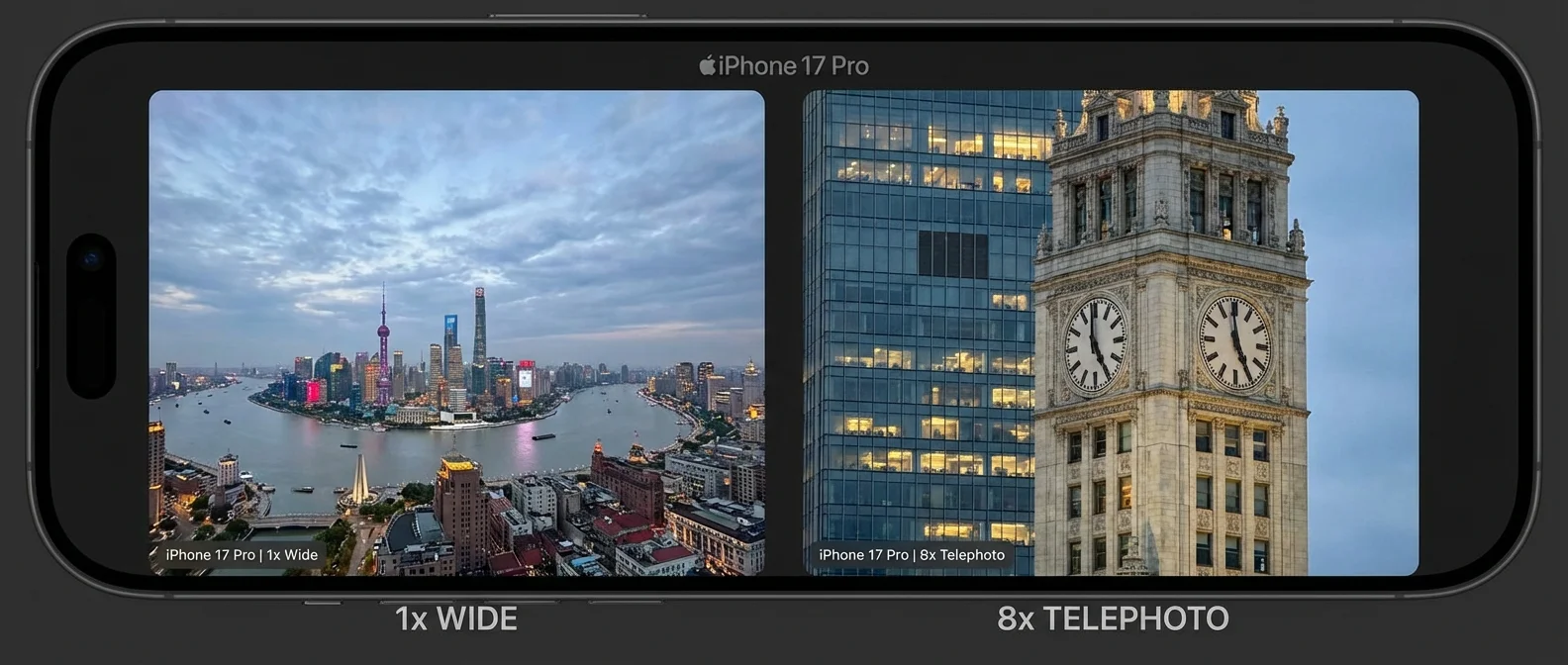
The iPhone 17 Pro telephoto uses a next-generation tetraprism design with a 48MP Fusion sensor — a major step up, as all three rear cameras are now 48MP. According to Apple, the sensor is 56% larger than the previous generation, with 1.4 μm quad-pixels (0.7 μm individual) and an ƒ/2.8 aperture. The equivalent focal length reaches 200 mm at 8×, while at 4× it equals 100 mm.
Apple describes this telephoto as “the longest iPhone Telephoto ever.” Combined with the Ultra Wide at 13 mm (0.5×) and the Main lens at 24/48 mm, the Pro Fusion system delivers a 16× total optical zoom range — all without swapping lenses.
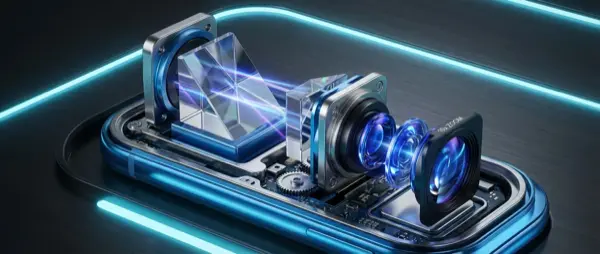
🔬 Tetraprism: How It Works
The tetraprism design “folds” the optical light path inside the iPhone's thin body using four reflecting prisms to achieve a 200 mm focal length without a massive barrel. This technique, first used in the iPhone 15 Pro Max (5×) and refined in the iPhone 16 Pro, now reaches 8× with the 56% larger sensor and improved optical image stabilization (OIS). The result is super-high-resolution 24MP photos by default at every focal length, according to Apple.
📖 Read more: Center Stage on iPhone 17: How It Transforms Group Selfies
✅ Where It Shines
Concerts & Events
At 8× (200 mm), you can capture a tight close-up of the performer from dozens of meters away without any digital cropping — something that until recently required a dedicated camera. The improvement over the 5× (120 mm) on the iPhone 16 Pro is striking: more detail, less noise, better natural background bokeh.
Nature & Wildlife
Ideal for birds, animals or distant landscapes. The 200 mm reach gets you close enough to skip an external telephoto lens entirely. The 48MP sensor with quad-pixel technology ensures plenty of detail even in challenging lighting, while the improved OIS reduces shake — critical at telephoto zoom levels.
Portraits
At 4× (100 mm) or 8× (200 mm), the telephoto creates natural bokeh without Portrait Mode. Faces render with minimal distortion compared to the 24 mm main lens. Paired with the latest-generation Photographic Styles, portraits achieve professional-grade quality.
"The telephoto features the next generation of our tetraprism design and a 56 percent larger sensor. With an equivalent 200 mm focal length, the 8x optical-quality zoom makes this the longest iPhone Telephoto ever — offering 16x total optical zoom range."
— Apple.com, iPhone 17 Pro⚠️ Where It Falls Short
Despite the 56% larger sensor, the telephoto still has smaller pixels (1.4 μm quad vs 2.44 μm on the main 48MP) and a narrower aperture (ƒ/2.8 vs ƒ/1.78). In low light, the main lens significantly outperforms it. Additionally, at 200 mm without a tripod, even minor hand movement can introduce blur — OIS helps, but steady hands or a tripod make a real difference.
📖 Read more: iPhone 17 Pro Price in Greece: Is It Worth Buying in 2026?
Tip: For the best results, use 8× in good lighting (outdoors, daytime). At night, prefer 1× or 2× for cleaner shots. Use 4× (100 mm) as a versatile intermediate focal length for more flexible portraits.
💰 Is the Upgrade Worth It?
Coming from iPhone 15 Pro or older (3× zoom, 77 mm), the upgrade to 8× (200 mm) is massive — more than double the optical reach. If you already have an iPhone 16 Pro (5×, 120 mm), the improvement exists (60% more zoom, larger sensor) but depends on how often you use telephoto. The iPhone 17 Pro starts at $1,099 (~€1,249 in Greece), while the Pro Max starts at $1,199 (~€1,449). If photography is a key priority, this telephoto fully justifies the upgrade.
Sources: