

Six million packages a day. That's what Amazon handles in the US alone, and now a four-legged robot from Switzerland is about to take over part of that workload. Amazon just acquired Rivr Technologies, a startup building delivery robots that climb stairs — something that until recently sounded like pure science fiction.
The deal closed this week, confirmed by Rivr CEO Marko Bjelonic via LinkedIn. Financial terms remain under wraps, but the move shows Amazon's aggressive push into autonomous delivery. What does this mean for those of us waiting for packages?
📖 Read more: Amazon $21B Data Centers in Spain
🤖 The "Dog on Wheels" Rewriting Delivery Rules
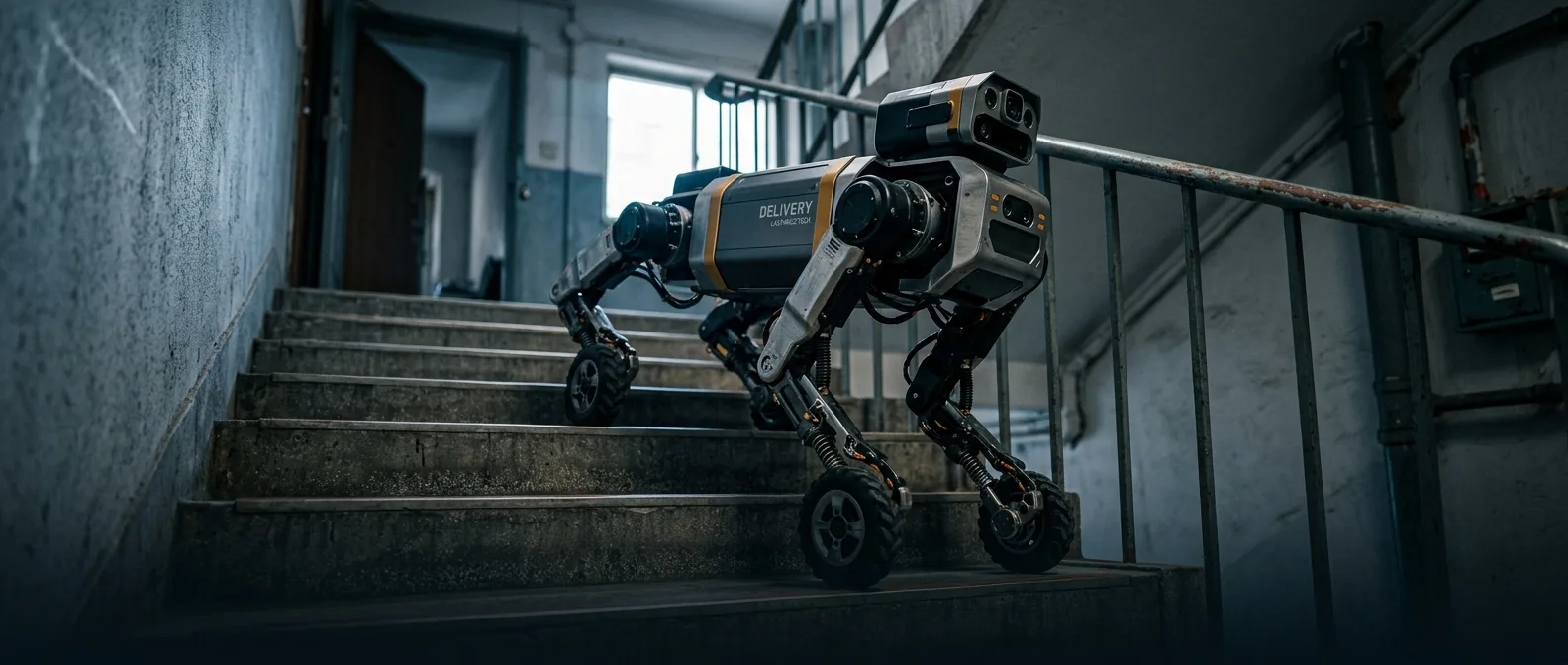
Bjelonic once described his creation as a "dog on wheels" — and the description fits perfectly. The Rivr Two, the company's flagship robot, is a four-legged machine that rolls on wheels but can switch locomotion modes when needed. Stairs? No problem. Curbs and sidewalks? Handles them like a champ.
The robot hauls over 27 kilograms of cargo in a 55-liter internal compartment. It cruises at speeds up to 14 kilometers per hour — roughly twice the pace of an average walker. But here's the kicker: it stops at red lights, opens doors, and climbs stairs just like a human delivery driver would.
⚡ Physical AI: The Next Generation of Robot Intelligence
This is where things get interesting. Rivr hasn't just built a "smart" machine — it's developed what it calls "Physical AI." This combines supervised and unsupervised learning that lets the robot learn from real-world conditions.
The key? The system can adapt to new robot forms within a week. Amazon didn't just buy a product — it acquired a platform that can evolve.
The company uses simulations and real-world data to feed its AI models. The result? A robot that doesn't just follow programmed instructions but "thinks" through its movements. When it encounters an obstacle it's never seen before, it learns to handle it.
The Unattended Delivery System
The Rivr Two has a clever delivery solution: loads from the top, delivers from the bottom. When it reaches its destination, it sits down and releases the package from its underside. No handling required, no waiting for the recipient. Drop and go.
📖 Read more: Vodafone + Amazon Satellites: Internet in Europe
📊 Amazon's Strategic Investment Play
Amazon didn't make this decision overnight. The Amazon Industrial Innovation Fund and Bezos Expeditions had already invested in Rivr as part of a €22.2 million seed round that closed in 2024. The startup had raised €25 million total and was valued at €100 million.
"The acquisition will accelerate our vision of building General Physical AI through doorstep deliveries, bringing robotics and AI closer to large-scale real-world application."
— Marko Bjelonic, CEO Rivr
Amazon is clearly thinking long-term. With over a million robots already in its warehouses, Rivr's technology could expand beyond deliveries. The Physical AI framework can apply to different types of autonomous machines — from warehouse automation to more advanced logistics solutions.
The Austin Pilot Program
In 2025, Rivr launched a pilot program in Austin with Veho, a package delivery company. The goal was to reach 100 robots by 2026. It's unclear if they hit that target, but Amazon obviously saw enough promise to move forward with the acquisition.
📖 Read more: Honor Robot Phone: Gimbal Camera in a Smartphone
🚛 Parallel Deliveries: The Future of Logistics
Here's where it gets really interesting. Amazon plans to integrate Rivr robots into its existing network of delivery partners. According to an internal memo revealed by CNBC, the company will work with third-party logistics contractors to test the technology.
Van Integration
The robot loads into the van and unloads at the destination for parallel deliveries.
Autonomous Navigation
Driver and robot head in different directions, doubling delivery efficiency.
Picture this scenario: An Amazon van arrives in a neighborhood and "releases" three robots. The driver takes one direction, the robots take three others. In half an hour, they've delivered packages to twelve addresses instead of three. That's the power of parallel delivery.
Safety and Interaction
The Rivr Two is designed with safety as a priority. It has lights that make it visible day and night, can stop instantly if it gets too close to people or obstacles, and has a physical emergency stop button. Autonomous operation, physical button, or remote command — all can stop it immediately.
🎯 The Battle for the "Last Mile"
Last mile delivery is the most expensive part of the logistics chain — and Amazon knows it. It costs roughly €3-5 per delivery and represents 53% of total shipping costs. If robots can cut this cost by even 30%, we're talking about billions in annual savings.
But it's not just about money. It's about speed and reliability. Robots don't get tired, don't get sick, don't need breaks. They can operate 24/7, effectively doubling delivery hours.
The reality though? Plenty can go wrong. Weather conditions, vandalism, technical problems, legal uncertainty. Amazon will need to solve all of these before we see robots on our streets.
The Zoox Connection
Amazon acquired Zoox, a self-driving vehicle startup, in 2020 for €1.2 billion. It's now testing SUVs with Zoox technology in multiple cities. Combining autonomous vans with Rivr robots, Amazon could create a fully autonomous last-mile delivery workflow.
📖 Read more: Lenovo AI Workmate: A Robot for Your Office
🌍 What This Means Globally
For now, Amazon's delivery robot experiments focus on the US. But Rivr's technology has been tested in Europe — specifically in Switzerland through a partnership with Just Eat. Global e-commerce delivery data shows 15% annual growth, so it's just a matter of time.
The big question? How will delivery drivers and labor unions react. In countries where labor relations are more complex than in the US, introducing robots will spark plenty of debates.
Regulatory Framework and Challenges
Most countries don't yet have regulatory frameworks for delivery robots. Unlike countries like Germany or the UK, which already have pilot programs, many regions only have legislation covering drones. Changes to traffic codes and new rules for autonomous vehicles on sidewalks will be needed.
💡 Questions That Remain
Amazon's acquisition of Rivr opens many questions. Will we see mass layoffs in the delivery sector? Will robots become targets for vandalism? What happens when two robots from different companies meet on the same sidewalk?
There's also the cost question. While Amazon didn't reveal deal terms, Rivr's €100 million valuation shows this technology isn't cheap. It will take years to recoup the investment — meaning Amazon is thinking very long-term.
However, if everything goes well, by 2030 we might not be surprised when a four-legged robot rings our doorbell. Until then, we'd better get used to the idea that the future of deliveries doesn't necessarily have a human face.
Sources: