

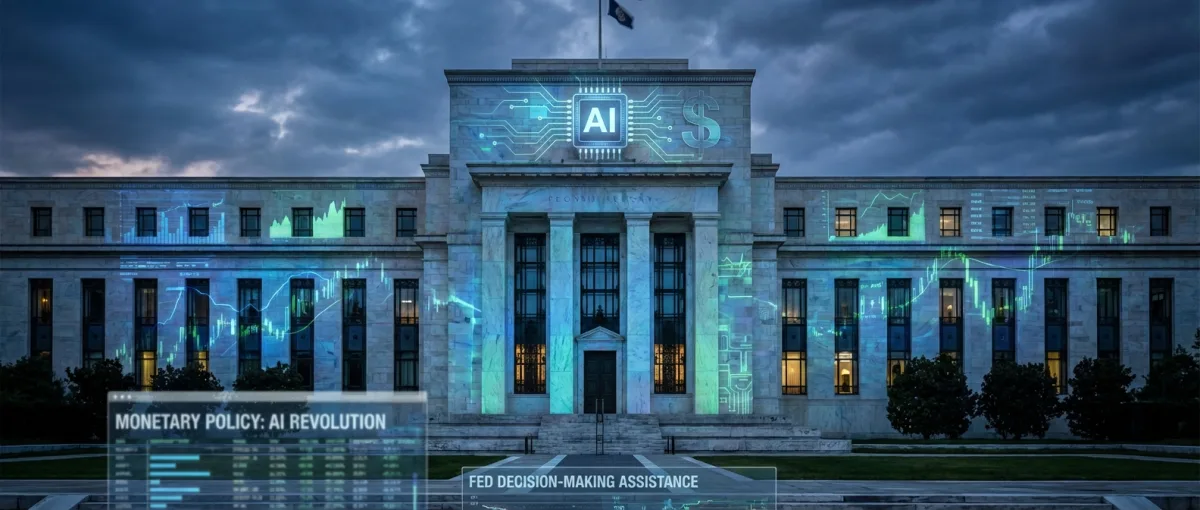
The Federal Reserve is holding interest rates at 4.25–4.50% — while four AI companies are now collectively worth roughly $12 trillion. These two facts aren't unrelated. Together, they're reshaping the global economy in ways no central bank fully anticipated.
🟢 The Fed in Uncharted Territory
In March 2026, the U.S. Federal Reserve held interest rates steady at 4.25–4.50%. The decision was expected, but it masks a deeper dilemma: how do you run monetary policy when artificial intelligence is rewriting the economic rulebook?
Fed Chair Jerome Powell has publicly acknowledged AI's “transformative” impact on the economy. There's good reason for that. AI creates deflationary pressure — it boosts productivity, cuts costs, and automates processes at scale. In theory, that should make rate cuts easier. In practice, nothing about this is simple.
Why the Fed is cautious: Massive AI infrastructure investments (data centers, chips, cloud) are generating trillions in demand, while automation pushes prices down. The central bank is caught between two opposing forces — and neither shows signs of easing.
📌 The Real Weight of the AI Economy
Nvidia, Microsoft, Google, Meta — four names, $12 trillion in combined market value. Nvidia alone surpassed $3 trillion in 2024 and remains among the world's most valuable companies. The tech sector now accounts for roughly 35% of the S&P 500's total market capitalization.
PwC estimates AI will add $15.7 trillion to global GDP by 2030. Goldman Sachs projects a 7% increase in global GDP over the coming decade. These aren't speculative figures — they reflect changes already visible across industries, services, and labor markets worldwide.
"Artificial intelligence is reshaping the structure of the economy in ways we couldn't have predicted five years ago."
— Jerome Powell, Chair of the Federal Reserve
💰 300 Million Jobs on the Line
Goldman Sachs estimates AI could displace 300 million jobs globally. Accountants, legal assistants, data analysts, customer service reps — no white-collar role is entirely safe from automation.
At the same time, entirely new professions are emerging: AI trainers, prompt engineers, AI ethicists, machine learning operations specialists. The question isn't whether jobs will disappear — they will. The question is whether new roles will appear fast enough, and whether workers can transition into them.
The IMF has warned that AI risks dramatically widening the gap between advanced and developing economies. Countries with strong tech infrastructure will benefit disproportionately, while the rest of the world risks falling further behind — creating a new kind of digital divide.
▶️ Central Banks Searching for Direction
It's not just the Fed grappling with this. The European Central Bank is actively studying AI's effect on inflation. The Bank of Japan is already using AI for economic forecasting. Globally, central banks face an unprecedented challenge: technology is evolving faster than their models can account for.
The big question: If AI deflates prices through productivity gains, central banks should cut rates. But if the AI investment bubble bursts, they'll need stability tools instead. Two scenarios, completely opposite — and the Fed has to prepare for both.
Bubble or Reality?
The critical question remains: are we looking at real value or a bubble? History shows that technological revolutions create periods of excessive optimism before delivering long-term benefits. The dot-com bubble of 2000 didn't mean the internet was worthless — it meant the market had run too far ahead of reality.
Something similar may be happening now. Companies that haven't yet proven clear AI-driven profits are being valued as if they've solved every problem. The market is pricing in perfect execution — something that rarely happens in practice.
What This Means for Consumers
For ordinary people, the Fed vs AI battle translates into very concrete things: mortgage rates, credit card costs, everyday prices. If AI significantly reduces production costs, consumer prices will fall. If the Fed responds with looser policy, borrowing gets cheaper.
But if the AI bubble bursts? Then we're looking at market turmoil, falling stocks, and a potential credit crunch. The reality will play out over the next 12 to 18 months — and the stakes couldn't be higher.