

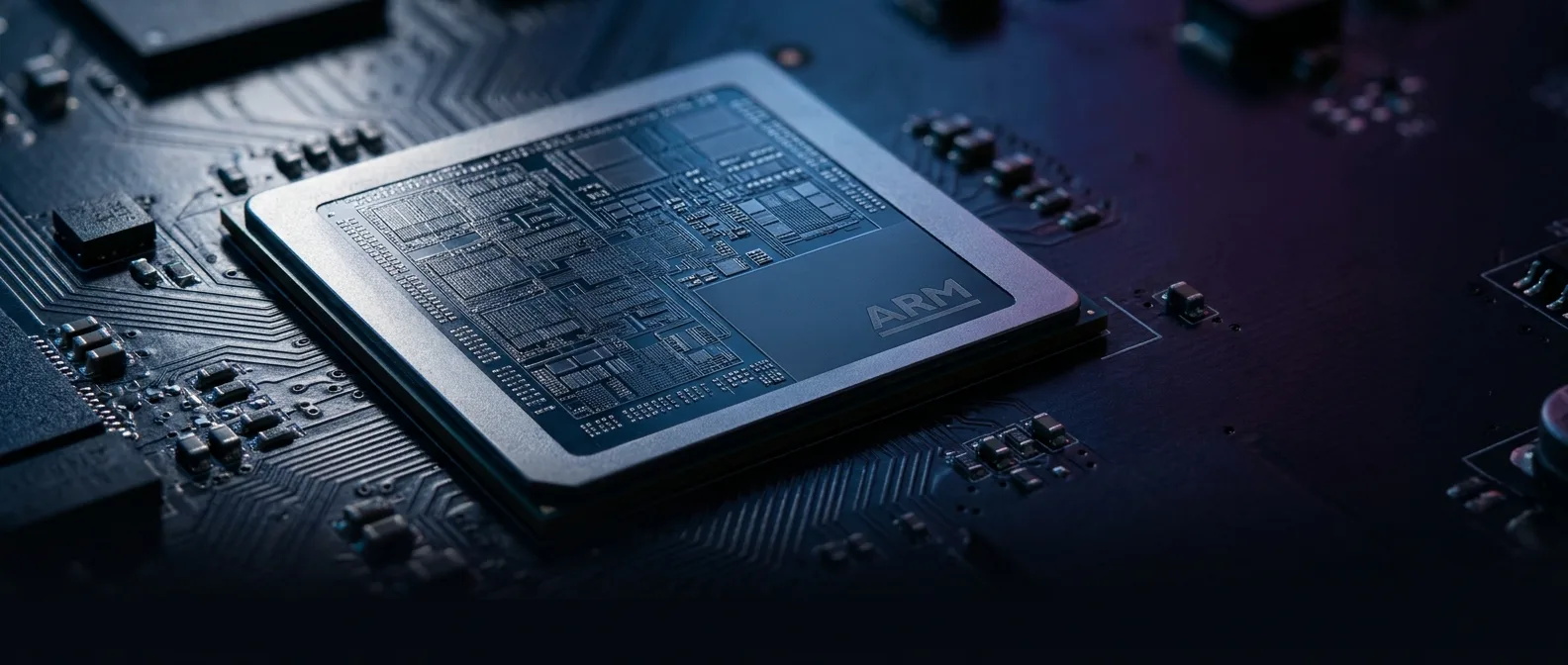
Thirty-five years after its founding, ARM just shattered its most sacred business rule: it's selling actual chips. Not blueprints. Not licensing deals. Real silicon you can buy directly from CEO Rene Haas, just like you'd order GPUs from Jensen Huang at NVIDIA.
The technical details hide a deeper story: ARM is abandoning the business model that built its empire. For decades, ARM was the "architect" — designing blueprints for chips that others manufactured. Apple, Samsung, Qualcomm took those designs and built their own processors. ARM made money from licensing fees, not hardware sales.
Now everything changes. The new **ARM AGI CPU** — the first chip ARM will sell directly — targets data centers running agentic AI. This is artificial intelligence that doesn't wait for human input to make decisions, but operates continuously and coordinates thousands of tasks simultaneously.
📖 Read more: Ricursive: AI Chip Startup Hits €4B Valuation in 2 Months
🔄 From IP Licensing to Direct Hardware Sales
ARM didn't make this choice lightly. ARM sees that the future of data centers demands systems nobody else can build with the same efficiency. "If you own the architecture, you are the platform," Haas explained to Stratechery. "The chip isn't the product — the system is." The first major customer is Meta. Zuckerberg's company worked closely with ARM to develop the AGI CPU, which will operate alongside Meta's own MTIA accelerators in data centers. OpenAI, SAP, Cerebras, and Cloudflare have also agreed to purchase the new chip. What Does "Agentic AI" Mean?
Traditionally, humans were the bottleneck in computing systems. In the agentic AI era, that constraint vanishes. AI agents coordinate tasks, interact with multiple models, and make real-time decisions — without waiting for user input.
Traditionally, humans were the bottleneck in computing systems. In the agentic AI era, that constraint vanishes. AI agents coordinate tasks, interact with multiple models, and make real-time decisions — without waiting for user input.
📊 ARM AGI CPU Technical Specs and Performance
The ARM AGI CPU builds on 136 cores using TSMC's 3nm process. ARM's reference design includes 1U servers with dual chips — totaling 272 cores per blade. A standard air-cooled rack can house 30 such blades, for 8,160 cores total. If that sounds impressive, wait for the liquid-cooled configuration: 336 ARM AGI CPUs in a 200kW rack, delivering over 45,000 cores. ARM promises 2x better performance per rack compared to the latest x86 systems. The advantage comes from three key factors: - **Memory bandwidth**: More efficient threads per rack, while x86 CPUs degrade when cores compete under sustained load - **Single-thread performance**: Arm Neoverse V3 cores outperform older architectures - **Compound effect**: More usable threads + more work per thread = massive performance gains per rack📖 Read more: Silicon-Carbon Batteries: 2 Days of Autonomy
⚡ Why Now and Why CPUs?
You might wonder: why CPUs when everyone talks about GPUs in AI? The answer lies in how modern AI data centers actually work. GPUs handle the heavy computational lifting, but CPUs manage everything else: scheduling workloads, moving data, coordinating accelerators, managing memory and storage. In agentic AI, this role becomes even more critical. Instead of one model waiting for prompts, we have systems coordinating thousands of agents in real-time. The CPU becomes the "pacing element" that determines how fast the entire system can move. $25 billion Data center CPU market in 2026
$60 billion Projected market by 2030
$100 billion With agentic AI CPUs included
🚀 What the Partners Are Saying
ARM's presentation featured executives from Meta, OpenAI, and other major companies. Meta's Santosh Janardhan explained that as the company moves toward "personal superintelligence" — AI that will make their apps deeply personalized — they need more silicon. "One of the most common things I hear at OpenAI: 'I need more compute,'" said Kevin Weil, the company's vice president of science. "It's kind of the currency of the realm."📖 Read more: 72-Hour Week in Tech: The Cost of the AI Race
🎯 The Risks of ARM's New Strategy
ARM's move isn't without risks. For the first time in its history, the company is competing with some of its former customers. NVIDIA, which uses ARM-based CPUs in its rack systems, announced this year it would sell standalone CPUs for the first time. Meta was among the early buyers. "ARM could be perceived more as a competitor than a partner as its strategy evolves," observes Ben Bajarin, CEO of Creative Strategies. For now, ARM focuses on a streamlined CPU with relatively few cores, designed specifically for AI agents. But over time, it might expand into general-purpose CPUs.📈 The Supply Chain Challenge
Another major issue is manufacturing capacity. TSMC — which produces the ARM AGI CPU — has already maxed out production on advanced processes. Every wafer ARM takes is one fewer for Apple, NVIDIA, or anyone else. "There's a supply chain constraint you can't ignore," Haas explained in the Stratechery interview. "We have to be very careful about how we manage that."📖 Read more: Tap to Phone Payments Launch in Greece for Small Business
🔬 Technological Innovations in ARM Silicon
The ARM AGI CPU isn't just another processor. Every element — from operating frequency to memory architecture and I/O — has been designed for massively parallel, high-performance agentic workloads in densely populated rack deployments. ARM partnered with Supermicro for liquid-cooled designs that can handle 200kW in a single rack. That's significantly more than the typical 36kW of air-cooled racks — but necessary for the density that agentic AI workloads demand."In the agentic AI era, the human bottleneck constraint disappears. Software agents coordinate tasks, interact with multiple models, and make real-time decisions."
ARM Newsroom
🌐 Ecosystem Response to ARM's Hardware Push
The industry reaction shows ARM hit a nerve. More than 50 companies — from hyperscale cloud providers to AI startups — support ARM's expansion of its compute platform into silicon. ASRockRack, Lenovo, and Supermicro have already announced commercial system availability. ARM plans to contribute its reference server design to the Open Compute Project (OCP), along with firmware, system architecture specifications, and debugging tools. This move will accelerate adoption and create a more open ecosystem.🚀 The Future of ARM Silicon Design
The AGI CPU is just the beginning. ARM commits to follow-on products targeting "best-in-class performance, scale, and efficiency." Meanwhile, it will continue the Arm Neoverse CSS product roadmap for customers who prefer building their own chips. But how will the company change internally? "We need a tighter relationship between hardware and software," Haas explained. "If you own the ISA, you are the platform — and the software ecosystem determines your fate." ARM is copying Apple's playbook: own the hardware, control the experience. The difference is that ARM targets an open ecosystem, not closed hardware for its own products. The stakes are enormous: if ARM can combine the energy efficiency that made it famous with the performance modern data centers demand, it could reshape the server CPU market. But if it fails or if the move alienates key partners, the next few years could be challenging for a company that successfully stayed in the shadows for 35 years.Sources: