

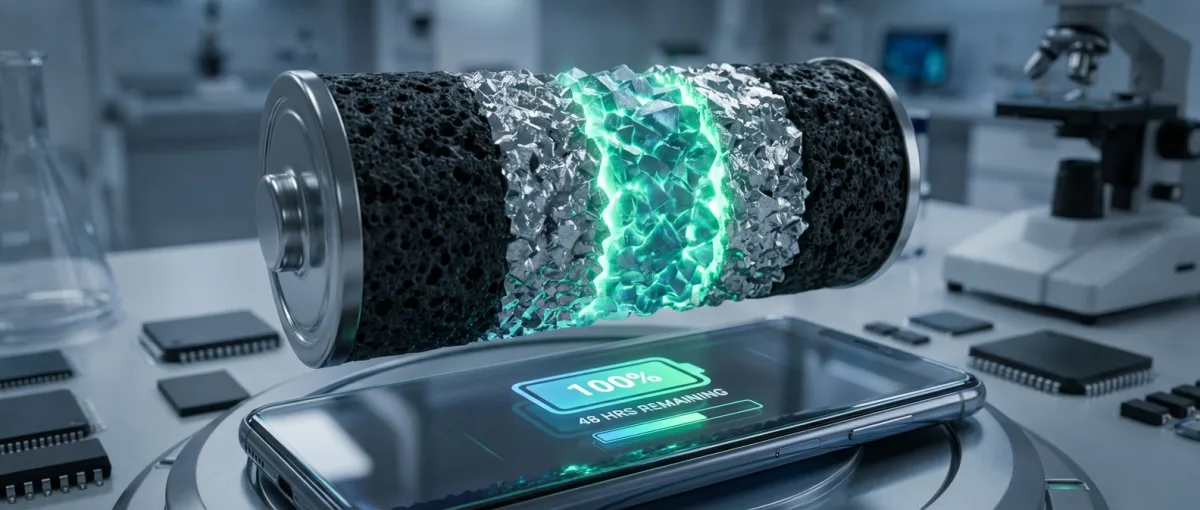
Imagine charging your phone once and it lasting two full days. Not in airplane mode. Not with Wi-Fi off. Normal use. Silicon-carbon batteries promise exactly that — and the first phones using them are already on shelves.
📖 Read more: Honor Robot Phone: Gimbal Camera in a Smartphone
🔬 What Changes with Silicon-Carbon
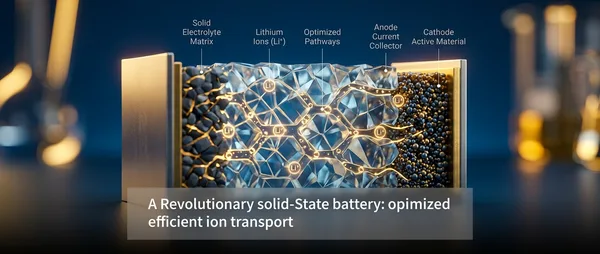
Traditional lithium batteries use graphite in the anode. New silicon-carbon cells replace part of the graphite with silicon particles wrapped in a carbon nanostructure. Silicon stores nearly 10 times more energy per gram than graphite. Result: same or smaller battery volume, dramatically more capacity.
The challenge was always durability. Silicon expands during charging (up to 300%), breaking the battery structure after a few cycles. The solution? Carbon nanostructures that “embrace” silicon particles and absorb expansion without cracking.
📖 Read more: China vs West: Tech War 2026 Update
📱 Which Phones Use Them
Xiaomi led the way. The ultra-thin 5,000 mAh power bank showcased at MWC 2026 uses silicon-carbon — that's why it's only 6mm thick and weighs 98 grams. The OnePlus 15 packed a silicon-carbon 7,300 mAh battery in standard smartphone dimensions. Honor, Oppo, and Realme followed with 6,500-7,000 mAh batteries in their 2025-2026 models.

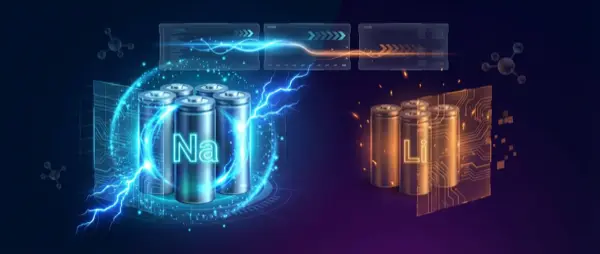
📖 Read more: Sodium-Ion Batteries Threaten Lithium's Energy Dominance
⏳ When Will We See 2-Day Battery Life
The truth? It depends. A phone with 7,000 mAh silicon-carbon, an efficient chip (Snapdragon 8 Elite Gen 5), and an LTPO AMOLED display can already achieve 2 full days of moderate use — emails, social media, streaming, navigation. Under heavy use (gaming, constant camera, 5G) it drops to 36-40 hours, which is still impressive. Samsung and Apple haven't adopted silicon-carbon yet, but are expected to follow by 2027.
📖 Read more: Woolworths AI Bot: The Viral Fail
🔮 The Future: EVs, Laptops, Wearables
This technology isn't just about smartphones. Silicon-carbon batteries are already being tested in electric vehicles (CATL and Samsung SDI are developing them), laptops (where battery life could exceed 20 hours), and wearables (smartwatches with 1-week battery life). The transition won't happen overnight, but early results are very encouraging.