

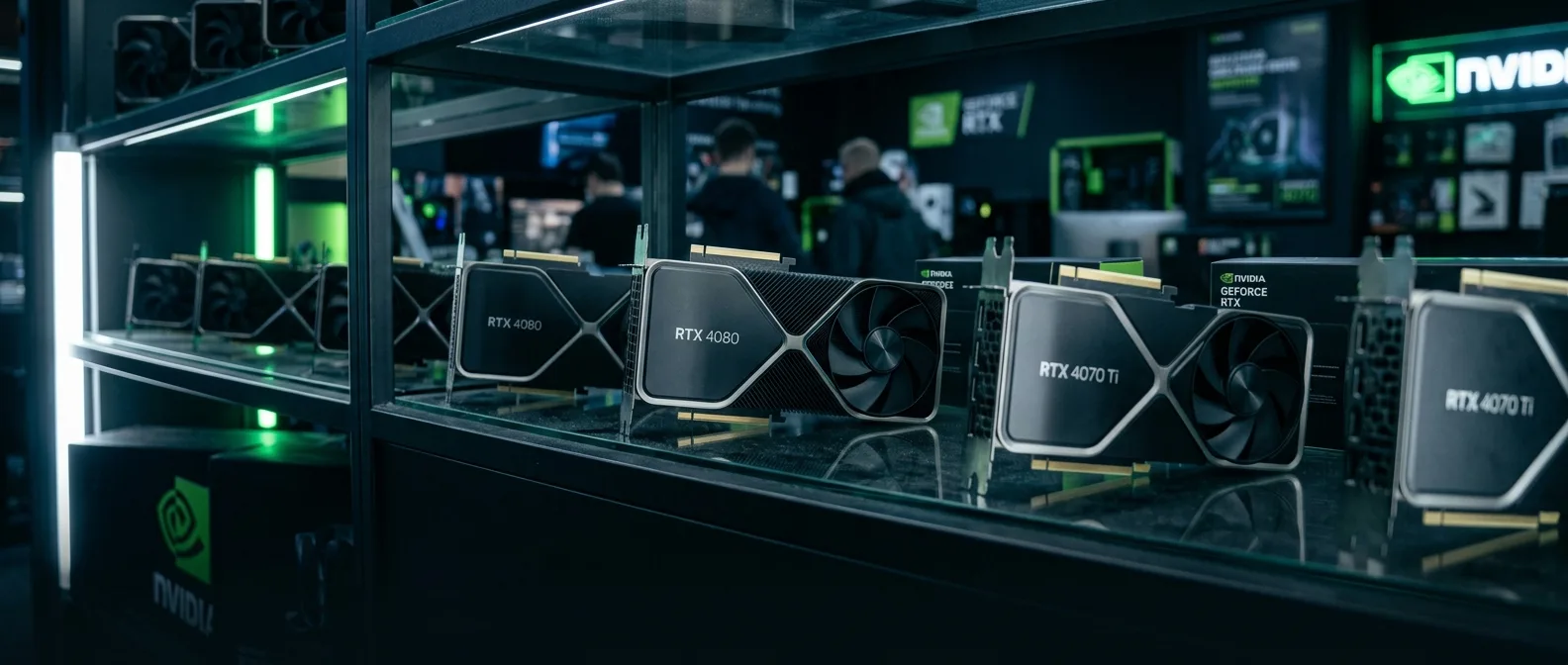
Zero new GPUs at CES 2026. NVIDIA dropped this bombshell on social media last Sunday, breaking a five-year streak of gaming GPU launches at the world's biggest tech show. The RTX 50 Super cards everyone expected? Canceled. Dead. Gone.
Behind this decision lurks a complex crisis in GDDR7 memory production. The same AI boom making NVIDIA filthy rich is now cannibalizing its gaming GPU business. When data centers pay triple for the same silicon, gaming cards become an afterthought.
⚡ Why CES 2026 Became a Gaming GPU Ghost Town
The paradox is stark. NVIDIA builds the most powerful chips in history — yet can't manufacture enough gaming cards to meet demand. The bottleneck? GDDR7 memory.
Only three companies worldwide produce GDDR7: Micron, SK Hynix, and Samsung. All three have order books stuffed with AI clients paying multiples of gaming prices. Why sell to NVIDIA for an RTX 5070 Super when the same chips fetch 300% markup in data centers?
The X announcement was brutal: "Quick note: No new GPUs will be announced." Five words that killed months of RTX 50 Super speculation and left gaming enthusiasts empty-handed.
GDDR7 isn't just faster than GDDR6. It's harder to manufacture, requires advanced production nodes, and delivers yield rates that don't align with mass-market gaming economics. When every gigabyte costs significantly more, the math on a budget RTX 5060 falls apart completely.
NVIDIA Digs Through Its Archives
The situation is so desperate that rumors suggest NVIDIA might restart RTX 3060 production. Why? Those cards use GDDR6 and manufacture on Samsung's older 8nm fabs. In today's market, "obsolete" suddenly becomes advantageous.
Picture NVIDIA engineers dusting off 2021 blueprints, searching for anything — literally anything — they can build at volume. The RTX 3060 that seemed ancient last year now looks like exotic technology in the GDDR7 shortage era.
📊 AI vs Gaming: The Memory Wars
AI infrastructure demand isn't crypto mining. This isn't a speculation bubble that'll pop in six months. Companies like OpenAI are planning computing clusters that exceed supply chain limits. Microsoft recently admitted it has GPUs sitting in boxes because it lacks ready data centers to house them.
This is a structural shift, not a temporary blip. Each new AI model demands more memory than its predecessor. Every company wants proprietary AI infrastructure. Result? Gaming waits in line behind trillion-dollar priorities.
The Crisis by the Numbers
The situation is so severe that enterprise GPU prices have hit the stratosphere. An RTX 6000 Ada with 48GB memory costs roughly €7,700 — if you can find one. Lead times for professional cards stretch seven months.
"Essentially, NVIDIA can't announce new GPUs when the factories behind them are completely strangled"
Tom's Hardware Analysis
Gaming cards under €2,000 make zero sense when identical memory sells for double in enterprise applications. The priorities are crystal clear — and gaming isn't winning.
🧮 AMD Grins with GDDR6 Strategy
While NVIDIA wrestles with GDDR7 shortages, AMD chose GDDR6 stability for its new RDNA 4 architecture. What looks like a technological step backward might actually be strategic genius.
The RX 8000 cards will hit market without the production bottlenecks strangling NVIDIA. That means better availability, stable pricing, and less consumer frustration. Sometimes boring wins.
AMD RDNA 4 Advantages
Built on GDDR6 with mature supply chains and stable production. Fewer bottlenecks, more GPUs on shelves when they launch.
NVIDIA Blackwell Disadvantages
Depends on GDDR7 produced in limited quantities. High costs, minimal availability for gaming applications.
Sure, GDDR6 has bandwidth limitations that'll show in benchmarks. But if you can't buy an RTX 5080 with GDDR7, theoretical advantages become meaningless. Availability beats performance when performance doesn't exist.
AMD Gets Extra Time
The RTX 50 Super delay gives AMD extra months to polish drivers and perfect RDNA 4 designs. When the RX 8800 XT launches — possibly this fall — it might be the only high-end gaming card you can actually purchase in reasonable time.
This is an opportunity AMD hasn't seen since the Radeon X1000 era. Market share gains not through superior products, but through supply chain reality. Sometimes the best strategy is simply showing up.
🔮 When Does Normal Return?
Short answer: not soon. Long answer: depends on when AI hype cools or GDDR7 capacity expands dramatically.
Memory fabs are building new production lines, but that takes years, not months. Samsung announced memory production investments, but results won't materialize until 2027-2028. The timeline for relief stretches beyond most upgrade cycles.
Gaming Market Scenarios
Medium-term, three scenarios emerge:
- AI demand plateau: If AI model development slows, memory capacity frees up for gaming applications. Probability: low.
- Manufacturing expansion: New fabs and improved GDDR7 yields increase supply. Probability: medium, timeline 2027+.
- Technology bifurcation: Gaming GPUs return to GDDR6 or alternative memory technologies. Probability: high for mid-range cards.
The likeliest outcome? A world where high-end gaming GPUs become even more premium products, while mid-range cards rely on older memory technologies. The GPU market splits into AI-first and gaming-accessible tiers.
What This Means for Gamers
If you own an RTX 4080 or better, you probably don't need to worry about 2026. Existing GPUs should handle most games adequately. But if you're waiting to upgrade from a GTX 1080 Ti, the situation gets complicated.
Used GPUs suddenly become attractive options. An RTX 4070 Super costing €600 used today might be a better deal than anything new in 2026. The secondary market becomes the primary market when new cards don't exist.
🎯 The Bigger Picture: AI Changes Everything
This crisis isn't just about gaming GPUs. It's about how artificial intelligence reshapes the entire semiconductor industry. NVIDIA has become an AI company that makes gaming cards in its spare time.
The geopolitical dimension complicates everything. Washington considers AI infrastructure national security. It won't intervene to lower gaming GPU prices while competing with China in the AI race. Gaming enthusiasts rank below strategic priorities.
The paradox of our era: We live in NVIDIA's golden age — and simultaneously the worst era for gaming GPU availability. Success and scarcity coexist.
Enterprise customers pay tens of thousands for AI accelerators. Gaming customers complain about €800 RTX 5070 cards. Which market do you think NVIDIA prioritizes? The math is simple, even if the consequences aren't.
Beyond NVIDIA
Intel attempts market entry with Arc Battlemage GPUs, but faces identical memory constraints. Rumors about Chinese GPU manufacturers intensify, but geopolitical barriers complicate Western market entry.
Practically, 2026 choices narrow to AMD (with GDDR6) or wait (for NVIDIA with GDDR7 that isn't coming). This isn't the best era for new gaming builds. Patience becomes the primary requirement.
CES 2026's real message: gaming no longer drives GPU innovation. That role belongs to artificial intelligence — and gaming GPUs became byproducts in a world where every tensor core matters more than every RT core.