

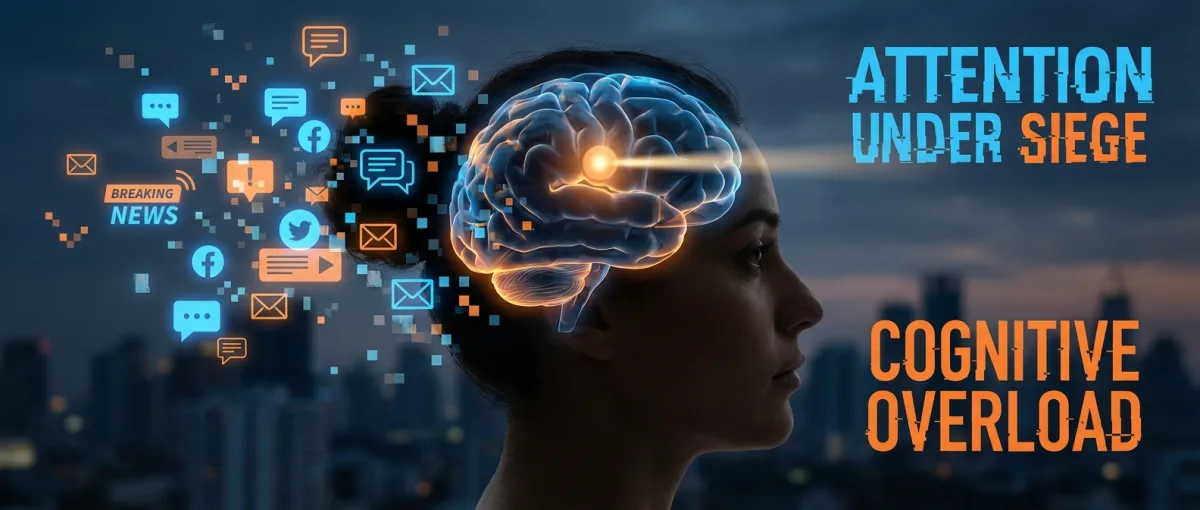
Average attention span has dropped to 47 seconds — worse than the mythical goldfish. TikTok, Reels, Shorts, and endless scrolling are changing how we think. Neuroscientists are sounding the alarm: the attention crisis has real consequences.
📖 Read more: AWS UAE Fire: 36-Hour Outage Hits 3 Continents
📊 The Numbers
According to a Microsoft Research and King's College London study, average sustained attention in digital users aged 18-35 dropped to 47 seconds in 2026 — from 2.5 minutes in 2004. Young people aged 16-24 scroll an average of 92 meters of screen daily, equivalent to about 90 minutes of passive scrolling.
The old “mythology” about goldfish having 9-second attention spans was inaccurate — but the 47-second figure for sustained task attention hasn't been disputed. And it's alarming.
📖 Read more: Battery Repurposing: The New Trend in Home Energy Storage
🧠 What's Happening in the Brain
Neuroscience explains: every notification, every new video, every like triggers a small dopamine release. The brain becomes addicted to these “micro-rewards” and gradually loses the ability to stay on one task without stimulation. It's not laziness — it's neurochemical change.
Gloria Mark, professor at UC Irvine and author of “Attention Span,” explains: "We're not becoming stupider. The brain responds to its environment. But this change isn't free — we pay with lost creativity, increased stress, and reduced capacity for deep thinking."

📖 Read more: Battery That Lasts 50 Years: Never Charge Again
📱 Which Platforms Are Most Responsible
Short-form video (TikTok, Reels, Shorts) was designed for dopamine hijacking: rapid transitions, autoplay, infinite scroll. But it's not just them. Push notifications (average user receives 96 daily), email threads, group chats — everything constantly competes for our attention.
💡 Practical tip: The “Pomodoro technique” (25 minutes focus + 5 minutes break) improves concentration by 40% according to research. Turn off notifications, put your phone in another room, and work with a timer. Simple but effective.
📖 Read more: Biometrics in Travel: EU Border Changes & Airport Updates
💊 Solutions: Technological and Otherwise
The “focus apps” industry is growing: Forest, Freedom, Opal, BeReal. Apple added “Focus Mode” to iOS. Google experiments with “attention-aware” features on Android. But experts emphasize technological solutions aren't enough — mindset change, digital detox, and (especially for children) screen time limits are needed.
Mindfulness meditation proves the most effective non-technological solution: 10 minutes daily measurably improves sustained attention after 8 weeks of practice.
📖 Read more: Blackout at Athens FIR: 8 Hours of Chaos in Greek Airspace