

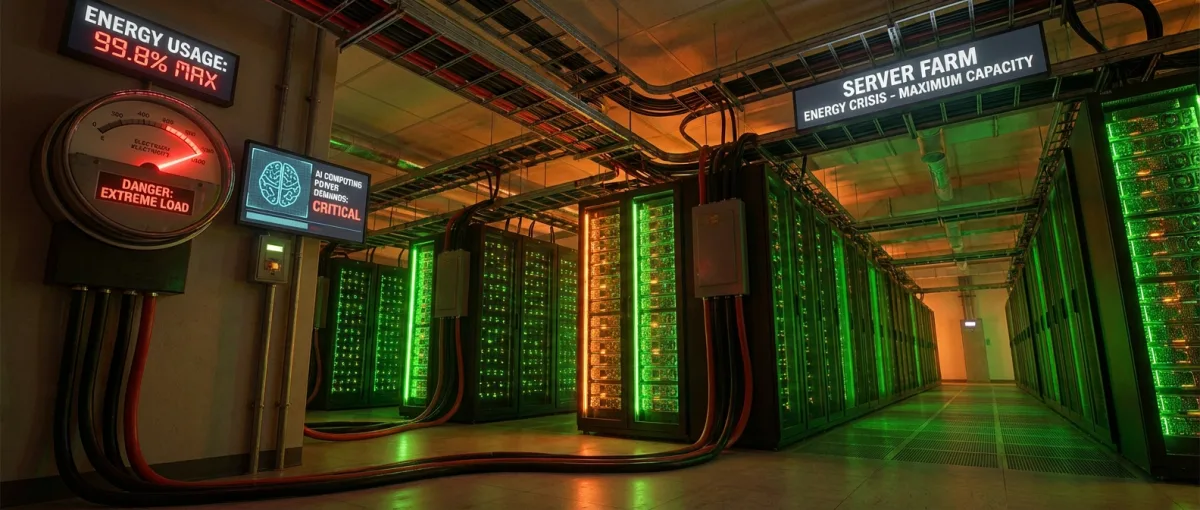
Every ChatGPT query burns about 10 times more energy than a Google search. Multiply that by millions of queries per hour, add massive model training runs, and you begin to understand why AI data centers are becoming energy-hungry monsters.
📖 Read more: Microsoft Data Centers: How Many Jobs They Bring and What They 'Consume'
⚡ The Numbers
According to the IEA (International Energy Agency), data centers worldwide consumed 460 TWh in 2025 — roughly equal to France. With the AI explosion, the 2027 forecast is 800-1,000 TWh. NVIDIA alone sells GPUs that need that much power — a rack with 8 H100 GPUs draws 10 kW, more than 3 households combined. A large AI data center can draw 100-300 MW — as much as a small city.
📖 Read more: Amazon $21B Data Centers in Spain
📖 Read more: ChatGPT Ads: End of Free Usage?
💧 Water: The Hidden Cost
Data centers don't just burn electricity — they burn water. Cooling GPU racks requires enormous quantities. One estimate: every 20-30 exchange ChatGPT conversation corresponds to 1.5 liters of water for cooling. In dry regions (Arizona, Spain, Australia), this creates massive friction with local communities. Microsoft already faces backlash over a Dutch data center's water consumption.
📖 Read more: ChatGPT Hacking: How Easy Is It?

🌱 Solutions on the Horizon
The industry isn't sitting idle. Nuclear power: Microsoft signed a deal to restart Three Mile Island. Amazon is buying nuclear plants. Liquid cooling: instead of air, GPUs are cooled with liquid — reducing cooling energy by 40%. Efficient chips: NVIDIA's B200 is 2x more efficient per watt than the H100. But demand grows faster than efficiency improvements.
📖 Read more: Chemical Plastic Recycling: Why It's the New Hot EU Topic
🤔 The Ethical Question
It's worth asking: which AI use is valuable enough to justify so much energy? An AI-powered medical diagnosis? Yes. An AI making memes? Probably not at 10 kW per request. The answer isn't “stop AI” — it's “use it efficiently.”