

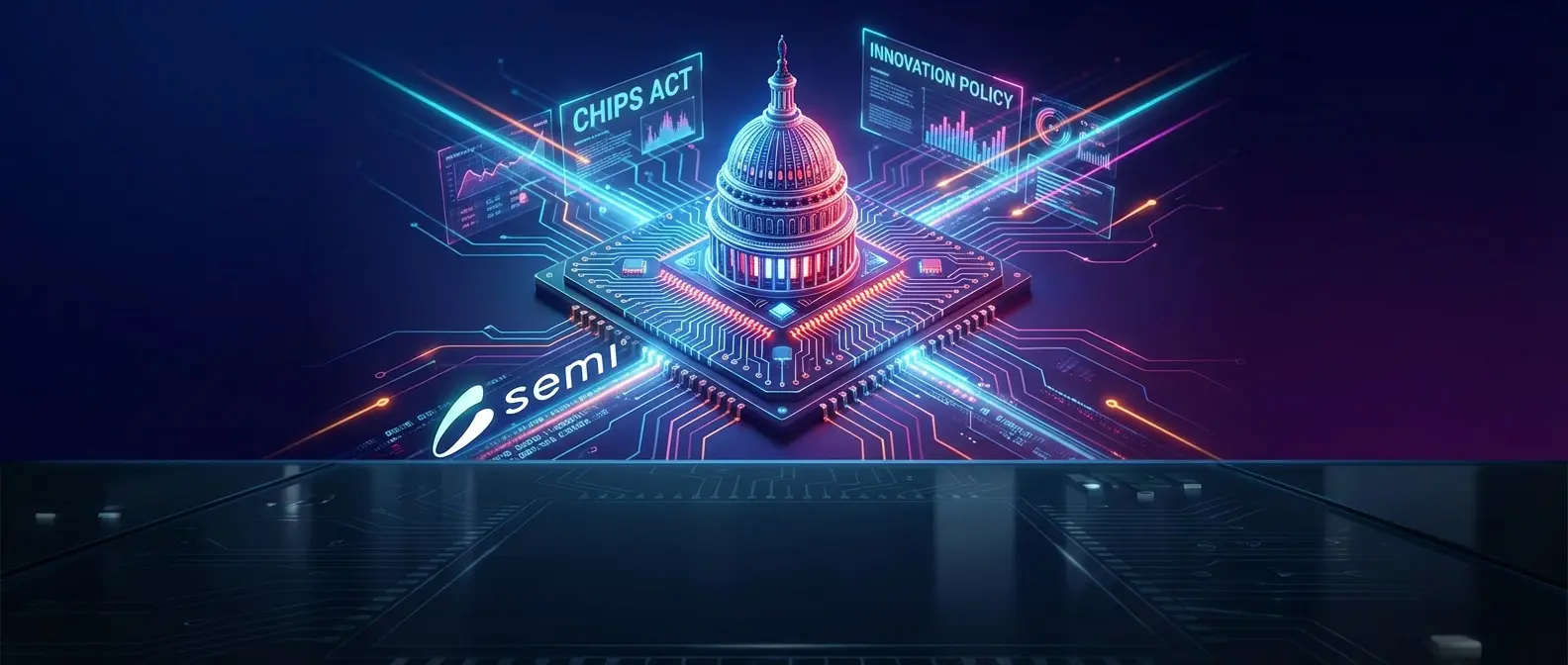
The semiconductor industry is at the center of a global geopolitical war. The US, after the CHIPS Act of 2022 which poured $52 billion into the sector, continues its aggressive policy. In 2026, SEMI (the global semiconductor industry association) presents the new US priorities — and the implications affect the entire planet.
📖 Read more: Intel Installed the First Commercial High-NA EUV by ASML
🏭 Why the US Wants to Dominate
Chips are everywhere — from smartphones to missiles, from cars to medical equipment. But 92% of advanced chips (under 10nm) are produced in just one country: Taiwan. This dependency is a nightmare for the US, especially with tensions with China over the Taiwan Strait.
In 2021, the chip shortage shut down car factories around the world. The pandemic showed how fragile the supply chain is. The US decided it can't leave its national security — and its economy — in the hands of others.
$52B
CHIPS Act Funding
92%
Advanced Chips from Taiwan
5
New Fabs Under Construction
🎯 SEMI's 5 Priorities for 2026
1️⃣ Domestic Production
Goal: 20% of advanced chips to be produced in the US by 2030. Intel, TSMC, and Samsung are building factories in Arizona, Ohio, and Texas.
2️⃣ AI Chips Priority
With the AI boom, demand for GPUs and AI accelerators is skyrocketing. Support for Nvidia, AMD, and Intel for domestic production.
3️⃣ Workforce
The biggest challenge: where will 100,000+ specialized engineers come from? Investment in STEM education.
4️⃣ China Restrictions
New export restrictions on advanced equipment. Ban on ASML EUV machines. Pressure on allies to follow suit.
5️⃣ R&D and Next Generation
Investment in 2nm and beyond. Quantum computing chips. Neuromorphic processors. Goal: the US must not fall behind.

🇪🇺 Impact on Europe and Greece
Europe responded with its own EU Chips Act (€43 billion). But the competition for talent and investment is fierce. Intel has a factory in Germany, but most investments go to the US where incentives are larger.
🇬🇷 Greece in the Game
Greece doesn't produce chips, but it can play a role in chip design. The HCCC (Hellenic Chip Competence Center) collaborates with international giants. Greek universities train engineers who are hired by Nvidia, AMD, and Arm. The challenge: keeping them in the country.
🔮 The Future: Two Worlds?
The most concerning prospect is a technology split: one world with American/Western chips and another with Chinese ones. Incompatible standards, different ecosystems, limited interoperability.
For consumers, this could mean more expensive devices as economies of scale are lost. For businesses, supply chain complexity. For governments, difficult alliance choices. The “cold tech war” has just begun.