

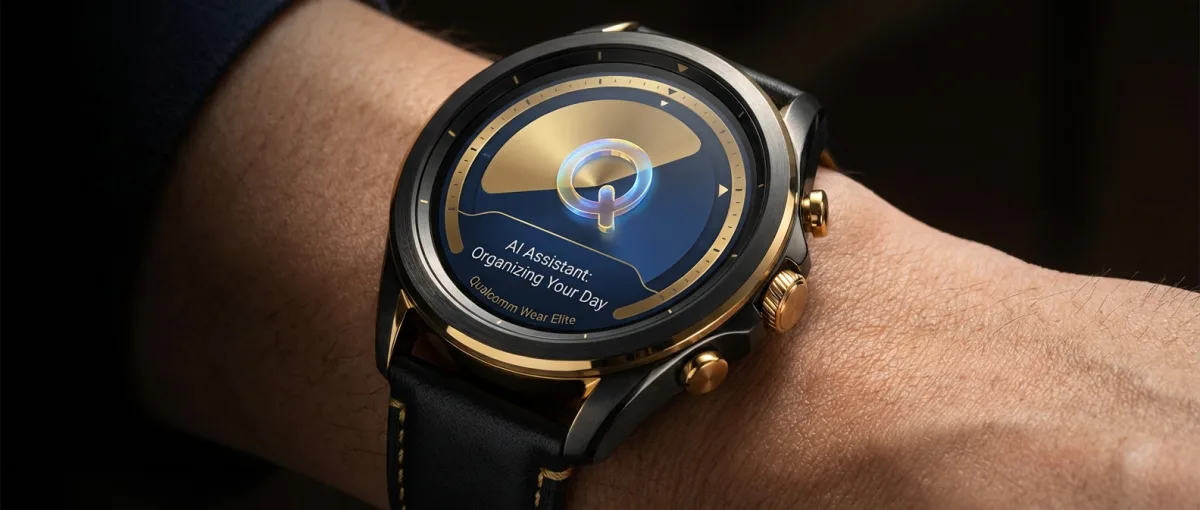
Qualcomm has always had an awkward relationship with wearables. Its chips powered most Wear OS watches, but they always seemed a step behind Apple's Watch S-series. The new Snapdragon Wear Elite promises to change that.
📖 Read more: Qualcomm X105 5G Modem: Next-Gen Speeds
🧠 On-Device AI for the First Time
The biggest innovation: the Wear Elite runs AI models locally, without cloud connectivity. What does that mean in practice? Your watch's AI assistant responds offline. Voice recognition happens on-device. Health monitoring analyzes data in real-time — heart rate variability, SpO2 trends, arrhythmia detection — without sending your data to any company's server.
📖 Read more: Wi-Fi 8: Qualcomm Races Ahead of the Standard
⚙️ Impressive Specs
The Wear Elite is built on a 4nm process — a first for wearable chips. That means significantly less power consumption compared to the previous Snapdragon W5+ Gen 1 (5nm). It integrates an NPU (Neural Processing Unit) dedicated to AI tasks, an Adreno GPU for smooth animations, and support for LTPO AMOLED displays up to 60Hz always-on.
Connectivity: Bluetooth 5.4, WiFi 6, optional LTE/5G, and UWB — another first for a Qualcomm wearable chip. This enables digital car keys, precise location tracking, and tap-to-pay without your phone.

📖 Read more: Dark Web: Victim Found from Room Photo
📱 Where We'll See It
Samsung is rumored to be considering the Wear Elite for the Galaxy Watch 8 series — a massive win for Qualcomm, given Samsung previously used its own Exynos chips. Google is expected to use it in the Pixel Watch 4. Brands like Mobvoi (TicWatch), Fossil, and Oppo Watch will follow.
🆚 Apple Watch: The Wear Elite brings Wear OS smartwatches close to Apple Watch S10 capabilities — especially in health monitoring and AI. The key difference remains the software ecosystem: Apple still leads in apps and integration.
📖 Read more: Data Act in Practice: Who Will 'Own' Your Device Data?
🔮 The Significance
The Wear Elite isn't just a better wearable chip. It signals that Qualcomm is finally taking wearables seriously. With on-device AI, UWB, and 4nm fabrication, Wear OS watches gain the tools to genuinely compete with Apple Watch. The question now shifts to manufacturers: will they capitalize on the hardware or slack off on software?