


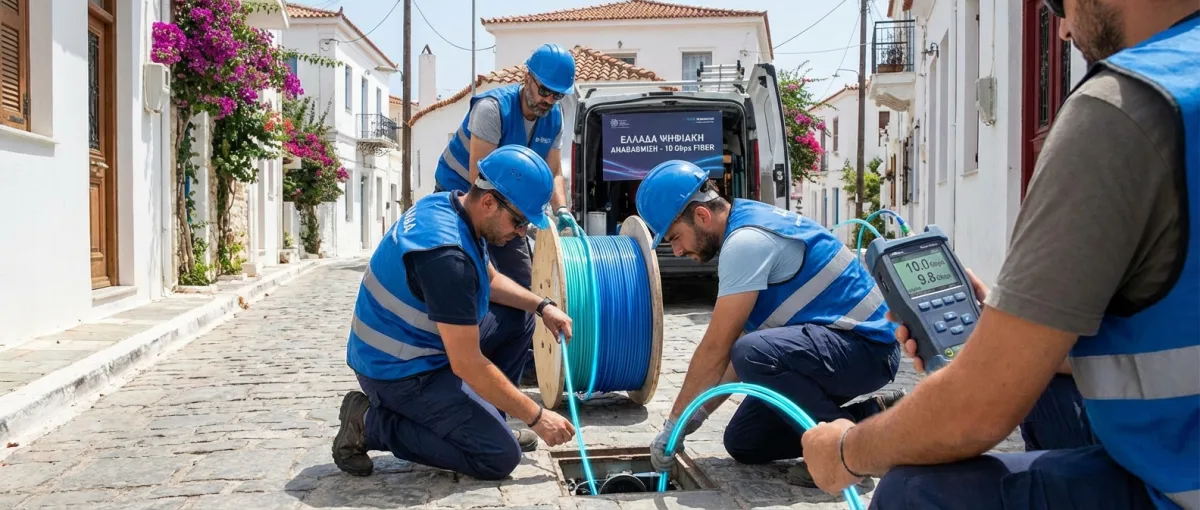
10 gigabits per second. Enough to download a 4K movie in 3 seconds. Or run four simultaneous cloud gaming sessions without a single pixel stuttering. COSMOTE just announced 10Gbps FTTH for Greek homes — but the gap between a press release and the fiber socket in your living room is wider than you might think.
📖 Read more: 5G Home Internet (FWA): When It's Worth It in 2026
▶️ What actually changes with 10Gbps
To put the numbers in context: at 10Gbps you can download a full 100GB game in under 80 seconds. Back up a 1TB hard drive to the cloud? Under 15 minutes. A 4K video call on Zoom or Teams uses roughly 20Mbps — meaning 10Gbps could theoretically handle 500 simultaneous calls. Nobody needs that, but the headroom is immense.
Until now, the fastest residential connection available from a Greek ISP was 1Gbps via FTTH — and only in areas where Grid Telecom, the company that builds and operates Greece's fiber-optic backbone, had pulled cable all the way to the building. 10Gbps isn't just “ten times faster.” It's a technology shift: from GPON (Gigabit Passive Optical Network, max 2.5Gbps downstream) to XGS-PON, a protocol that supports symmetrical 10Gbps — identical upload and download speeds.
The upgrade happens mainly at the exchange equipment (OLT) and the home terminal (ONT). The fiber itself doesn't need replacing — that's the beauty of it. XGS-PON gear is supplied by Nokia and Huawei, both of which already work with OTE Group (Deutsche Telekom) at the European level.
Technical note: XGS-PON runs on the same fiber-optic infrastructure already in the ground. The upgrade requires new equipment at both ends — OLT at the exchange, ONT at the home — with no digging or new cables. That means wherever FTTH already exists, the jump to 10Gbps is theoretically quick.
🔎 Which areas get 10Gbps first
COSMOTE hasn't published an exact map, but the first rollout targets central areas of Athens, Thessaloniki, Heraklion, and Patras. In other words, locations where Grid Telecom already has a mature FTTH network and only needs a headend upgrade.
For the rest of Greece, the picture is different. The fiber-optic network currently reaches around 3.5 million homes — mostly in major urban centers. Fiber penetration stands at roughly 15%, well below the EU average of 22%. Many areas don't have any FTTH connection at all, let alone 10Gbps.
If you live in a mid-sized city — Larissa, Volos, Ioannina, Kavala — you likely won't see 10Gbps before 2028. Grid Telecom prioritises high-density subscriber areas where the investment pays back faster. Smaller cities enter the queue later — if they enter it at all.

📖 Read more: Brain-Invading Superbug Destroys Man's Eye in Shocking Case
⚠️ The apartment building problem
There's an obstacle that's uniquely Greek. In countries like France or Spain, the provider runs fiber into the building and that's it. In Greece, installing vertical in-building wiring in an apartment block (polykatoikia) requires unanimous consent from all property owners. We're talking a full owners' assembly, a vote, and official minutes. A simple majority isn't enough — in many cases, every single owner must agree.
In practice, that means one owner who doesn't want “holes in the wall” or fears extra costs can block an entire building. That's a serious drag on FTTH expansion in a country where roughly 80% of urban housing consists of apartment buildings. EETT (the Hellenic Telecommunications and Post Commission) has been pushing for a regulatory fix, but so far no legislation has been passed.
The irony: many Athens apartment blocks were built in the 1970s and '80s with copper phone wiring. Replacing it with fiber doesn't require heavy construction — usually a thin cable runs through existing conduits. But the legal process is heavier than the technical one. In buildings where owners live abroad or apartments sit empty, convening a valid assembly becomes near-impossible.
"Greece needs to address regulatory barriers in in-building wiring if it wants to meet the EU's Gigabit targets for 2030."
— European Commission, Digital Decade Report 2025💰 Pricing: how much will it cost
Today, COSMOTE sells 1Gbps FTTH for around €50 per month. For 10Gbps, there's no official price yet, but analyst estimates hover around €80-100 monthly. Realistically, pricing will depend on demand — and right now, very few people actually need 10Gbps at home.
Who does need that kind of speed? Content creators uploading 4K/8K video. Companies with distributed teams. Power gamers running cloud gaming across multiple screens. And of course, households with 10+ devices online simultaneously — which isn't that uncommon when two adults work from home while kids are streaming.
There's also the future-proofing angle. Ten years ago, a 24Mbps connection felt more than enough. Today, 4K streaming, smart home devices, VR headsets, and AI assistants chew through multiples of that bandwidth. 10Gbps prepares homes for the 2030s — holographic calls, immersive gaming, local AI with cloud sync. The question isn't whether we'll need that much bandwidth, but when.
For businesses, 10Gbps can replace expensive leased lines. A small architecture studio uploading plans to the cloud, a post-production house sending rushes to clients in London, a medical practice transferring bulky DICOM files — all become feasible without corporate connections costing thousands of euros per month. As long as the fiber reaches the building.

🇪🇺 Greece is behind the EU target
The European Union has set a clear goal: gigabit connectivity for every household by 2030, through the Digital Decade programme. With just 15% fiber penetration, Greece is far behind. Even countries like Romania (70%) and Portugal (65%) have far higher rates.
📖 Read more: Intel Installed the First Commercial High-NA EUV by ASML
The government is counting on the SFBB (Super-Fast Broadband) programme, which targets 525,000 underserved areas, mainly in mountainous and island regions. But remote islands still depend on satellite or fixed wireless over 4G/5G. The gap is enormous. And it has real consequences: young professionals who want to work remotely from an island can't get a reliable connection, tourism businesses lose guests who consider WiFi a basic accommodation criterion, and remote education remains a challenge for students in isolated areas.
🟢 What about the other providers
COSMOTE isn't alone. NOVA (formerly Wind Hellas) provides fiber through wholesale access to Grid Telecom's network, and so does Vodafone Greece. However, neither has announced 10Gbps packages yet. The upgrade timeline will depend on the wholesale pricing Grid Telecom sets and how EETT regulates access.
The reality: 10Gbps at your home isn't coming tomorrow. For central areas of major cities, probably sometime in 2026. For suburbs, 2027-2028. For smaller towns, it depends on whether SFBB finishes on schedule. For the islands, nobody is giving a date.
What you can do right now
If you're in an area with FTTH coverage, check cosmote.gr for fiber availability at your address. If it's available and you want 10Gbps when it launches, make sure your apartment building already has vertical fiber wiring. If it doesn't, start the conversation at the next owners' meeting — because that process alone can take months.
The fiber is here. 10 gigabits are coming. But between cutting-edge technology and decades-old bureaucracy, Greece's fastest residential connection may still require a painfully slow “yes” from the third-floor owners' assembly.