

More than 1.5 million Greek citizens over 65 have never sent an email. They've never logged into gov.gr. They don't know what a “digital signature” means. And while the country races to digitize everything — from medical prescriptions to public service appointments — an entire segment of the population is being left behind. The Voucher 65+ program aims to change that, with subsidized digital training designed specifically for senior citizens.
🔍 What Voucher 65+ actually is
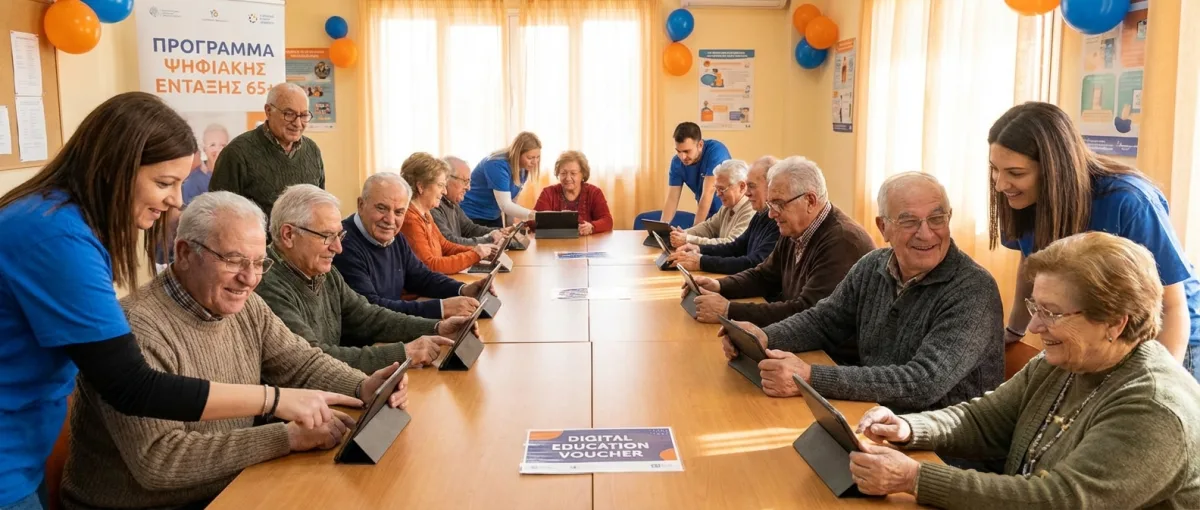
Voucher 65+ is a subsidized training coupon program, funded through ESPA (Greece's EU structural fund framework) and the Recovery and Resilience Facility (RRF). It targets citizens aged 65 and older, with one goal: basic digital literacy. That means learning to use a smartphone, navigate the internet, send email, access the gov.gr platform, handle e-banking, and interact with digital public services.
Training is delivered through certified providers — mainly KEDIVIM (university-based lifelong learning centers) — and includes both theoretical instruction and hands-on practice. At the end of the program, participants must pass a certification exam to receive a nationally recognized digital skills credential.
💡 The numbers paint a stark picture
According to the DESI (Digital Economy and Society Index), Greece ranks below the EU average in digital skills. Just 52% of Greeks possess basic digital competencies, compared to the EU average of around 56%. Among citizens over 65, the figure drops below 20%.
Meanwhile, the EU's Digital Decade initiative has set a target of 80% of adults having basic digital skills by 2030. Greece needs to nearly double its performance among seniors in four years. Without programs like Voucher 65+, that target remains a fantasy.
Key program details
Application platform: voucher.gov.gr — the central hub for ESPA-funded training voucher applications.
Managing authority: DYPA (Public Employment Service), in coordination with Greece's Ministry of Digital Governance.
Cost to participants: Zero. Training is fully covered by the voucher.
Duration: 60–100 hours, depending on the training provider.
Certification: Mandatory examination upon program completion.

🔍 Gov.gr changed the rules — but not for everyone
Since 2020, Greece has been systematically migrating public services to the gov.gr platform. Statutory declarations, power of attorney documents, public service appointments, digital prescriptions, certificates — all online. For younger generations, that spells convenience. For those over 65, it spells exclusion.
A 72-year-old in Larissa can't book a hospital appointment without Taxisnet credentials. A 68-year-old in Patras needs her grandson to pull up a certificate. This dependence isn't just inconvenient — it's a matter of dignity and autonomy.
💰 Where the money comes from
Greece has committed €600 million through the Recovery and Resilience Facility (RRF) for digital skills. The budget is spread across multiple programs: 50,000 training places for the unemployed in digital, green, and financial literacy; 75,000 places for employed workers in green skills; and specialized programs for vulnerable groups — including seniors aged 65+.
The voucher.gov.gr platform serves as the central application gateway. Beneficiaries select a training provider, complete the program, and receive certification. DYPA (formerly OAED, Greece's public employment service) manages the entire process on the government side.

▶️ AI Factory “Pharos” and the infrastructure angle
Alongside training programs, Greece is investing in core digital infrastructure. The recently launched AI Factory “Pharos” is one of the country's most ambitious digital transformation projects, designed to develop AI applications across healthcare, agriculture, and public administration.
What does this have to do with seniors? Everything. AI-powered tools can make digital services far more accessible: voice assistants in Greek, auto-fill for complex forms, simplified interfaces. Training today's 65+ cohort will pay off exponentially if combined with technology that lowers the barriers to entry.
💡 What still needs to change
Training vouchers are a solid first step, but they're not enough on their own. Seniors need ongoing support, not just a 60-hour course. They need help desks at public service centers staffed with digital assistance specialists. They need apps designed with accessibility in mind from day one. And they need a culture that stops treating digital illiteracy as “grandpa's problem.”
Europe is moving in this direction. Countries like Estonia and Finland have already built networks of digital mentors for the elderly. Greece can follow — but only if programs like Voucher 65+ go beyond counting beneficiaries on paper and actually reach the village, the neighborhood, the living room of a 70-year-old who just wants to book a doctor's appointment on their own.
Sources:
European Commission — Digital Economy and Society Index (DESI)
Greek Government — Voucher Training Platform
DYPA — Public Employment Service
Greece 2.0 — Recovery and Resilience Plan