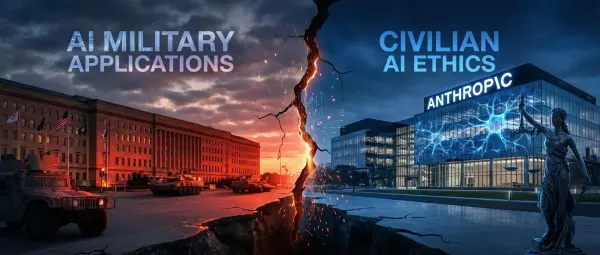


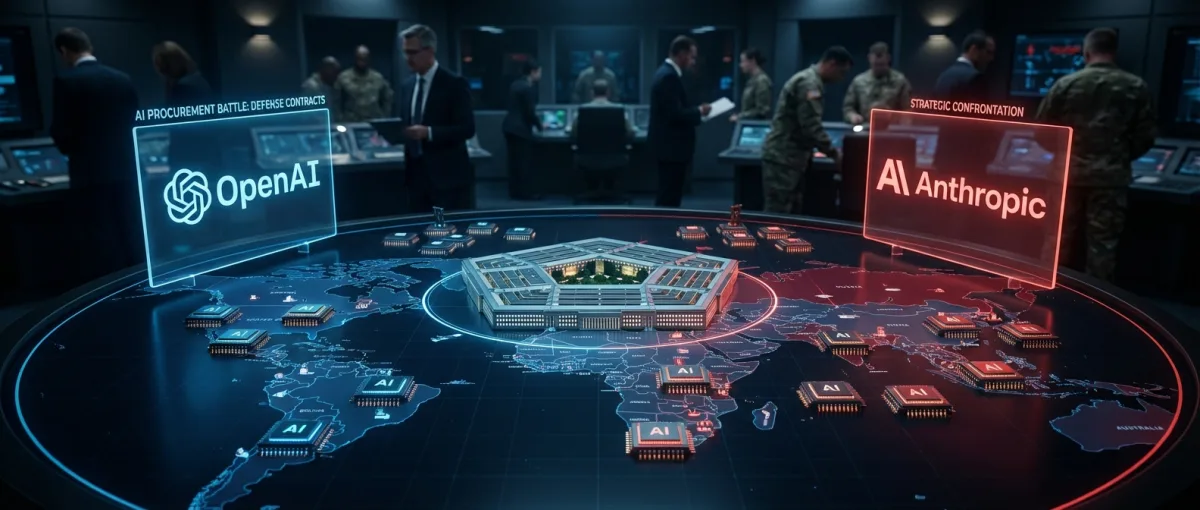
Two companies, two different philosophies, one client: the United States military. The OpenAI versus Anthropic battle over Pentagon contracts isn't just a commercial rivalry — it reveals the deep fracture in the world of artificial intelligence.
📖 Read more: Anthropic vs Pentagon: AI Clash
🏛️ The Starting Point
The story began in February 2026, when Defense Secretary Pete Hegseth asked AI labs to renegotiate their contracts under new terms. The change? AI models could be used for “any lawful purpose” — no exceptions. OpenAI agreed. Anthropic refused.
The contrast was striking. Sam Altman, CEO of OpenAI, presented the agreement as a win for safety, claiming existing laws protect the red lines. Dario Amodei, CEO of Anthropic, countered that the phrase “any lawful use” leaves a door open to practices his company considers unacceptable.
🔬 The Points of Disagreement
Anthropic had two non-negotiable points: no mass surveillance system for American citizens and no autonomous system that can kill without human approval. OpenAI, technically, supports the same principles — but accepted language that, according to sources, gives the Pentagon significantly more room for interpretation.
The critical difference lies in the legal framework. Laws like FISA Section 702 and the Patriot Act allow — at least in some interpretations — the collection of citizen data for national security reasons. OpenAI accepted this framework. Anthropic wanted to go beyond it.
📖 Read more: ChatGPT Ads: End of Free Usage?
📌 Key difference: OpenAI accepted “any lawful use” — meaning any use the law permits. Anthropic demanded explicit exceptions, regardless of legality. This difference looks small on paper, but in practice it's enormous.

💸 Who Wins
Short-term, OpenAI. Defense contracts are worth billions, and Anthropic's departure leaves an open field. Elon Musk's xAI also accepted the new terms, so Anthropic stands essentially alone on the side of “hard ethics.”
Long-term? The answer depends on the legal battle. If Anthropic prevails in court, it will create case law that changes how the government interacts with tech companies. If it loses, the message will be clear: in 2026 America, the defense market doesn't accept conditions.
📖 Read more: Instagram: Fake AI Disability Profiles
🌍 International Reactions
The EU is watching closely. The EU AI Act, being implemented in phases, classifies autonomous weapons systems as “high-risk AI” and sets strict requirements. Some European officials think Anthropic's stance aligns more with European values — but this could become a problem if the company needs European funding or partnerships.
In the UK, GCHQ already uses AI models. In China, Alibaba and Baidu don't face equivalent ethical dilemmas — the government doesn't ask. This asymmetry worries supporters of the view that the West must use AI in military applications without restrictions.
🔮 What It Means for Us
This case concerns every AI user. If companies can't set terms with governments, then today's safety policies — on hallucinations, bias, malicious use — could be overturned tomorrow by a ministerial decision. The Anthropic-Pentagon conflict isn't just a military story. It's a story about the boundaries of every tech company facing the state.