

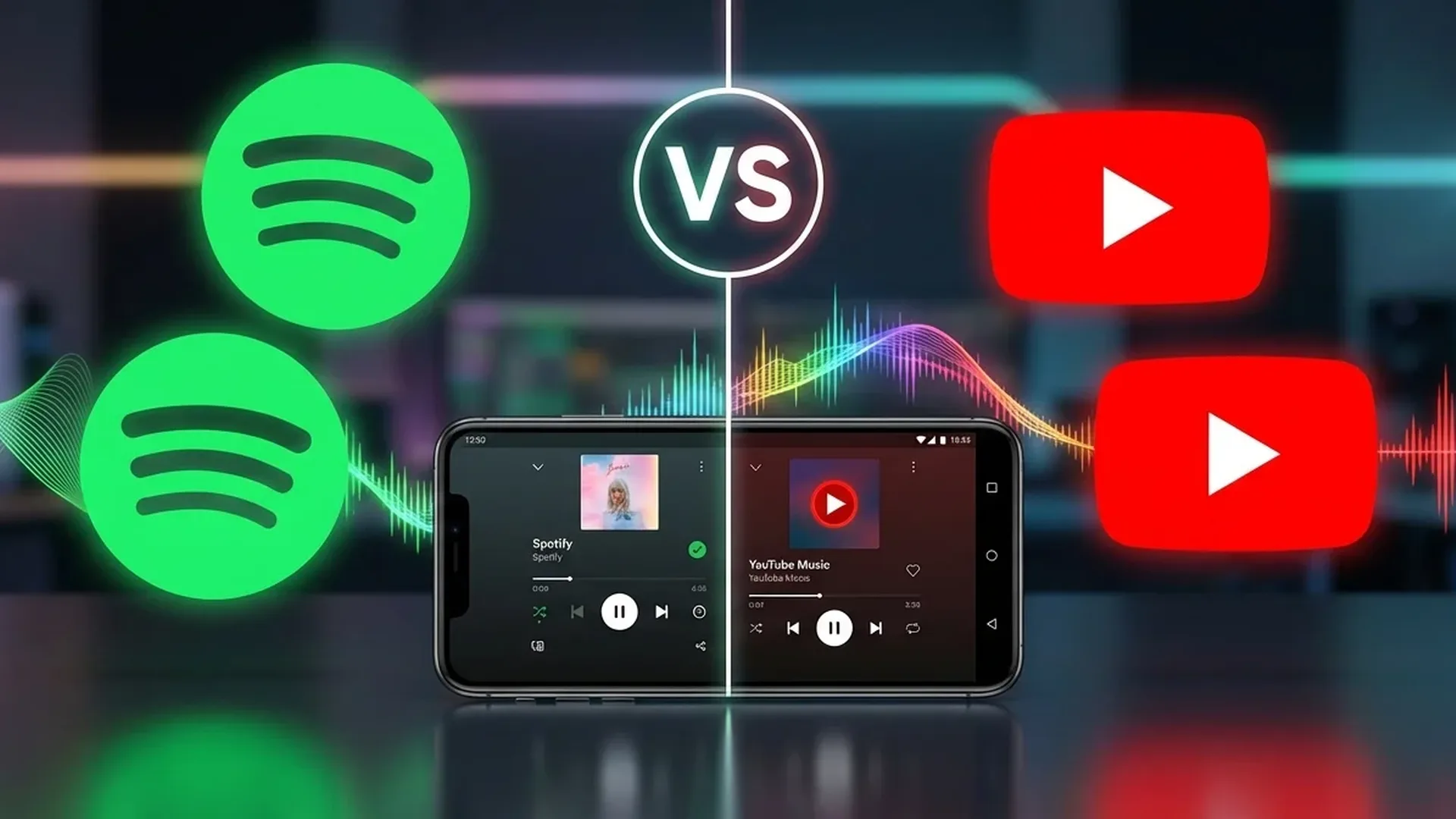
Spotify and YouTube Music are the two most popular music streaming services on Android. Which offers better sound quality, which has the best discovery features, and which one deserves your money? Here is our detailed comparison for 2026.
📖 Read more: Android Accessibility: Complete Features Guide
Music Library
Both services boast catalogs exceeding 100 million songs. In practice, the difference lies not in the numbers but in the content. YouTube Music has one massive advantage: it includes live performances, covers, remixes, DJ sets, and mashups uploaded to YouTube by users. These simply do not exist on Spotify. If you are looking for that rare live rendition or a fan-made remix, YouTube Music wins clearly.
On the other hand, Spotify offers better podcast integration. Music and podcasts live in a single app with separate lists, playback history, and push notifications for new episodes. YouTube Music tried expanding into podcasts but the experience remains inferior.
Audio Quality
This has been a friction point for years. Spotify finally launched Spotify HiFi in 2025, supporting CD-quality lossless audio (16-bit/44.1kHz FLAC) and Hi-Res (24-bit/48kHz). It requires a Premium subscription. YouTube Music Premium offers 256 kbps AAC but does not support lossless audio. If sound quality is your priority, Spotify wins hands down. The difference on good headphones — especially wired — is noticeable.
📖 Read more: Android Storage: Free Up Space Now
AI & Discovery
This is where the real battle unfolds. Spotify has the best music discovery algorithms in the world. Discover Weekly, Release Radar, Daily Mixes, and AI DJ all learn your taste with remarkable accuracy. The AI DJ feature (now available in over 50 countries) works like an AI radio host that builds a playlist for you in real time, mixing your favorites with new discoveries.
YouTube Music fights back with its own AI tools: Smart Downloads, Supermix playlists, and “Ask for Music” — you request songs using natural language (such as “play something chill for a Sunday evening”). It works well, but the results are not curated with the same finesse as Spotify playlists.
AI DJ vs Ask for Music: Spotify AI DJ learns what you love AND pushes you outside your comfort zone. YTM “Ask for Music” does exactly what you ask — effective, but without surprises.
Pricing & Free Plans
Spotify's free tier is significantly better: on-demand playback on mobile (with ads), full access to all playlists, shuffle play on anything. YouTube Music's free tier only plays with the app open — no background playback. This makes it nearly unusable as a daily music app on Android.
- Spotify Premium: €10.99 per month (Individual), €14.99 (Duo), €17.99 (Family, up to 6 members)
- YouTube Music Premium: €10.99/month (Individual), €17.99 (Family, 5 members)
- YouTube Premium: €13.99 per month — includes YTM Premium AND ad-free YouTube videos
If you already pay for YouTube Premium to get ad-free video, YouTube Music is a free bonus. If you want music only, Spotify is the more complete solution.
📖 Read more: Developer Options: Hidden Android Settings
Android Integration
Both apps support Android Auto, Wear OS, Google Assistant, and Chromecast. YouTube Music comes pre-installed on most new Android phones as the default music app. Spotify supports Spotify Connect — seamless playback switching between devices (phone, laptop, smart speaker) without pausing. This feature does not exist in YouTube Music and is a genuine game-changer for multi-device users.
Which Should You Choose?
Choose Spotify if: you want the best discovery algorithms, lossless audio, built-in podcast support, and seamless multi-device switching via Spotify Connect. It is the ideal choice if music quality and discovery matter most.
Choose YouTube Music if: you want access to live performances and user-uploaded content, already pay for YouTube Premium, or live primarily in the Google ecosystem (Nest speakers, Pixel phones). The YouTube video integration is unique and irreplaceable.
"Spotify teaches you to love music you didn't know existed. YouTube Music lets you find tracks that exist nowhere else."
Sources: Spotify Premium, YouTube Music