

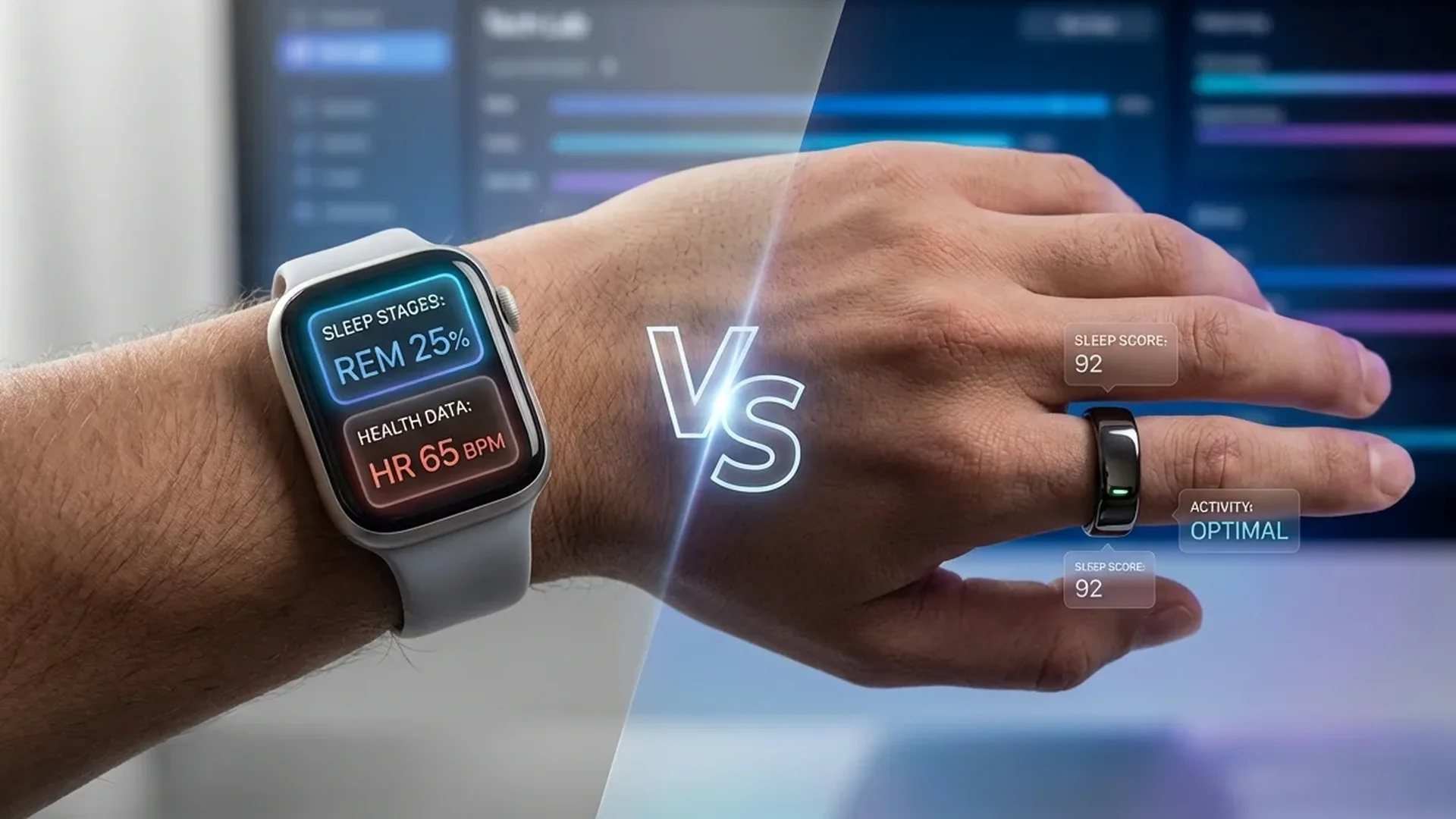
Watch or ring? This is a question increasingly on the minds of health tech enthusiasts in February 2026. The Apple Watch Series 11 and Oura Ring 4 represent two entirely different philosophies in health tracking — a full-featured smartwatch versus a discreet titanium ring. In this comprehensive guide, we examine which one best fits your needs and lifestyle.
📖 Read more: Apple Watch vs Amazfit T-Rex Ultra 2: Budget Beast or Not?
Two Entirely Different Products
Before diving into numbers and specifications, it's worth emphasizing something important: the Apple Watch Series 11 and Oura Ring 4 don't even belong in the same product category. One is a full-featured smartwatch with a display, apps, notifications, and GPS. The other is a titanium ring that looks like jewelry and has no screen whatsoever. The comparison, therefore, isn't about which is “better” overall — it's about which one better serves your specific priorities.
The Apple Watch delivers a complete smartwatch experience. You can answer calls, read messages, navigate with maps, listen to music, and naturally track dozens of health metrics right from your wrist. The Oura Ring 4, on the other hand, operates completely silently — you slip it on your finger and forget it's there while it collects sleep data, heart rate data, and body temperature readings in the background.
Design and Comfort
The Oura Ring 4 weighs less than 6 grams and is crafted entirely from titanium. It's so lightweight that after a few days of wear you completely forget it's on your finger. Available in multiple colors and sizes, it looks more like fine jewelry than a tech gadget. This makes it ideal for anyone who wants to monitor their health without broadcasting that they're wearing technology.
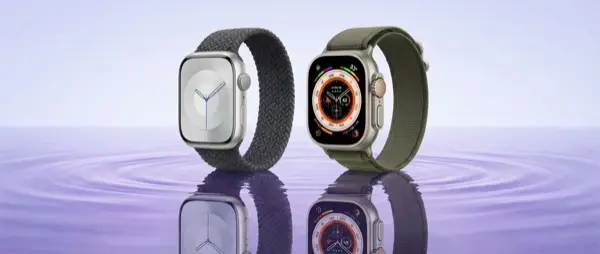
The Apple Watch Series 11, while elegant with its latest design refinements, is clearly a tech watch on your wrist. The OLED display is gorgeous and bright, but the size (41mm or 45mm) makes it quite noticeable. For some, this is an advantage — you can glance at information anytime. For others, especially during sleep, it can prove uncomfortable and distracting.
Sleep Comfort — A Critical Difference
The biggest practical difference between these two devices shows up at night. The Oura Ring is virtually invisible during sleep — you feel nothing on your finger. In contrast, many Apple Watch users struggle to sleep comfortably with a watch strapped to their wrist. If sleep quality is your primary concern, this deserves serious consideration in your decision.
Health Tracking: What Each One Does
Oura Ring 4: The Sleep Specialist
The Oura Ring 4 has been the gold standard in consumer sleep tracking for years. It measures sleep stages (light, deep, REM), wake time, heart rate variability (HRV), skin temperature, and produces a detailed Sleep Score each morning. Additionally, its Readiness Score tells you how prepared your body is for activity, combining data from sleep quality, recovery metrics, and recent physical exertion.
The ring's position on your finger provides a distinct advantage over the wrist: PPG (photoplethysmography) sensors capture a cleaner signal from finger arteries, especially during sleep when movement is minimal, ensuring greater accuracy in critical HRV measurements.
Apple Watch Series 11: Complete Health Hub
The Apple Watch Series 11 covers significantly broader ground in health monitoring. Beyond sleep tracking (which has improved substantially in watchOS 26), it offers electrocardiogram (ECG), blood oxygen measurement (SpO2), fall detection, crash detection, wrist temperature sensing, VO2 Max estimation, and much more. For users with chronic conditions or those requiring comprehensive health oversight, the Apple Watch is clearly the more complete solution.
That said, the Apple Watch's sleep tracking quality, while reliable, doesn't yet match the depth of analysis that Oura provides. Particularly in areas like Readiness Score and long-term recovery trends, Oura remains the undisputed leader in consumer wearables.
Battery Life: The Massive Gap
Here, the Oura Ring 4 wins by an enormous margin. With battery life lasting 5 to 7 days depending on usage patterns, you barely need to think about charging. Simply place it on the charging stand once a week for about an hour and you're good to go for another full week.
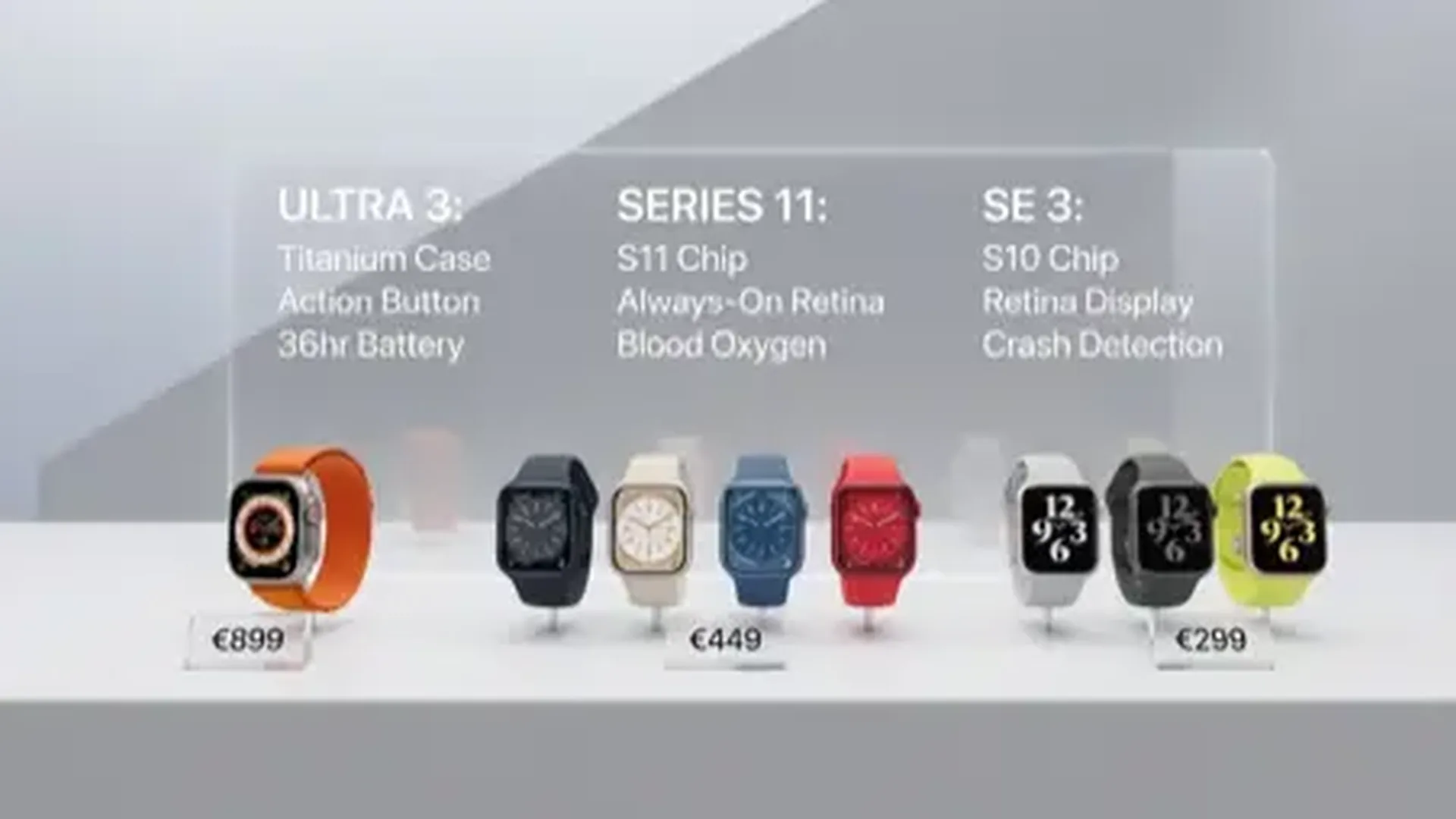
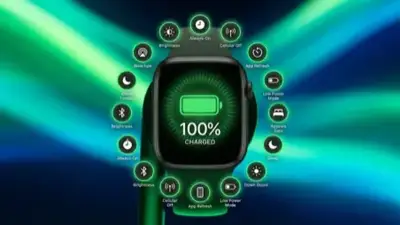
The Apple Watch Series 11 offers approximately 36 hours of battery life under normal use, or up to 72 hours in Low Power Mode. This means you practically need to charge it every night or every other day. If you want to wear it for sleep tracking too, you need to find a charging window during the day — something that isn't always convenient.
Cost of Ownership: Oura's Hidden Trap
A significant drawback of the Oura Ring 4 is its mandatory monthly subscription of €5.99 for access to detailed analytics and insights. Without it, you only see basic metrics. Over 2 years, that adds up to <€144 on top of the purchase price (~€349), bringing total ownership cost to roughly €493. By comparison, the Apple Watch Series 11 (~€449) requires no subscription whatsoever for full access to all health data.
📖 Read more: Apple Watch vs Galaxy Watch 7: 2026 Comparison
Activity Tracking and Smart Features
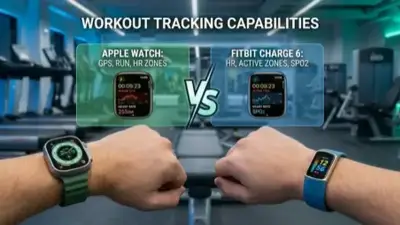
In activity tracking, the Apple Watch dominates completely. It features built-in GPS, a compass, an altimeter, automatic workout detection for dozens of exercise types, and real-time heart rate zones. You can run, swim, cycle, or practice yoga with comprehensive data displayed right on your wrist as you move.
The Oura Ring 4 offers basic step counting and automatic recognition of some activities, but without GPS, without real-time metrics, and without any display, it simply cannot compete with Apple Watch in this domain. If exercise is central to your daily routine, the Apple Watch is the only logical choice between the two.
As for smart features, there's simply no comparison to be made. The Apple Watch offers notifications, phone calls, messages, Apple Pay, turn-by-turn navigation, music streaming, podcasts, Siri voice assistant, third-party apps, and countless other capabilities. The Oura Ring doesn't interact with the user in any way — all data viewing happens exclusively through the phone app.
"I wear the Oura Ring at night for exceptional sleep tracking and the Apple Watch during the day for everything else — it's the perfect combination for getting the best of both worlds."
— Kostas M., user of both devicesCan You Wear Both Together?
The short answer is: yes, and many people already do exactly that. The most popular approach is wearing the Oura Ring at night for excellent sleep tracking without any discomfort, and switching to the Apple Watch during the day for activities, notifications, and health monitoring. Data from both devices can synchronize via third-party apps through Apple Health, giving you a complete 24-hour picture of your wellness.
Of course, this approach means paying for two devices. If your budget is limited, you'll need to choose just one — and that decision depends entirely on which health priorities matter most in your daily life.
Final Verdict
The Oura Ring 4 is the ideal choice if sleep and recovery are your primary focus, if you want something completely discreet that doesn't look like technology, and if you don't need smartwatch functionality. It shines as a dedicated health tracking companion alongside your smartphone.
The Apple Watch Series 11 is the ideal choice if you want an all-in-one device for health, fitness, and smart features. It offers incomparably more capabilities across every category, but it takes up space on your wrist, requires more frequent charging, and may prove uncomfortable during sleep for some users.
Frequently Asked Questions
Which has better sleep tracking?
The Oura Ring 4 is considered slightly superior for sleep tracking thanks to better HRV accuracy from finger-based measurement and greater comfort during the night. However, the Apple Watch Series 11 has made significant strides in this area with recent software updates.
Do I need an iPhone for the Oura Ring?
The Oura Ring works with both iPhone and Android devices. The Apple Watch, however, works exclusively with iPhone — which limits options for Android users considerably.
Is the Oura monthly subscription worth it?
If you want access to detailed analytics, health scores, and personalized insights, the subscription (€5.99/month) is essentially mandatory. Without it, the ring's functionality is dramatically reduced to basic metrics only.
Which is more accurate for heart rate?
Both devices use PPG (photoplethysmography) technology. The Oura Ring tends to be slightly more accurate at rest and during sleep, while the Apple Watch excels noticeably in heart rate measurements during physical exercise.
Can I make calls with the Oura Ring?
No. The Oura Ring has no microphone, no speaker, and no interaction capability of any kind. All data is displayed exclusively on your smartphone through the Oura companion app.
Which one is waterproof?
Both devices are waterproof. The Oura Ring 4 handles depths up to 100 meters, while the Apple Watch Series 11 is rated WR50 for shallow water swimming. If you need greater water resistance, the Apple Watch Ultra 3 is rated for depths up to 100 meters as well.