

Price and What You Get
The Apple Watch SE (2nd generation) costs approximately €279, while the Fitbit Charge 6 retails at €159. The €120 difference isn't enormous, but you should consider that with the Fitbit you'll likely want the Fitbit Premium subscription (€9.99 per month) for access to detailed sleep analytics, stress management tools, and personalised workout programmes.
The Apple Watch SE requires no subscription — all health metrics and detailed analytics are included free through the Health app. If you factor in Fitbit Premium costs for a year (€120), both products end up at roughly the same total price. This significantly changes the value equation and is worth considering before making your decision.
Form Factor: Watch vs Band
The most fundamental difference is form factor. The Apple Watch SE is a full smartwatch with a square OLED touchscreen, Digital Crown, and the ability to install apps. The Fitbit Charge 6 is a slim fitness band with a small AMOLED touchscreen — lighter, more discreet, but with far fewer interaction capabilities.
If you wear a watch all day and want to interact with it — replying to messages, using apps, making contactless payments — the Apple Watch SE is the right choice. If you want something you strap on your wrist, forget about, and that simply records everything in the background, the Fitbit Charge 6 does that job brilliantly. The smaller form factor also makes it more comfortable for sleeping.
Sleep Tracking: Fitbit's Advantage
Thanks to its 7-day battery, the Fitbit Charge 6 tracks sleep without you ever worrying about charging. The Apple Watch SE, with 18-hour battery life, needs daily charging — which makes consistent sleep tracking more challenging. You'll need to find a charging window each day.
Battery Life
The Fitbit Charge 6 delivers up to 7 days of battery life under normal use, while the Apple Watch SE manages approximately 18 hours. This is a massive difference in daily life: with the Fitbit you charge once a week, while the Apple Watch demands nightly charging without exception.
In practice, this means the Fitbit Charge 6 can be worn 24/7 without interruption — ideal for people who want continuous heart rate monitoring, sleep tracking, and step counting. With the Apple Watch SE, you need to find a charging window every day, typically before bed or during a shower. For many users, this is the single biggest trade-off.
Health Sensors
The Apple Watch SE features a second-generation heart rate sensor, fall detection, Crash Detection for car accidents, high and low heart rate notifications, and VO2 Max tracking. It does not include ECG or SpO2 — those are reserved for the Series 11 and Ultra 3 models.
The Fitbit Charge 6 offers continuous heart rate monitoring, SpO2, an EDA (Electrodermal Activity) sensor for stress measurement, sleep tracking with stages (Light, Deep, REM), skin temperature variation, and a Daily Readiness Score. While it lacks ECG, the EDA stress sensor is an interesting feature not found on the Apple Watch SE, and many users find it genuinely useful for managing daily stress levels.
Fitness Tracking
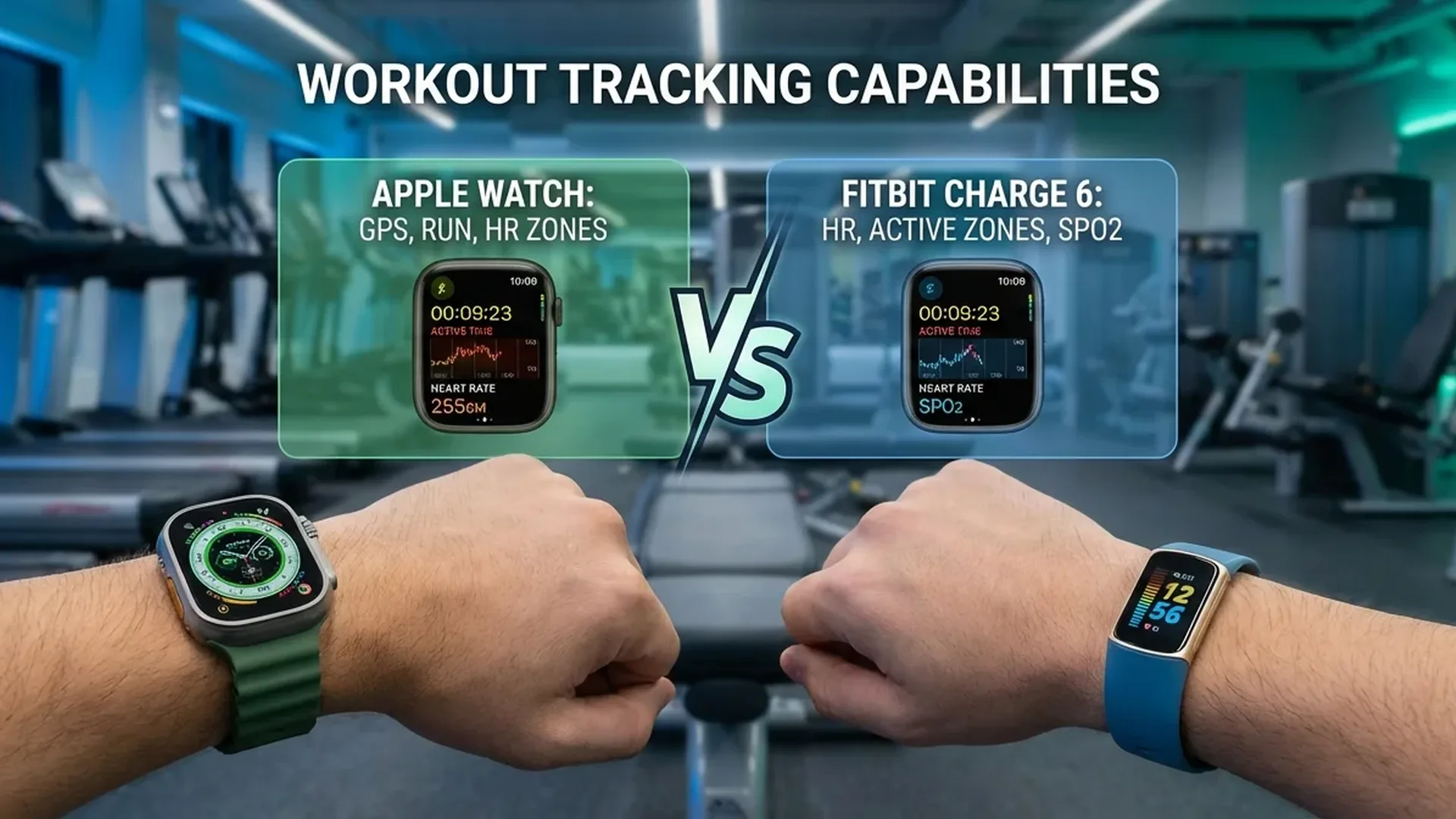
Both devices excel at activity tracking. The Apple Watch SE automatically recognises multiple workout types, offers Activity Rings for daily motivation, and integrates fully with Apple Fitness+ for guided workouts (requires a separate subscription at €9.99 per month).
The Fitbit Charge 6 automatically tracks steps, floors climbed, active heart rate zones, and supports over 40 exercise types. With Fitbit Premium, you get detailed daily insights, workout recommendations based on your Daily Readiness Score, and long-term trend charts. Google integration (Fitbit is owned by Google) also brings Google Maps navigation and Google Wallet for contactless payments directly on the band.
Notifications and Apps
The difference here is enormous. The Apple Watch SE delivers full notifications with the ability to reply to messages, emails, WhatsApp, and other apps directly from the wrist. It has a complete App Store with thousands of third-party apps, Apple Pay, Siri voice assistant, Walkie-Talkie, Find My iPhone, and much more.
The Fitbit Charge 6 displays notifications but you cannot reply to them. It supports Google Wallet for payments, YouTube Music for music playback, and Google Maps for basic navigation. Beyond these, there is no app store and you cannot install third-party applications. If your main needs are fitness tracking and basic notification alerts, this is sufficient. If you want a true smartwatch experience, it falls short.
Google Integration
Google's acquisition of Fitbit has brought significant changes to the platform. The Charge 6 supports Google Wallet, Google Maps turn-by-turn navigation, and YouTube Music streaming. This means you can pay for coffee, get walking directions, and listen to music — all from a small fitness band on your wrist.
However, Google integration doesn't match the depth of the Apple ecosystem. There's no equivalent to Find My iPhone, you can't unlock your computer from your wrist, and interaction with other Google devices (Pixel, Nest) is far more limited compared to what the Apple Watch does with iPhone, Mac, and HomeKit. The Apple ecosystem advantage is real and significant for iPhone users.
Fitbit Premium: Is It Worth It?
Without Fitbit Premium (€9.99/month), you lose detailed Sleep Insights, Daily Readiness Score, Stress Management Score, and personalised workout plans. Basic functions (steps, HR, workout tracking) work for free, but you miss a significant portion of the experience. Apple Watch SE offers comparable analytics for free through the Health app.
Which Should You Choose?
If your priority is pure fitness monitoring — steps, sleep, heart rate, stress — in a lightweight, discreet band with excellent battery life, the Fitbit Charge 6 is an outstanding choice. Especially if you use Android, the Google integration makes it even more appealing and well-integrated with your phone.
If you want a watch that does everything — fitness, apps, payments, notifications, App Store, Siri, Find My — and you use an iPhone, the Apple Watch SE offers incomparably more capabilities. The only sacrifice is the 18-hour battery life, which means daily charging is non-negotiable.
For people who want exclusively a fitness band without distractions — no social media notifications, no apps, just health and exercise data — the Fitbit Charge 6 remains the top choice in its category. It's purpose-built for that single job and does it exceptionally well.
Frequently Asked Questions
Do I need Fitbit Premium?
It's not essential, but it adds significant value. Without Premium, you lose detailed sleep insights, personalised programmes, and the Daily Readiness Score. Basic functions (steps, heart rate, workouts) work without a subscription, but you miss a substantial part of the Fitbit experience.
Which is better for running?
The Apple Watch SE offers built-in GPS, and the Fitbit Charge 6 also features built-in GPS. Both track pace, distance, and heart rate reliably. The Apple Watch provides more real-time metrics on screen thanks to its larger display, which runners often prefer during workouts.
Can I swim with the Fitbit Charge 6?
Yes, it's water-resistant to 50 metres and tracks swimming. The Apple Watch SE is also water-resistant to 50 metres. Both devices automatically detect swimming and record relevant metrics like laps and duration.
Does the Fitbit Charge 6 work with iPhone?
Yes, it works with both iPhone and Android via the Fitbit app. The experience is identical on both platforms — an advantage if you switch phones frequently or use an Android device.
Which has better sleep tracking?
The Fitbit Charge 6 is considered slightly better at sleep tracking, mainly because of battery life — it can be worn comfortably 24/7. With Fitbit Premium, it provides a detailed Sleep Score, sleep stages (light, deep, REM), and long-term trends. The Apple Watch SE tracks sleep reliably, but the need for daily charging makes consistent overnight use more challenging.
Is the €120 difference worth it for Apple Watch SE?
If you need smartwatch features (apps, Apple Pay, Siri, notifications with reply), absolutely — there's no comparison. If you only want fitness tracking, the Fitbit Charge 6 does an equally good job at a lower upfront price, but remember to factor in the Premium subscription cost for the full experience.