

📖 Read more: iPhone 18 Pro: Split Launch — What It Means for You
📐 Design: Book-Style with 4:3 Aspect Ratio
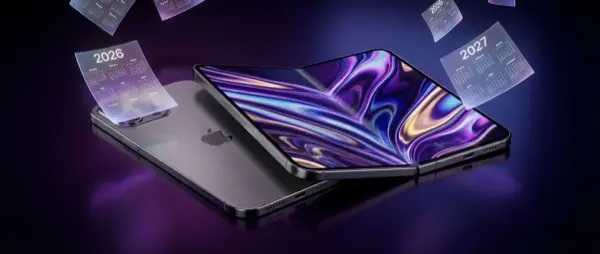
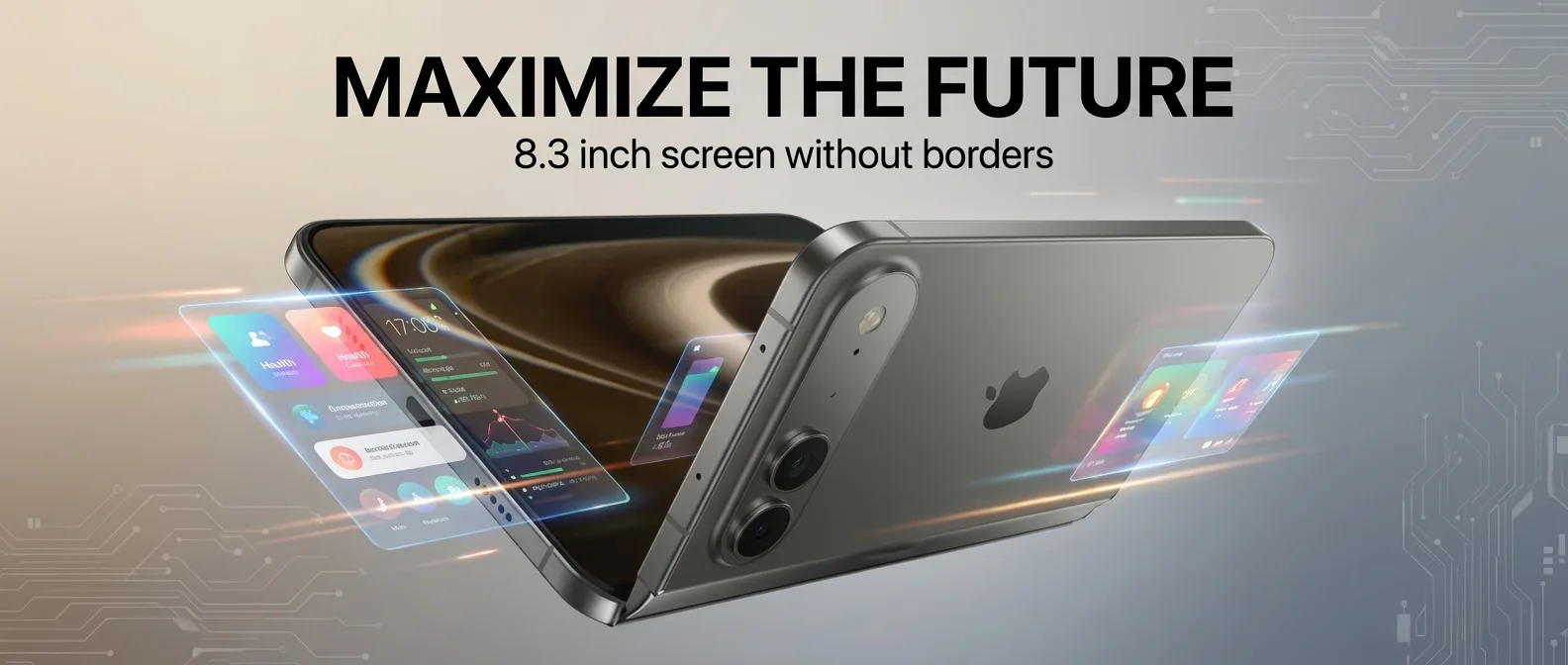
According to the latest leaks (MacRumors, February 2026), Apple ultimately chose a book-style design instead of a clamshell form factor. The iPhone Fold will open horizontally like a book, offering an inner display the size of an iPad mini.
The inner (unfolded) display will measure 7.76 inches with a resolution of 2,713 x 1,920 pixels, while the outer display (when closed) will be 5.49 inches with a resolution of 2,088 x 1,422 pixels and a 4:3 aspect ratio. This means it will be shorter and wider than current foldables, resembling a small iPad rather than a regular phone.
If the 4.5mm unfolded thickness is confirmed, it will be the thinnest device Apple has ever built — surpassing even the iPad Pro 12.9″ which measures 5.1mm. According to UBS analysts, the thickness may end up being a few millimeters more, but it still remains thinner than any current iPhone.
🔧 The Crease Disappears: New Display Technology
One of the biggest problems with foldable smartphones has always been the visible crease at the fold point. Apple, according to multiple reports, made no compromises on this issue.
To achieve this, Apple uses ultra-thin glass from Lens Technology and raw materials from Corning, combined with an entirely new Samsung OLED display technology. This new technique integrates touch sensors directly into the display, reducing the overall thickness by ~19%.
Apple is also evaluating transparent polyimide film — a harder protective membrane — to distinguish itself from the competition in durability, according to reports from February 2026.
⚙️ Liquid Metal & Titanium Hinge
The hinge is the most critical component of any foldable smartphone. Apple plans to use liquid metal — an amorphous metal that the company has been studying for over 15 years.
🔩 Liquid Metal Hinge
More durable than titanium alloy, it resists bending and deformation. Its structure comes from rapid heating and cooling during production.
🛡️ Titanium + Aluminum Frame
According to analyst Jeff Pu, the frame will combine titanium at stress points and aluminum elsewhere, for both durability and lightness.
📱 Structural Glass Mid-Frame
Apple is exploring a glass mid-frame that would minimize the crease, with a color filter-on-encapsulation layer for cleaner colors.
📸 Cameras: 4 Lenses Total
The iPhone Fold is expected to feature a total of four cameras:
- Rear main camera: 48MP Main lens
- Rear Ultra Wide: 48MP Ultra Wide lens
- External selfie: Hole-punch camera on the outer display
- Internal under-display: 24MP camera under the display — an industry first at this resolution
The under-display 24 megapixel camera will be an industry first — no Android foldable has reached this resolution for an under-display camera. It should be noted that there will be no telephoto lens, likely due to space constraints.
💻 A20 Processor & C2 Modem
The heart of the iPhone Fold will be the A20 chip, manufactured using TSMC's new 2nm process. The transition to 2nm brings:
Apple is also expected to use WMCM (Wafer-Level Multi-Chip Module) technology, which integrates RAM directly into the wafer alongside the CPU, GPU, and Neural Engine. This means faster performance in Apple Intelligence tasks, better thermal management, and improved AI processing.
Another important element is the C2 modem, the second generation — successor to the C1. Unlike the C1, the C2 will support mmWave 5G and will match the performance of Qualcomm modems.
📖 Read more: iPhone Fold: Release Date & What We Know So Far
🔋 Battery: The Largest in an iPhone Ever
Despite the ultra-thin design, Apple has worked hard on energy efficiency. According to recent reports:
💡 The iPhone Fold battery is estimated between 5,400 and 5,800 mAh — the largest capacity Apple has ever put in an iPhone. For comparison, the iPhone 17 Pro Max has 5,088 mAh.
Apple reduced the display driver IC from 28nm to 16nm, a significant improvement that saves energy. High-density battery cells specifically designed for foldables will also be used.
🔐 Touch ID Instead of Face ID
In a surprising move, analyst Ming-Chi Kuo reports that Apple will likely not include Face ID in the iPhone Fold. The reason? There isn't enough space in the internal structure for Face ID components, given the priority on thinness.
Instead, Touch ID integrated into the side button will be used — similar to the iPad mini. This change is noteworthy, as Apple just eliminated Touch ID from the iPhone lineup with the iPhone 16e.
The device will also be eSIM-only, without a physical SIM tray — just like the iPhone Air.
💰 Price: Between $1,800 and $2,500
This is where things get interesting — and expensive:
📊 iPhone Fold Price Estimates
If these prices are confirmed, in Greece the iPhone Fold will likely cost between €2,200 and €2,800 or even more, taking into account Greek taxes and the significant historical pricing difference with the US. This is nearly double the price of the iPhone 17 Pro Max.
📅 When Is It Coming Out?
According to multiple sources — Wall Street Journal, Ming-Chi Kuo, Jeff Pu, The Information — Apple is targeting the release of the iPhone Fold in late 2026, alongside the iPhone 18 Pro, iPhone 18 Pro Max, and iPhone 18 Air.
However, there is also a possibility of a delay. Kuo reports that development is behind initial expectations and yields could create stock shortages until 2027. A separate report (October 2025) even suggested a possible complete postponement to 2027.
🔮 Tip: Apple is already planning a second-generation iPhone Fold for 2027, which would coincide with the 20th anniversary of the original iPhone.
🆚 How Does It Compare to the Competition?
Samsung is already on its 6th generation of foldables (Galaxy Z Fold), while Google, Motorola, and Huawei have their own solutions. Apple is arriving late, but with some key advantages:
📊 iPhone Fold vs Samsung Galaxy Z Fold 7
Samsung has already responded by preparing a “Wide Fold” smartphone that mimics Apple's design, according to ETNews reports (December 2025). This shows how seriously Samsung takes the iPhone Fold threat.
🇬🇷 What It Means for Greek Users
If you're interested in the iPhone Fold, here are a few things you should know:
- Price in Greece: Expected between €2,200–€2,800+, depending on storage capacity
- Colors: Initially only black and white variants
- eSIM: You'll need an eSIM — check with your carrier (Cosmote, Vodafone, Nova)
- Repair: Foldable technology will require specialized repair expertise
- Availability: Shortages are expected in the first days — pre-ordering is ideal
At OnOff.gr, we closely follow every development around the iPhone Fold and will update this article as soon as new details are announced. If you need any support or repair for your iPhone, contact us!