

📖 Read more: iPhone Fold: Release Date & What We Know So Far
The Crease Measurements
According to the Weibo account “Fixed Focus Digital,” Apple has submitted production line orders for its foldable iPhone — effectively confirming a 2026 launch. Through this process, the crease measurements have been revealed :
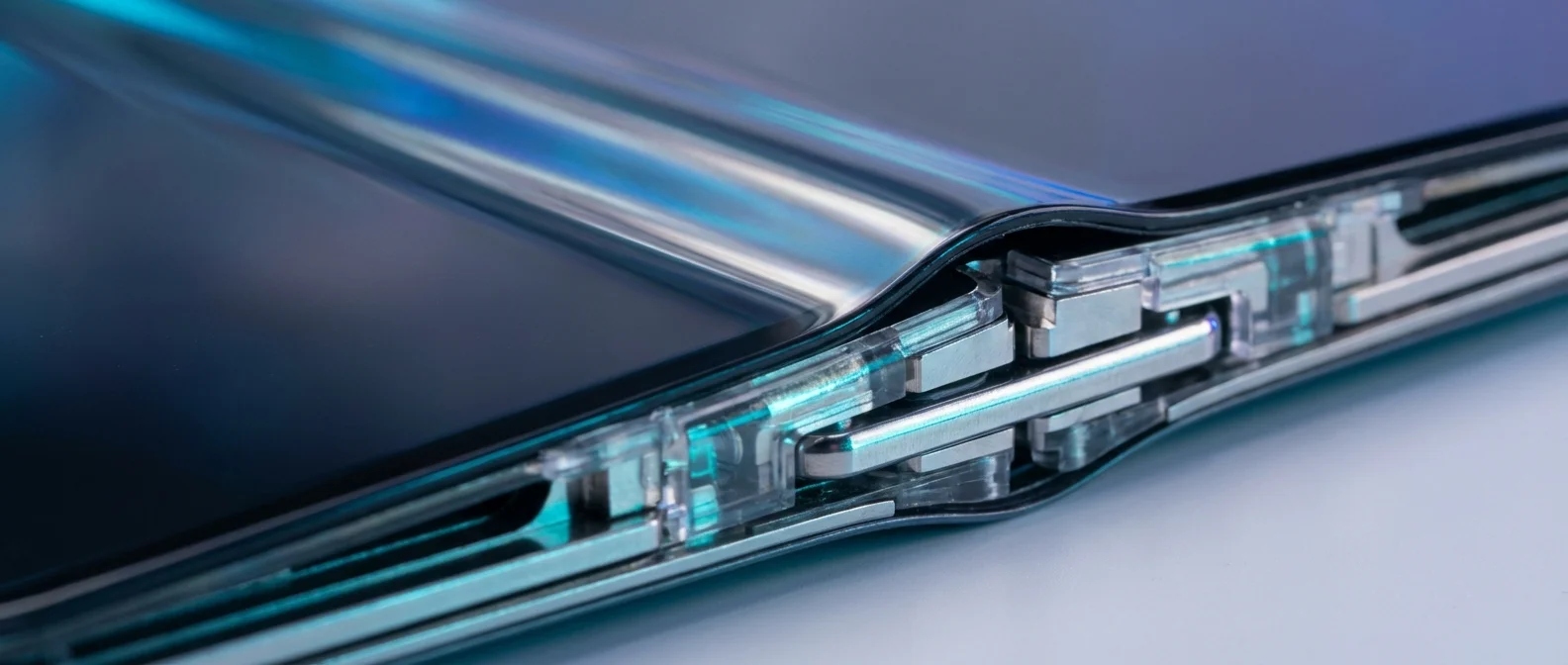
A crease depth under 0.15 mm means the fold line is virtually invisible to the naked eye and imperceptible to the touch . The crease angle below 2.5° indicates how smooth the transition is — a smaller angle means a flatter, ridge-free surface ✨.
Ultra-Thin Glass: Corning & Lens Technology
Apple isn't using CPI (Colorless Polyimide) plastic like Samsung Galaxy Z Fold — instead it opts for Ultra-Thin Glass (UTG) . Supplier Corning provides the raw materials, while China-based Lens Technology handles processing thanks to its expertise in glass strengthening and minimizing side cracks after cutting.
On top of the UTG, Apple is evaluating a transparent polyimide film as an additional protective layer . This significantly differentiates the feel and durability from competitors — real glass instead of plastic.
Next-Gen Samsung Panel (CoE)
Samsung Display created an entirely new OLED panel that has never been used in any foldable . It uses Color Filter on Encapsulation (CoE) technology — eliminating the traditional polarizer film, making the display brighter and thinner.
📖 Read more: iPhone 18 Pro: Split Launch — What It Means for You
Panel Technology Innovations
- Touch sensors integrated directly into the panel (reduces thickness ~19%)
- No polarizer film → higher brightness
- Lighter build + more rigid structure
- Structural glass mid-frame + circular polarizer module → purer colors
What sources are saying: "Virtually crease free" (Feb 2025), "No crease at all" (Samsung showcase CES, Jan 2026), and "Apple solved the crease problem" (Chinese UDN, Nov 2025) .
Liquid Metal Hinge
The hinge is just as critical as the screen. Apple is using liquid metal (amorphous metal) — a material it has researched for over 15 years . It's produced through rapid heating and cooling, creating a structure more resistant to bending and deformation than even titanium. It has a stainless steel look — a premium, sturdy feel 🔩.
The frame combines titanium (for stress-bearing areas) and aluminum (for heat dissipation and low weight), according to analyst Jeff Pu. This combination ensures the device won't bend over time .
Design & Dimensions
- Style: Book-style (like Galaxy Z Fold), not clamshell
- Inner display: 7.76" (2,713×1,920) — 4:3 aspect ratio like iPad mini
- Cover display: 5.49" (2,088×1,422)
- Thickness: ~4.5 mm open / 9-9.5 mm closed
- Cameras: 2×48MP rear + hole-punch exterior + 24MP under-display interior
- Biometrics: Touch ID in power button (no Face ID)
- Battery: 5,400-5,800 mAh — the largest in any iPhone ever
- Chip: A20 Pro (2nm TSMC) + C2 modem with mmWave 5G
- SIM: eSIM only (no physical tray)
"Volume buttons move to the top right (like iPad mini). The left side is completely button-free — all space is dedicated to the display and battery."
— Instant Digital, Weibo (Feb 2026)📖 Read more: 7 iPhone Features That Can Save Your Life
What to Keep in Mind
The 0.15 mm figure refers to a brand-new device . The real test will be what happens after 6-12 months of daily use and thousands of folds. No foldable to date has achieved zero crease long-term — yet.
Ming-Chi Kuo warns of supply shortages possibly into 2027 due to production complexity. Pricing is expected at $1,800-$2,500 (~€1,700-€2,400) — nearly double the iPhone 18 Pro Max .
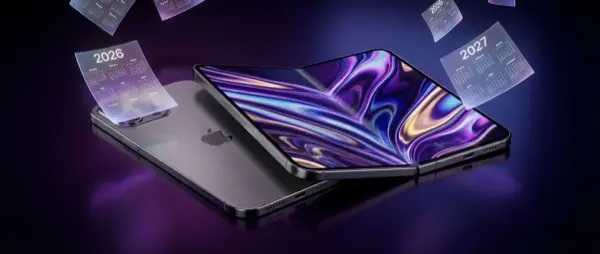
Apple is expected to announce the iPhone Fold alongside the iPhone 18 Pro models in September 2026. It will be the biggest form factor change since the original iPhone in 2007 📱.