

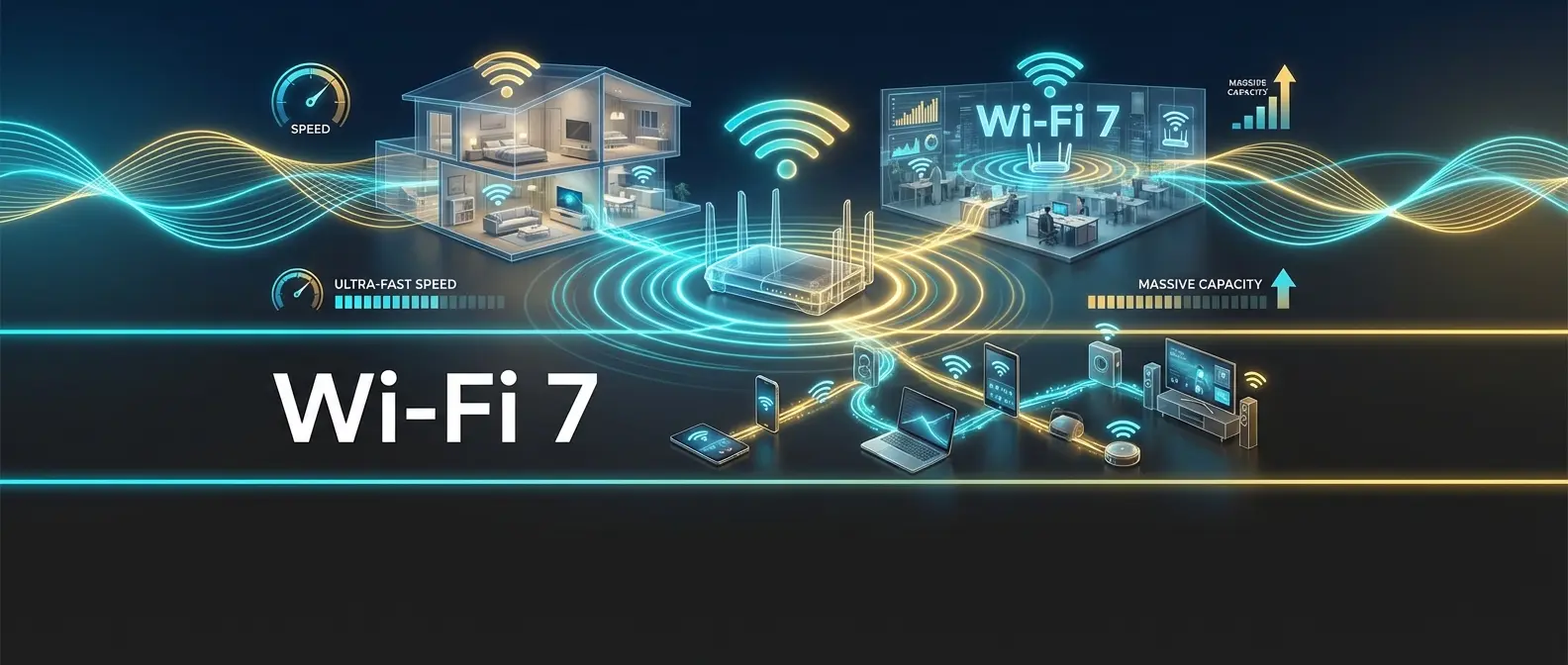
Home and business wireless connectivity is gearing up for a massive leap. Wi-Fi 7, officially known as IEEE 802.11be, is no longer a future technology but a reality hitting the Greek market in 2026. With theoretical speeds reaching 46 Gbps and revolutionary features like Multi-Link Operation, it promises to change the way we use the internet in our daily lives.
📖 Read more: Bluetooth 7.0: What the New Generation Brings
📡 What Is Wi-Fi 7 and Why It Matters
Wi-Fi 7 is the seventh generation of wireless networking technology, successor to Wi-Fi 6E released in 2021. The most important difference isn't just higher speeds, but an entirely new architecture that enables more reliable and stable connections even in environments with many devices. While previous Wi-Fi generations focused on increasing maximum speed, Wi-Fi 7 introduces fundamental changes in how devices communicate with access points.
Multi-Link Operation (MLO) is perhaps the most significant innovation. For the first time, a device can connect simultaneously to multiple frequency bands (2.4 GHz, 5 GHz, and 6 GHz) and transfer data in parallel across all of them. This means that if one band is congested or experiencing interference, data is automatically routed through another, without any interruption noticeable to the user. For applications like video calls, cloud gaming, and real-time streaming, this is a huge improvement.
▶️ The Technical Features That Make the Difference
Beyond MLO, Wi-Fi 7 brings a series of technical improvements that add up to a significant upgrade in user experience. Channel width doubles to 320 MHz (from 160 MHz in Wi-Fi 6), allowing more data to be transferred per unit of time. The 4096-QAM (Quadrature Amplitude Modulation) technology replaces Wi-Fi 6's 1024-QAM, achieving 20% higher data density per transmission symbol. These technical features may sound abstract, but they translate to real-world speeds that can exceed 5 Gbps under ideal home use conditions.
Another important innovation is Preamble Puncturing, which allows Wi-Fi 7 routers to use portions of the spectrum that were traditionally avoided due to interference. Instead of blocking an entire 320 MHz channel because a small portion of it has interference, the system can “puncture” the problematic segment and use the rest. In practice, this means better utilization of the available spectrum and more stable connections in crowded environments like apartment buildings.
| Feature | Wi-Fi 6 | Wi-Fi 6E | Wi-Fi 7 |
|---|---|---|---|
| Max speed | 9.6 Gbps | 9.6 Gbps | 46 Gbps |
| Channel width | 160 MHz | 160 MHz | 320 MHz |
| Modulation | 1024-QAM | 1024-QAM | 4096-QAM |
| Frequency bands | 2.4/5 GHz | 2.4/5/6 GHz | 2.4/5/6 GHz + MLO |
| Multi-Link | No | No | Yes |

💡 The Situation in Greece
The Greek market follows international Wi-Fi developments with a relatively short delay. The first Wi-Fi 7 routers started appearing in Greek stores in November 2025, and as of today there are about 15 models available from manufacturers like ASUS, TP-Link, Netgear, D-Link, and Xiaomi. Prices range from around 180 euros for entry-level models to 600+ euros for top-tier gaming routers. Similarly, Wi-Fi 7 mesh systems start at 350 euros for a two-unit pack.
📖 Read more: Wearable Health 2026: Top Health Gadgets
The major internet providers in Greece (COSMOTE, Vodafone, Nova) have not yet officially announced Wi-Fi 7 routers as part of the equipment they provide to subscribers. However, market sources indicate that COSMOTE is preparing to introduce Wi-Fi 7 equipment for FTTH (Fiber to the Home) subscribers from the second half of 2026. Until then, consumers who want Wi-Fi 7 need to purchase their own router and connect it to their provider's ONT (Optical Network Terminal) or modem.
📶 Is the upgrade to Wi-Fi 7 worth it?
Yes, if: You have a 500+ Mbps fiber connection, many devices at home, do gaming or 4K/8K streaming, or use VR/AR applications.
Not yet, if: You have VDSL or slow internet, few devices, or your current needs are covered by your existing router. Wait for prices to drop and the technology to mature further.
📡 Wi-Fi 7 for Businesses
While the consumer Wi-Fi 7 market is still in its early stages, businesses are seeing significant benefits from adopting the new technology. MLO is especially useful in high-density environments like offices, hotels, shopping centers, and airports. The ability to simultaneously connect across multiple bands ensures that even when hundreds of users are connected to the same network, the experience remains acceptable for everyone.
Enterprise equipment manufacturers like Cisco, Aruba (HPE), and Ruckus have already announced or released Wi-Fi 7 access points. In Greece, the first Wi-Fi 7 installations in corporate environments are expected during 2026, primarily in large technology companies and the banking sector. For small and medium businesses, prosumer Wi-Fi 7 routers offer a more affordable alternative that provides many benefits of the new technology without the high cost of enterprise equipment.

📡 What You Need to Take Full Advantage of Wi-Fi 7
Buying a Wi-Fi 7 router is just the beginning. To fully leverage the new technology's capabilities, you also need devices that support Wi-Fi 7. For now, the list is limited but growing fast. The flagship smartphones of 2025 and 2026 (iPhone 16 Pro, Samsung Galaxy S25, Google Pixel 9) support Wi-Fi 7, as do top-tier laptops with Intel Core Ultra or AMD Ryzen 8000 processors. For older devices, USB Wi-Fi 7 adapters exist, but their availability in Greece is still limited.
Another important consideration is your internet connection. If you have VDSL at 50 Mbps, a Wi-Fi 7 router won't give you faster internet — you'll simply get those 50 Mbps with better coverage and lower latency. To take advantage of Wi-Fi 7's high speeds, you need a fiber connection of at least 500 Mbps, ideally 1 Gbps or more. In Greece, such speeds are available via FTTH in urban areas, with coverage gradually expanding.
🔍 Compatibility and Transition
The good news is that Wi-Fi 7 is fully backward compatible with all previous Wi-Fi versions. A Wi-Fi 7 router can serve Wi-Fi 4, 5, 6, and 6E devices without issues — those devices simply won't take advantage of the new features. This means the upgrade can be gradual: buy a Wi-Fi 7 router now, and your devices will progressively upgrade over the coming years as you replace smartphones, laptops, and tablets.
One thing to keep in mind is router placement in your home. The 6 GHz band that Wi-Fi 7 uses for the highest speeds has shorter range than older bands. If your home is large or has many walls, a mesh system with multiple access points is probably a better choice than a single powerful router. Wi-Fi 7 mesh systems are already available and offer the best coverage combined with top-tier speeds.
📡 The Future of Wi-Fi
Wi-Fi 7 isn't the end of the road — it's an important milestone on the path to even more advanced technologies. The IEEE has already begun work on Wi-Fi 8 (802.11bn), expected around 2028–2030 with even higher speeds and better efficiency. However, Wi-Fi 7 will remain the leading technology for at least the next 3–4 years, and investing in Wi-Fi 7 equipment today is a safe long-term choice.
For Greek consumers, 2026 is a good year to start looking into Wi-Fi 7, especially if you have a fiber connection and many devices at home. Prices will continue to drop in the coming months as more models enter the market, and the technology will mature with firmware updates that improve performance and stability. Patience may be rewarded with better prices and more reliable equipment.