

Greece is located in one of Europe's most seismically active regions. Every year thousands of earthquakes are recorded, most small, but several are felt. Technology cannot predict earthquakes, but it can warn us precious seconds before the destructive waves arrive.
📖 Read more: Greece Rolls Out Smart Water Meters in 2026
⚠️ What is Earthquake Early Warning (EEW)
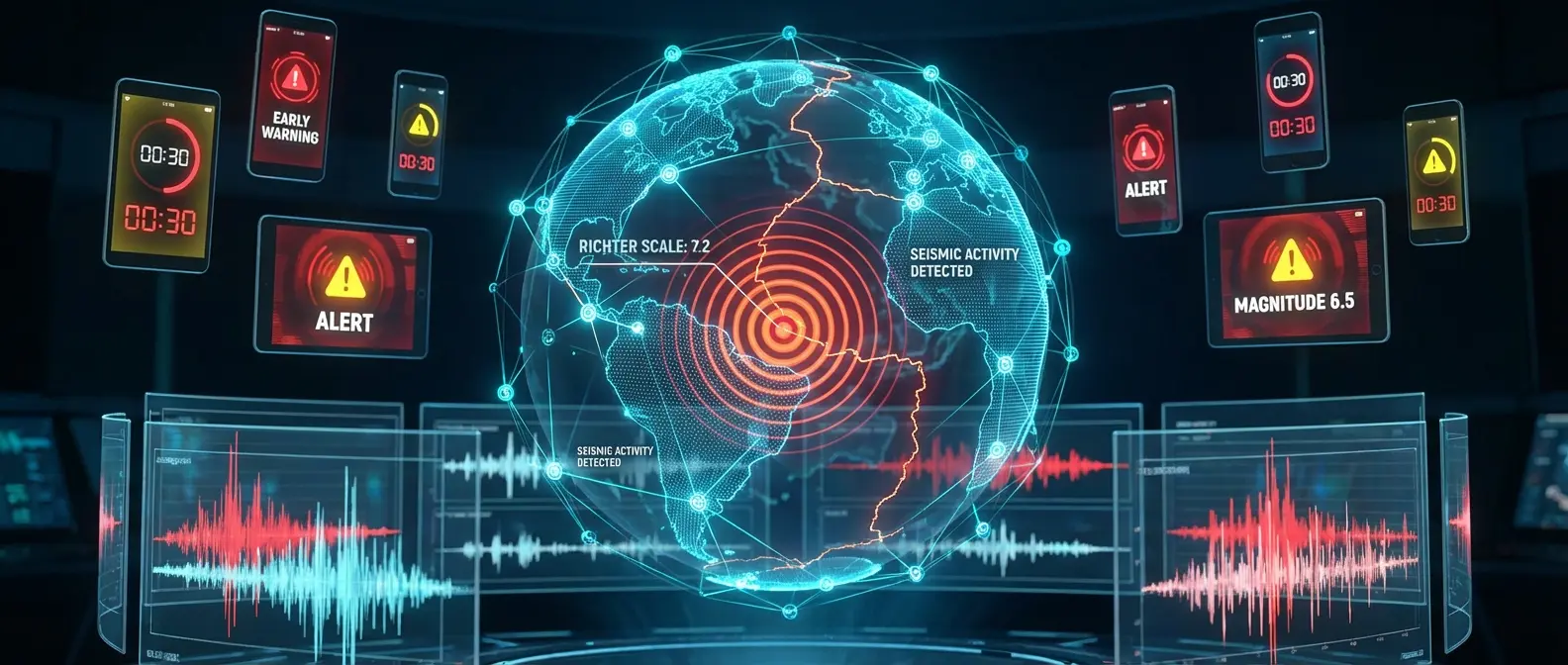
Earthquake Early Warning is a system that detects an earthquake as soon as it begins and sends a warning before the destructive waves (S-waves) arrive. How does this work? The first waves to arrive (P-waves) are fast but weak. The sensors detect them, calculate the location and magnitude, and send an alert before the destructive shaking reaches you.
The warning time depends on the distance from the epicenter. Close to the epicenter, we're talking about 5-10 seconds. At a distance of 100 km, the time can reach 30-60 seconds. Enough time to protect yourself, to stop trains, to shut off gas pipelines.
⚡ How the warning works
- The earthquake begins at the focal depth
- P-waves (fast, weak) reach the nearest sensors
- The system calculates location and magnitude in 1-3 seconds
- Alert sent to phones, sirens, automated systems
- S-waves (destructive) arrive seconds later
📖 Read more: EU Digital Identity Wallet: Europe's New Digital ID System
📡 The sensor network in Greece
The Geodynamic Institute of Athens operates one of the densest networks of seismographs in Europe. Over 1,500 sensors cover the country, with denser coverage in high-risk areas such as the Ionian, the Gulf of Corinth, the Aegean and Crete.
2026 marks the full operation of the Greek EEW. Citizens will receive warnings via the 112 app, cell broadcast, and sirens in public spaces. The system will be automatically activated for earthquakes of magnitude 4.5+ Richter.
📖 Read more: Greek Microsatellite in Orbit: Where It Will Be Used
⚠️ When you receive an alert
- Drop, cover, and hold on
- Stay away from windows and shelves
- Do not use elevators
- If driving, pull over safely
🏢 Infrastructure automation
- Automatic gas pipeline shutdown
- Train and metro deceleration
- Elevator door opening
- Hospital generator activation

🟢 The technology behind the sensors
Modern seismographs use MEMS accelerometers, the same technology found in smartphones. This has dramatically reduced costs and enabled the development of dense networks. Each sensor sends data in real time via 4G/5G or satellite connection.
📖 Read more: Greek Startups 2026: Which Ones Stand Out?
What's most interesting is that smartphones can function as supplementary sensors. Google has already activated Android Earthquake Alerts in many countries, including Greece. This adds millions of measurement points to the global network.
🟢 What changes for citizens
The big change is psychological. Instead of being caught off guard by the terrifying shaking, you'll have a few seconds to prepare. This can save lives — especially for people in dangerous positions (stairs, elevators, near glass).
Of course, the system isn't perfect. There will be false alarms and missed warnings. For earthquakes with an epicenter very close by, the time may not be enough. But even a few seconds can make the difference.
OnOff Science
We explain the science behind the technology that protects us.
📖 Read more: Havana Syndrome 2026: Truth or Myth