

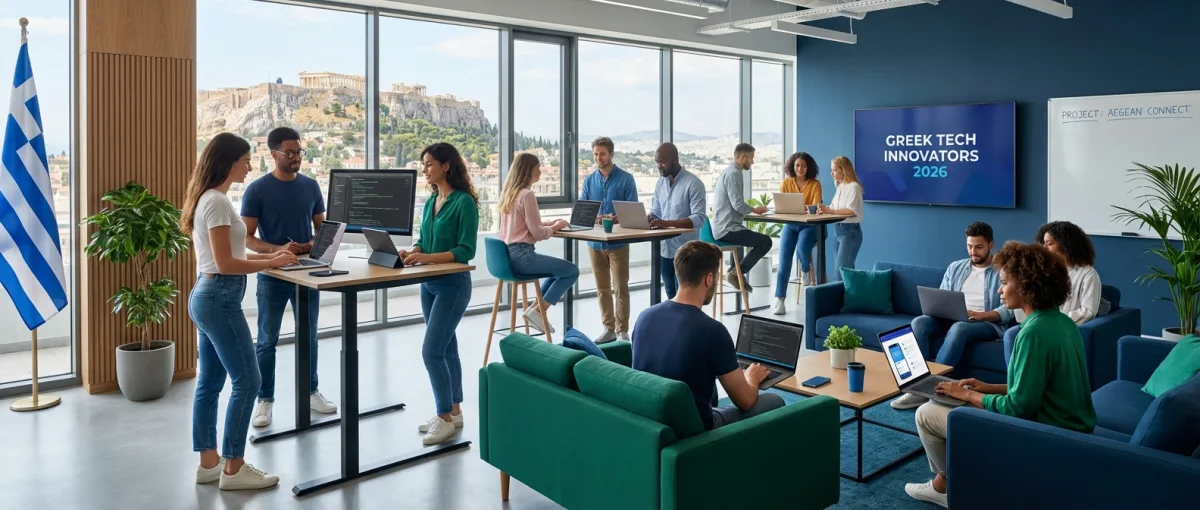
Seven hundred and thirty-two million euros. That's how much investors poured into Greek startups in a single year. Behind that figure lie 90 companies, dozens of founders, and an ecosystem that barely resembles what it was five years ago. Greece in 2026 isn't just hoping for a bailout anymore — it's chasing Series A rounds.
📖 Read more: OTE: TERNA Fiber Acquisition and the Fiber Optic Battle
📊 The Numbers That Speak for Themselves
According to the FWD Greece Innovation Pulse 2025-2026 report, the €732 million invested across 90 startups reflects a maturing ecosystem. This isn't seed-stage pocket change. We're talking about capital that funds scaling, international expansion, and products already in production.
Meanwhile, Greece's National Registry of Startups (EMNE) — powered by the Elevate Greece platform — now lists 879 companies. In the latest cycle alone, 22 new ones were added, four of them through a fast-track process. That fast-track pathway matters: it signals the state apparatus is slowly starting to understand that bureaucracy kills innovation.
🏦 The Money: Who's Backing Whom
The standout figure in funding: the Iliad Fund (Iliad Partners VC) raised $50 million, with three systemic Greek banks participating. When banks that traditionally struggled to lend to SMEs decide to jump into venture capital, something shifts in the mindset.
EnvolveXL, on the other hand, announced 5 new investments in sectors that don't follow the typical Silicon Valley playbook: EdTech, Media, HealthTech, and Property Management. That diversification matters — Greek startups aren't just copying what works abroad. They're solving local problems with technology.
💡 Worth noting: The Piraeus Startup Accelerator is entering its second year and expanding into Thrace. Decentralizing innovation — beyond the Athens-Thessaloniki corridor — is critical if Greece wants a genuine startup ecosystem rather than just a startup bubble in the capital.

🎪 egg Innovation Summit: 3 Days That Mattered
On February 11-13, 2026, the egg Innovation & Investment Summit took place, organized through Eurobank's egg program. Three days packed with pitch sessions, investor panels, and networking. It wasn't another “selfie event with startuppers.” It was the moment where early-stage Greek companies sat in the same room as fund managers handling hundreds of millions.
📖 Read more: Polymarket: $529M in War Betting
The significance of these events goes beyond deals closed on the spot. They build relationships. They create trust. And in an ecosystem where funding often depends on who you know, that carries real weight.
🤖 AI Enters the Game
Two developments in 2026 defined Greece's relationship with artificial intelligence. First, OpenAI signed a Memorandum of Understanding in Thessaloniki, in collaboration with the Ministry of Development and Endeavor, centered around the Alexandros Innovation Zone. Second, Mistral AI's CEO visited Maximos Mansion and signed a corresponding MOU.
What does that mean in practice? Two of the biggest AI players globally now see Greece as a playing field. The government responded by activating the Greek AI Accelerator — a support program for AI-focused startups backed by institutional funding.
"Supporting innovation is a deliberate choice. We're designing a Ministry of Research, Innovation, and Higher Education that will provide a permanent institutional foundation for this effort."
— Prime Minister K. Mitsotakis
🏭 Startups With "Hands": Alicia Bots and Perfectaki Able
It's not just software. Alicia Bots, a robotics startup, inaugurated a new production center in Koropi, partnering with Lomar (Libra Group). A hardware startup on Greek soil with an actual production line — that doesn't happen every day. The company develops robotic systems targeting logistics and industrial applications.
On the other end of the spectrum, Perfectaki Able focuses on people with mobility challenges. It's an accessibility platform supported through the STARTAB program. Technology doesn't always need to chase the hype — sometimes, real success is measured in the daily life of someone who can now do something they couldn't before.
📖 Read more: Privacy Browsers: Life Without Cookies
🏛️ Institutional Support: Words or Action?
The announcement of a new Ministry of Research, Innovation, and Higher Education is ambitious. If executed properly, it would mean a unified policy framework instead of fragmented programs that get announced at events and forgotten within three months.
The signals so far are positive but mixed. The EMNE fast-track shows intent. The lack of a clear tax framework for stock options in startups shows that intent alone isn't enough. Greece needs to compete with countries like Estonia and Portugal that have been offering startup visas and tax incentives for years.
🔮 What to Expect in 2026
If the €732 million from 2025 serves as a foundation, 2026 is shaping up to be even more dynamic. The MOUs with OpenAI and Mistral AI will start translating into real projects. The Greek AI Accelerator will announce its first cohorts. New cities beyond Athens and Thessaloniki — Patras, Heraklion, Ioannina — are staking their claim on the map.
The biggest challenge remains the same: keeping talent in Greece. The funding exists. The programs exist. The institutional will appears to be there. What's still missing is the feeling that you can build a company of global scale without having to relocate to London or Berlin. That will determine whether the numbers mean something — or whether we're just counting money that leaves.