


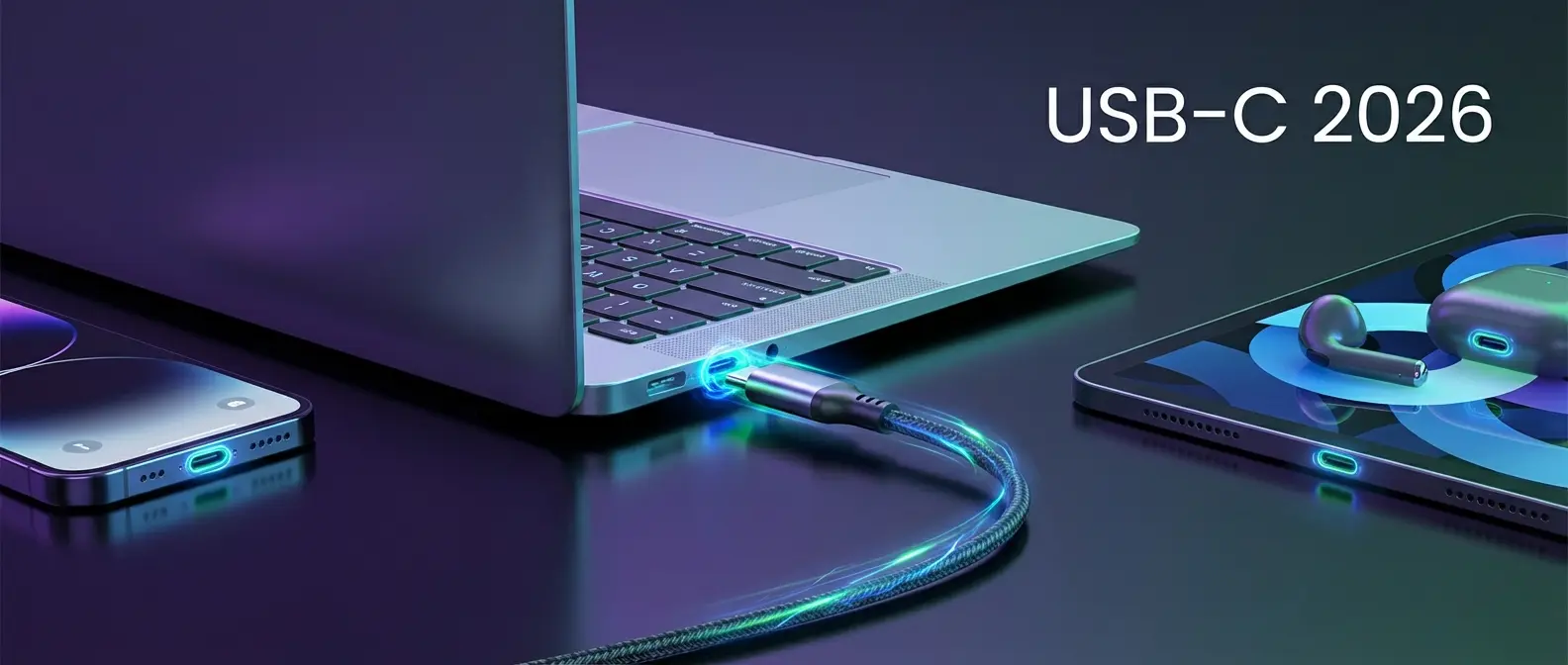
After smartphones and tablets, laptops are next. From April 2026, every new laptop sold in the European Union must have a USB-C port for charging. This decision, part of the European common charger regulation, is expected to drastically reduce electronic waste and simplify the lives of millions of consumers. But what does this change mean in practice for the market?
📖 Read more: EU Deepfakes Law: What's Being Prepared
⚖️ The EU Regulation: What It Stipulates Exactly
EU Regulation 2022/2380, known as the common charger directive, was implemented gradually from December 2024. The first phase covered smartphones, tablets, digital cameras, headphones, portable speakers, video game controllers, e-readers, keyboards, mice, and portable GPS devices. The second phase, starting in April 2026, extends the requirement to laptops, making USB-C the only acceptable charging standard for virtually every portable electronic device.
The rationale behind the regulation is twofold. On one hand, it aims to reduce electronic waste caused by the countless different types of chargers that accumulate in consumers' homes. The European Commission estimates that approximately 11,000 tonnes of charger-related e-waste are discarded annually in the EU. On the other hand, the regulation seeks to save consumers money, as they will no longer need to buy new chargers every time they switch devices or manufacturers.
💻 Gaming Laptops: The Big Challenge
Applying the regulation to laptops isn't as straightforward as with smartphones. While most ultrabooks and business laptops consume 45-65W and can be comfortably charged via USB-C Power Delivery, gaming laptops and mobile workstations present an entirely different picture. A top-tier gaming laptop with an Intel Core Ultra 9 or AMD Ryzen 9 processor and an NVIDIA RTX 4080 or 4090 graphics card can require 280W or even 330W at peak performance, far beyond the 240W offered by USB-C Power Delivery Extended Power Range.
Manufacturers have found solutions to this problem. The first is dual charging, where the laptop has two USB-C ports that can be used simultaneously for charging, reaching a total of 480W. The second is a hybrid approach, where the laptop has both a USB-C charging port and a traditional proprietary port for full power. The EU regulation allows this approach, as long as there is at least one USB-C port capable of charging the device, even at reduced capacity.
⚡ What This Means in Practice for Gaming Laptops
Gaming laptops will be able to charge via USB-C for light use (web browsing, video, office work), but will need their proprietary charger for gaming. This means you can travel with a small USB-C charger for most of your needs, and leave the heavy charger at home or the office.

📊 The State of the Market
The laptop market has already largely adapted to the new reality. According to data from major electronics retail chains, over 85% of laptops sold today already have at least one USB-C port with charging capability. Models lacking this feature are mainly very affordable entry-level laptops and certain specialized gaming models. These models will be gradually phased out from the market by April, as retailers sell off existing stock.
For consumers buying a laptop today, the recommendation is clear: choose a model with USB-C charging, even if it costs slightly more. The investment will pay off in the long run, as you'll be able to use the same charger for your laptop, smartphone, tablet, and any other USB-C device you own. Additionally, USB-C chargers are typically more compact and lighter than traditional laptop chargers, which makes a difference when traveling.
📖 Read more: Foldable Phones Under €500: Mainstream 2026
🔍 Major Manufacturers and the Transition
Apple was a pioneer in adopting USB-C for MacBooks, with all models from 2015 onwards charging exclusively via USB-C. The current MacBook Air and MacBook Pro use MagSafe 3 for charging, but retain full USB-C charging capability, fully complying with the regulation. Microsoft followed with the Surface Pro 9 and Surface Laptop 5 series, while older models with the Surface Connect port do not meet the requirements and will not be sold as new after April.
Major Windows laptop manufacturers such as Dell, Lenovo, HP, and ASUS have adapted their production lines over the past two years. Business lines (Dell Latitude, Lenovo ThinkPad, HP EliteBook) have supported USB-C charging for years, and even consumer lines have now incorporated this capability. The only exception remains the high-end gaming laptop segment, where manufacturers employ the hybrid charging solution mentioned earlier.
| Laptop Category | Typical Consumption | USB-C Charging | Compliance Status |
|---|---|---|---|
| Ultrabook | 30-65W | Full | ✅ 100% ready |
| Business Laptop | 45-90W | Full | ✅ 95%+ ready |
| Gaming (mid-range) | 120-180W | Partial/Full | ✅ 80%+ ready |
| Gaming (high-end) | 230-330W | Hybrid | ⚠️ Adapting |
| Mobile Workstation | 180-280W | Hybrid | ⚠️ Adapting |

⚡ Chargers: What to Look For When Shopping
With mandatory USB-C charging, the charger market becomes more complex but also more interesting. Not all USB-C chargers are the same, and choosing the right one is critical for the best user experience. The key factor is power output (in Watts), which must be at least equal to your laptop's required power. A 65W charger will fully charge an ultrabook, but will be insufficient for a gaming laptop that will continue to drain under load.
GaN (Gallium Nitride) technology has revolutionized USB-C chargers, allowing much smaller dimensions for the same power output. A modern 100W GaN charger is roughly half the size of a traditional 90W laptop charger. On the market, GaN chargers are available from around €40 for 65W up to €80-100 for 140W models with multiple ports. Manufacturers like Anker, Baseus, UGREEN, and Belkin offer reliable options, though you should be cautious with no-name brands that may not meet safety standards.
🔌 USB-C Charger Buying Guide for Laptops
For Ultrabooks (30-65W): A 65W charger is ideal. Small size, lightweight, perfect for travel.
For Business Laptops (45-90W): A 100W charger gives headroom for faster charging and future compatibility.
For Gaming/Workstation: A 140W+ charger or dual charger. Alternatively, USB-C for light use + proprietary charger for gaming.
Important: Make sure the charger supports USB Power Delivery (PD) 3.0 or newer.
📖 Read more: USB4 2.0 & Thunderbolt 5: 80Gbps Speeds Coming in 2026
📝 Cables: The Weak Link
One of the biggest issues with USB-C charging is the cables. Not all USB-C cables can handle high power, and an unsuitable cable can drastically limit charging speed or even cause safety concerns. For laptop charging above 60W, you need a cable rated for at least 100W, while for power above 100W you need a cable labeled “240W” or “EPR” (Extended Power Range).
The challenge is that many cheap USB-C cables don't carry clear labeling about their capabilities. Cables that come with smartphones, for example, typically support only 15-25W and are not suitable for laptop charging. The recommendation is to buy cables from reputable manufacturers with clear labeling of the maximum supported power. A good 100W cable costs around €15-25, while 240W cables range from €25-40.
🌱 Environmental Benefits
Beyond convenience for consumers, the regulation has significant environmental benefits. The European Commission estimates that full implementation of the regulation will reduce charger-related e-waste by approximately 1,000 tonnes annually in Greece alone. Additionally, decreased production of new chargers means fewer CO2 emissions, less raw material consumption, and a reduced environmental footprint from transportation.
An interesting aspect is that the regulation gives manufacturers the option to sell devices without a charger in the box, with a corresponding price reduction. Apple has already adopted this practice with iPhones, and is expected to extend it to MacBooks. For consumers who already have plenty of USB-C chargers at home, this represents additional savings and further reduces waste.
👥 What Changes for Consumers
In summary, the transition to mandatory USB-C charging brings several practical changes for consumers. First, simplification: one charger for all devices. You no longer need to carry multiple chargers when traveling, and you don't need to search for the right charger in your cable drawer. Second, savings: you can use chargers you already own, and when you need to buy a new one, it will serve all your devices for years.
Third, portability: modern GaN USB-C chargers are much smaller and lighter than traditional laptop chargers. A 65W charger fits in your pocket, and even a 100W one is comparable in size to old 30W chargers. Fourth, flexibility: you can charge your laptop from USB-C power banks for emergencies, something that was impossible with proprietary chargers.
🔎 Tips for the Transition
If you're thinking of buying a new laptop in 2026, the advice is simple: choose a model with USB-C charging. If you already have a laptop without USB-C charging and it works perfectly fine, there's no reason to replace it — the regulation only applies to new sales. When it's time to upgrade, you'll automatically enjoy the benefits of the new regulation. If you want to prepare, invest in a good 100W GaN charger and a few quality USB-C cables. This investment will serve you for years, regardless of what devices you'll have in the future.