

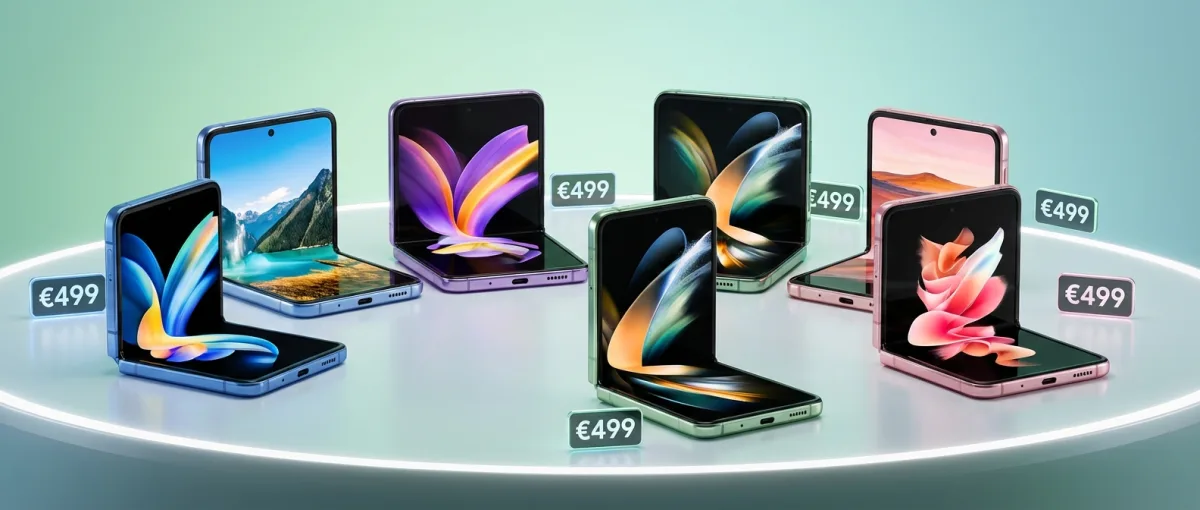
Two years ago, a foldable under €1,000 was a fantasy. Today, folding smartphones are dropping to prices that put them within reach of average consumers. Are we finally at the point where a foldable becomes a mainstream purchase?
📖 Read more: Micro-LED Makes a Strong Comeback in 2026: Revolutionary
📉 The Price Drop
The foldable market has gone through four phases. 2019-2020: first models above €2,000, riddled with issues. 2021-2022: stabilization around €1,000-1,500. 2023-2024: Chinese manufacturers enter and push prices down. 2025-2026: the first reliable models under €500. What changed isn't just technology — it's manufacturing scale. Samsung, Motorola, Oppo, and Xiaomi have cut production costs enough that a foldable can now cost as much as a mid-range slab phone.
📖 Read more: MWC 2026: The 10 Standout Gadgets
📱 Who's Playing Under €500
Motorola pioneered budget foldables. The Razr 50 Ultra dropped noticeably in price, while the new Razr Fold series targets exactly the €500 threshold. Oppo launched Find N Fold models under €600 in Asian markets, while Xiaomi is preparing a budget foldable for European release. Samsung doesn't have a sub-€500 model yet, but a Galaxy Z Flip FE (Fan Edition) is rumored for 2026.

📖 Read more: The Trick Making 2026 Displays 3x More Durable
🔍 What You Sacrifice at Lower Prices
No budget foldable is perfect. Trade-offs include: camera (mid-range sensors instead of flagship), processor (Snapdragon 7-series instead of 8-series), durability (fewer certifications, thinner glass), and software updates (2-3 years instead of 5-7). These aren't necessarily deal-breakers. If you don't need the top camera sensor and don't keep phones longer than three years, a budget foldable can serve you well.
📖 Read more: Rising Tech Prices: What's Driving Up Laptop and Component Costs in 2026
🤔 Worth the Buy?
The question isn't “foldable or slab” anymore. It's “which foldable.” For someone who wants a phone that folds to half its size, doesn't need the best camera sensor, and doesn't want to spend €1,200 — the 2026 market finally offers real options. The outer screen handles quick notifications, the inner display provides space for multitasking, and the user experience is no longer “experimental.”
Thinking about upgrading this year? Wait until summer. By then, most budget models will have launched and early reviews will show which ones are actually worth your money.
📖 Read more: eSIM in Europe: Why Switching Carriers Gets Easier in 2026