

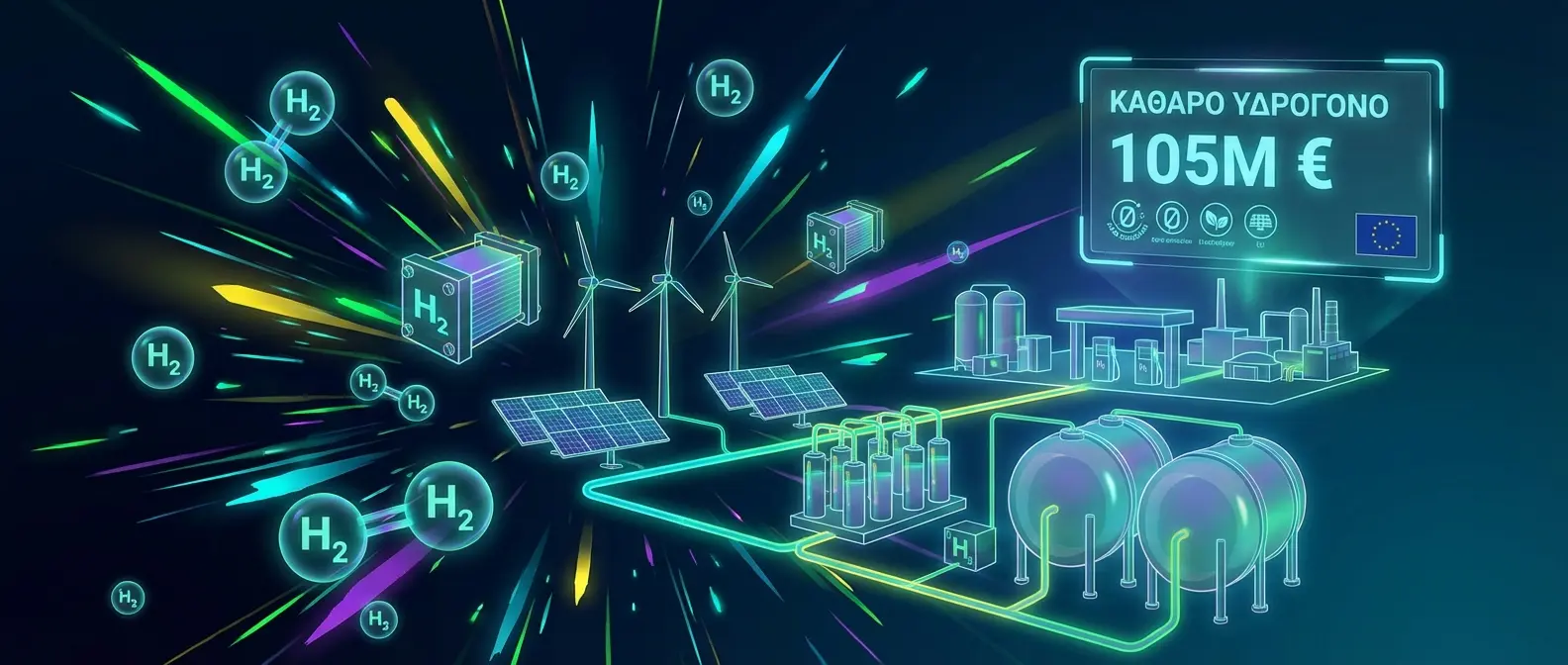
Hydrogen has been considered the “fuel of the future” for decades, but until recently its production remained expensive and energy-intensive. In 2026, the European Union is throwing its weight behind green hydrogen, announcing funding of €105 million through the Clean Hydrogen Joint Undertaking programme. The goal? To make Europe a global leader in the hydrogen economy—a bet that is both environmental and geopolitical.
📖 Read more: Dodecanese Interconnection: When Does Energy Isolation End?
❓ Why Hydrogen Is So Important
Climate change demands a radical shift in how we produce and consume energy. While electric vehicles and renewable sources (solar, wind) cover a large part of our needs, there are sectors that are difficult to electrify: heavy industry (steel, cement, chemicals), maritime transport, aviation, and large-scale energy storage.
Hydrogen offers a solution to all of these. When burned or used in fuel cells, it produces only water as a byproduct—zero CO₂ emissions. Additionally, it can be stored for long periods, making it ideal for balancing the fluctuations of renewable energy sources (e.g. when there is no wind or sunshine).
💡 Did You Know...
1 kg of hydrogen contains three times the energy of 1 kg of gasoline. This high energy density makes it attractive for applications where weight is critical (aircraft, long-haul trucks).
💡 The “Colours” of Hydrogen
Not all hydrogen is the same. The industry uses a “colour” system to distinguish the different production methods, depending on their environmental footprint:
⬛ Grey Hydrogen
Produced from natural gas through steam reforming. It is the cheapest method but emits significant amounts of CO₂. Today it accounts for 95% of global hydrogen production.
🔵 Blue Hydrogen
A similar process to grey, but with carbon capture and storage (CCS). It reduces emissions by 85-95%, but still relies on fossil fuels and requires expensive carbon storage infrastructure.
🟢 Green Hydrogen
Produced through water electrolysis using 100% renewable energy. Zero CO₂ emissions. This is the hydrogen the EU is targeting and forms the core of the 2026 funding.

📌 The Clean Hydrogen Joint Undertaking Programme
The Clean Hydrogen JU is a public-private partnership between the European Commission and the hydrogen industry. Founded in 2021 as the successor of FCH JU (Fuel Cells and Hydrogen), it has a budget of approximately €1 billion for the 2021-2027 period.
The 2026 call focuses on three key pillars:
Next-Generation Electrolysers
Development of high-efficiency electrolysers at lower cost. The goal is to reduce the cost of green hydrogen production below €2/kg by 2030— down from today's €4-6/kg. Research includes PEM, SOEC, and alkaline electrolyser technologies.
Storage and Transport
Hydrogen is the lightest element in the universe, which makes it difficult to store and transport. The funding covers research into high-density storage materials, hydrogen pipelines, and the conversion of existing natural gas networks.
End-Use Applications
Pilot projects for using hydrogen in industries (steelworks, chemicals), heavy vehicles (buses, trucks, trains), and building heating. Particular emphasis is placed on "Hydrogen Valleys"—regions with an integrated value chain.
🇪🇺 Major Hydrogen Projects in Europe
The Clean Hydrogen funding complements the already existing major hydrogen projects being implemented across Europe. Here are some of the most ambitious:

ℹ️ Greece's Position on the Hydrogen Map
Greece has significant potential for green hydrogen production, thanks to its abundant sunshine and strong winds. The National Hydrogen Strategy sets a target of 1 GW production capacity by 2030.
White Dragon
A project in Western Macedonia for green hydrogen production and the gradual transition of the region away from lignite. It combines photovoltaics, electrolysers, and use in local industries.
Green HIPo
A partnership for green hydrogen in the Epirus Region, targeting maritime and sea transport. The strategic location of Igoumenitsa as a gateway to Italy makes the project particularly attractive.
💡 The Challenges That Remain
Despite the optimism, the transition to a hydrogen economy faces serious obstacles:
- Cost: Green hydrogen is still 2-3 times more expensive than grey. Massive investments in renewable sources and electrolysers are needed.
- Infrastructure: Europe needs thousands of kilometres of hydrogen pipelines. Converting existing natural gas networks is possible but complex.
- Efficiency: The hydrogen production-storage-use chain has energy losses at every stage. Overall, only 25-35% of the original energy is utilised.
- Competition: Other technologies (batteries, direct electrification) are evolving rapidly and may prove more effective in certain applications.
📡 The Future: Predictions for 2030 and Beyond
According to REPowerEU, Europe aims to produce 10 million tonnes of green hydrogen within the EU and import another 10 million tonnes by 2030. This will require investments in the range of €300-400 billion.
📊 Estimates for 2030
🎯 Conclusion
The €105 million funding through Clean Hydrogen JU represents yet another step in the European hydrogen strategy. It is not a panacea—hydrogen will not replace everything—but it is a critical piece of the decarbonisation puzzle.
For Greece, participation in this technological revolution is an opportunity: to harness its sunshine and wind, create jobs in the green economy, and establish itself as an energy hub in Southeast Europe.
OnOff Team
The OnOff.gr team follows developments in green energy and technologies shaping the future.