


Barcelona once again hosted the world's biggest mobile technology expo. From March 2 to 5, 2026, MWC at Fira Gran Via became a playground for gadgets that surprise, provoke, or simply don't make sense yet — and that's precisely what makes them interesting.
🤖 Honor Robot Phone: A Smartphone That Moves
Honor decided smartphones don't move enough. The result? A phone with a motorized gimbal camera that unfolds, looks around, and danced to Imagine Dragons on stage at MWC. Beyond the spectacle, the 200MP camera promises video stabilization that would rival a professional gimbal. Honor says it will ship sometime in 2026, though pricing remains unknown. And the Robot Phone isn't just a gadget play — Honor simultaneously announced it's developing a humanoid robot for household tasks, a striking pivot for a smartphone manufacturer.
📱 Xiaomi 17 Ultra & Leica Leitzphone
Xiaomi keeps pushing mobile photography boundaries. The Xiaomi 17 Ultra features a 1-inch sensor, Snapdragon 8 Elite Gen 5, a 6,000 mAh battery, and a 200MP Leica camera system. The special Leitzphone edition takes things further: redesigned industrial aesthetics with Leica's iconic red dot, software tuned by the German firm, and a rotating camera ring that controls zoom, focus, and more. The Verge's reviewer described it as a “top-tier fidget spinner” thanks to its exceptional haptics. European pricing starts at around €1,399 — expensive, but this is closer to a camera than a phone.
📸 Fun Fact: Xiaomi also unveiled an ultra-thin 5,000 mAh power bank that's just 6mm thick, weighs 98 grams, and costs €59.99. Want it in orange? That'll be an extra €5.

🎮 Lenovo Legion Go Fold
Gaming handhelds keep getting wilder. Lenovo showcased the Legion Go Fold, a concept with an 11.6-inch foldable display. It folds in half like a book, has detachable controllers, and can be used in modes nobody asked for but everyone wants to try. It runs Windows, meaning access to Steam, Game Pass, and every PC title without emulation. Build quality impressed at hands-on demos, though weight and foldable panel durability remain open questions. No release date — this is still firmly in concept territory.
💎 Honor Magic V6: Thinner, Tougher
The thinnest foldable ever. That's Honor's claim for the Magic V6, and the numbers back it up. With a record-setting 6,660 mAh battery (the largest in any foldable to date), Snapdragon 8 Elite Gen 5, and a 7.95-inch inner display, it's an impressive package. What truly stands out? The IP69 rating — a first for any foldable. That means resistance to high-pressure water jets and dust, something no other folding phone can claim. Pricing starts at €699.99 for Honor's MagicPad 4 tablet, while the V6 foldable slots above that.

⌚ Qualcomm Snapdragon Wear Elite
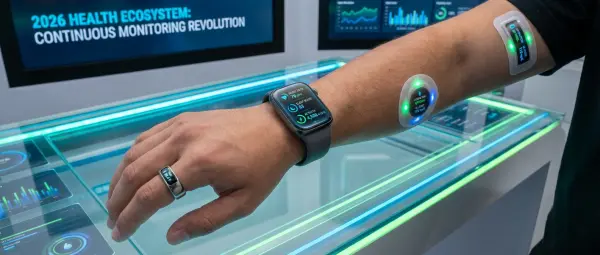
Qualcomm brought the Elite branding to wearables. The new Snapdragon Wear Elite promises on-device AI for smartwatches and wearable gadgets. For the first time, a wearable chip can run local AI models without cloud connectivity. This means faster voice assistant responses, more accurate health tracking, and — theoretically — a smartwatch that doesn't need your phone for basic AI functions. First devices are expected by late 2026.
🔥 The Remaining Highlights
The action didn't stop there. Motorola impressed with the new Razr Fold, whose screens (inner and outer) are brighter than any competitor by a significant margin. Tecno showcased an ultra-thin modular concept phone with no wired charging port at all. Vivo dropped the X300 Ultra with a 400mm Zeiss telephoto lens — the most ambitious smartphone photography system we've seen.
Lenovo wasn't done with the Legion Go Fold. The AI Workmate, a desk robot with an articulated arm, puppy dog eyes, and an Intel Core Ultra processor, can digitally sign documents, project presentations via a built-in Pico projector, and probably annoy your co-workers. The same company showed a modular AI PC concept with hot-swappable ports — think Framework laptop, but with dual screens.
📊 What This Means for Consumers
MWC 2026 marks three trends. First, foldables are becoming serious tools — thinner, tougher, with batteries that actually last. Second, AI isn't just about chatbots anymore. It's in chips, wearables, office robots, and gaming handhelds. Third, mobile photography is dangerously close to dedicated cameras — especially with 1-inch sensors and partnerships like Leica-Xiaomi and Zeiss-Vivo.
If you're in the market for a new device this year, the choices have never been more interesting. Just wait for the hands-on reviews before hitting that buy button.