

Nokia is changing strategy and betting everything on AI-driven networking. Future networks won't need manual configuration — they'll optimize themselves in real time. The Finnish company just unveiled the new era of telecommunications.
📖 Read more: SES Launches Revolutionary mPOWER Satellites in 2026
🤖 What Is AI-Native Networking
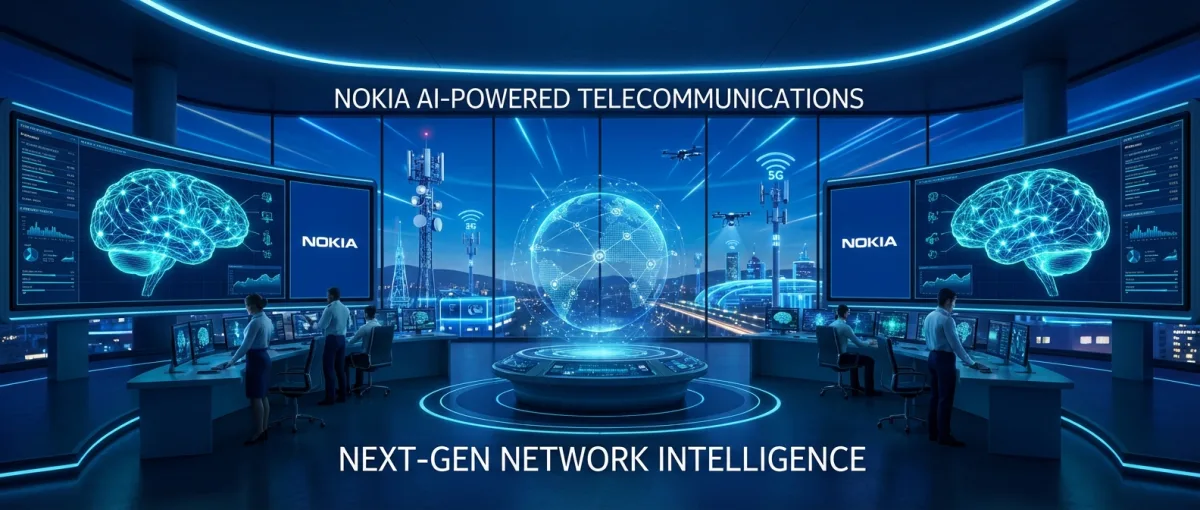
Nokia presented at MWC 2026 the “AI-Native Network Platform,” a system using AI at every network level. Instead of engineers manually configuring thousands of antennas and routers, AI takes over: predicting traffic congestion, redistributing bandwidth automatically, and detecting problems before they appear.
The platform integrates machine learning models trained on data from over 200 networks worldwide. It can minimize dropped calls by 60%, improve data speeds by 35%, and reduce network energy consumption by 25% — without new hardware.
📖 Read more: Subsea Data Cables: 7 New Systems by 2027
📡 Why the Industry Needs AI
Modern telecom networks are incredibly complex. An average provider manages millions of parameters: antenna coverage, traffic routing, interference management, power optimization. Complexity increases exponentially with 5G and the upcoming 6G. Human engineers simply cannot optimize these networks in real time.
Nokia isn't alone. Ericsson presented a similar system, Huawei the same (in Asian markets), and Samsung Networks is preparing its own. The industry is moving unanimously — “smart” networks are no longer a luxury but a necessity.
📖 Read more: AST SpaceMobile: Satellite Direct to Phone

🌍 What This Means for Users
For end users, AI-native networking translates to fewer dead zones, faster 5G in densely populated areas, and better experience at concerts, stadiums, and public transport — spaces where networks currently crash due to overload. The change will be invisible but profound.
📖 Read more: eSIM in Europe: Why Switching Carriers Gets Easier in 2026
💡 Key point: AI doesn't replace telecom engineers — it upgrades them. Instead of manual tuning, they oversee AI. Nokia estimates one engineer with AI tools can manage 10 times more antennas than before.
🔮 6G and AI: The Road Ahead
Nokia is already working on 6G, expected around 2030. 6G networks will be AI-native from inception — AI won't be “added” to 6G, it will be part of the fundamental architecture. Terabit speeds, sub-millisecond latency, and holographic communication — all based on AI self-optimization.