

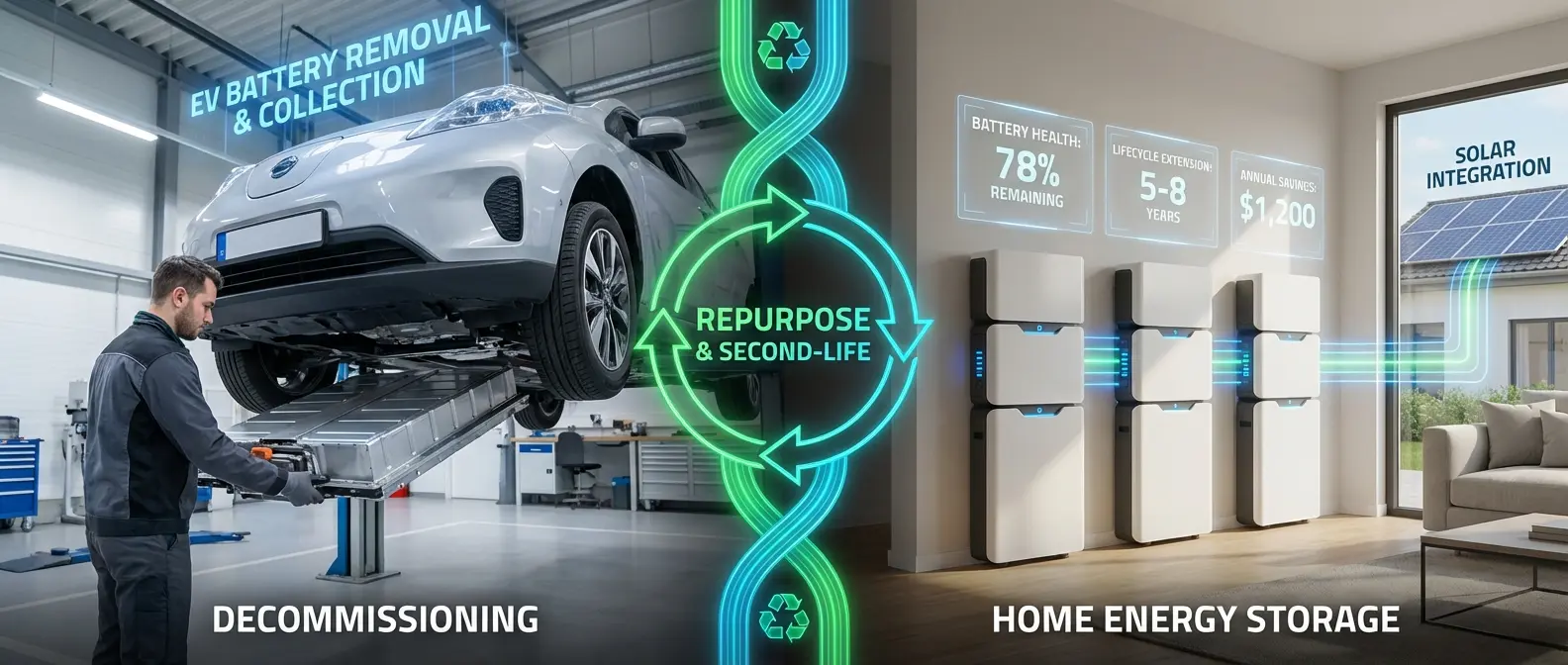
Every year, thousands of electric vehicles in Greece reach the point where their batteries can no longer deliver the required driving range. But these “tired” batteries still retain 70-80% of their original capacity — too little for a car, but more than enough to power a home for years. Welcome to the era of second-life batteries.
♻️ From the Road to the Home: A Circular Economy
The idea is simple yet revolutionary. The lithium-ion batteries that power electric vehicles are designed for the extreme demands of driving: rapid discharges, high temperatures, and thousands of charge cycles. When their capacity drops to 70-80%, they are considered unsuitable for cars — the range is no longer acceptable.
But for a home energy storage system, the requirements are much lower. There is no need for rapid discharge, no temperature issues, and the cycles are fewer. A “used” car battery can continue operating in a home for another 8-12 years.
70-80%
Remaining capacity
8-12 years
Additional lifespan
50-60%
Lower cost vs. new batteries
🔋 The Journey of a Second-Life Battery
The process begins when an electric vehicle is retired or upgraded. The battery — typically a pack containing hundreds of cells — is removed and transported to a specialized processing center. There, technicians test each cell individually: capacity, internal resistance, and temperature history.
The cells that pass inspection are regrouped into new packs, adapted for residential use. A new Battery Management System (BMS), inverter, and safety system are added. The final product is a complete storage system, ready to be connected to solar panels or the grid.
🔬 The Science Behind the Selection
Each lithium-ion cell is evaluated through State of Health (SoH) testing. Cells with an SoH below 65% are rejected and sent for recycling. The remaining ones are sorted by capacity and resistance — it is critical to match similar cells for optimal performance and safety.

🇬🇷 The Greek Market in 2026
Greece is making a dynamic entry into the second-life battery market. With over 45,000 electric vehicles on the road and numbers doubling every 18 months, the supply of “tired” batteries is growing. At the same time, the explosive growth of solar panels is creating massive demand for home energy storage.
🏭 GreenPower Solutions
A Greek startup that partners with car dealerships to collect batteries. They offer 5-15 kWh systems with a 5-year warranty. Prices from €2,500 for 5 kWh — nearly half the price of new batteries.
⚡ ReVolt Energy
Based in Thessaloniki, they specialize in batteries from Nissan Leaf and Tesla Model S. They also offer a rental service: €35/month for a 10 kWh system, ideal for those who want to avoid upfront costs.
🔄 Renault Greece
Renault offers an official “Second Life” program for Zoe and Kangoo batteries. Certified systems with full manufacturer warranty. Ideal for those who want the reassurance of a major brand.
The market is expected to triple by 2028, as the first wave of electric vehicles sold between 2018-2020 reaches the end of their first life. This will bring an abundance of batteries to the market and further price drops.
💰 Why Choose a Second-Life Battery
The first and most obvious advantage is cost. A 10 kWh system with new batteries costs €5,000-8,000. With second-life batteries, the price drops to €2,500-4,000. For a Greek family looking to maximize their solar panels, this difference can mean a payback period of 3-4 years instead of 6-8.
But beyond the financial aspect, there is also the environmental benefit. Manufacturing new lithium-ion batteries requires mining rare metals (lithium, cobalt, nickel), enormous amounts of water and energy. By giving existing batteries a second life, we reduce the demand for new production and delay recycling — which is itself an energy-intensive process.
💵 Savings
50-60% lower cost than new batteries
🌍 Environment
70% reduction in carbon footprint
⏱️ Longevity
8-12 years of additional operation
🔒 Reliability
Proven automotive-grade technology

🏠 Practical Applications
The most common use is in combination with residential solar panels. During the day, the panels generate electricity that is stored in the battery. In the evening, the family consumes the stored energy instead of buying from the grid. For a typical Greek home, a 10 kWh system comfortably covers evening needs.
The Papadopoulos family in Glyfada installed a 13 kWh system with Nissan Leaf batteries last year. “Our electricity bill dropped from €180 to €35 per month,” says Mr. Papadopoulos. "And in the summer, with the solar panels and battery, we are almost completely self-sufficient."
But the applications don't stop at homes. Small businesses use second-life batteries for peak shaving — storing energy at night (when electricity is cheap) and using it during peak hours. Farmers install systems in remote barns for irrigation without a grid connection. Even telecommunications companies use second-life batteries as backup for cell towers.
⚠️ What to Watch Out For
As with any market, there are risks. First, quality varies. A battery from a car that was mistreated (fast charging, extreme temperatures) will have a shorter lifespan than one that was used gently. Always ask for the battery's history and SoH test results.
Second, the warranty. Reputable suppliers offer at least 3-5 years of warranty. If someone offers only 1 year or none at all, that's a red flag. Also, make sure the warranty covers the electronics (BMS, inverter), not just the cells.
🚫 Avoid
- Suppliers without a physical presence in Greece
- Systems without CE certification
- Batteries without history or test results
- Excessively cheap prices (below €200/kWh)
🏛️ Subsidies and Legal Framework
The Greek government recognizes the importance of home energy storage. The "Save Energy – Store Energy" program subsidizes the purchase of storage systems up to 50% for residential consumers and 40% for businesses. The maximum subsidy amount is €3,000 for households and €10,000 for businesses.
Important: the subsidy also applies to second-life batteries, provided they meet safety criteria (CE certification, certified BMS). This means you can acquire a 10 kWh system for an actual cost of under €1,500 — an investment that pays for itself in 2-3 years.
📋 Steps to Get the Subsidy
- Register on the exoikonomo.gov.gr platform
- Submit a quote from a certified installer
- Application approval (15-30 days)
- Installation and inspection
- Subsidy disbursement
🔮 The Future: 2027 and Beyond
The second-life battery market is still in its infancy but growing rapidly. As millions of electric vehicles worldwide reach the end of their first life, the supply will increase dramatically. Prices are expected to drop by 30-40% by 2028.
At the same time, the technology is improving. New AI systems can accurately predict the remaining lifespan of each cell. Standardization is increasing, making the process more reliable. And major car manufacturers — Tesla, VW, BMW — are developing their own second-life programs, lending credibility to the market.