

SES, one of the world's largest satellite operators, announced the most ambitious launches of the decade. With the mPOWER fleet and new-generation MEO satellites, the company targets global satellite broadband. What does this mean for telecommunications?
📖 Read more: Greek Microsatellite in Orbit: Where It Will Be Used
🛰️ The mPOWER Fleet
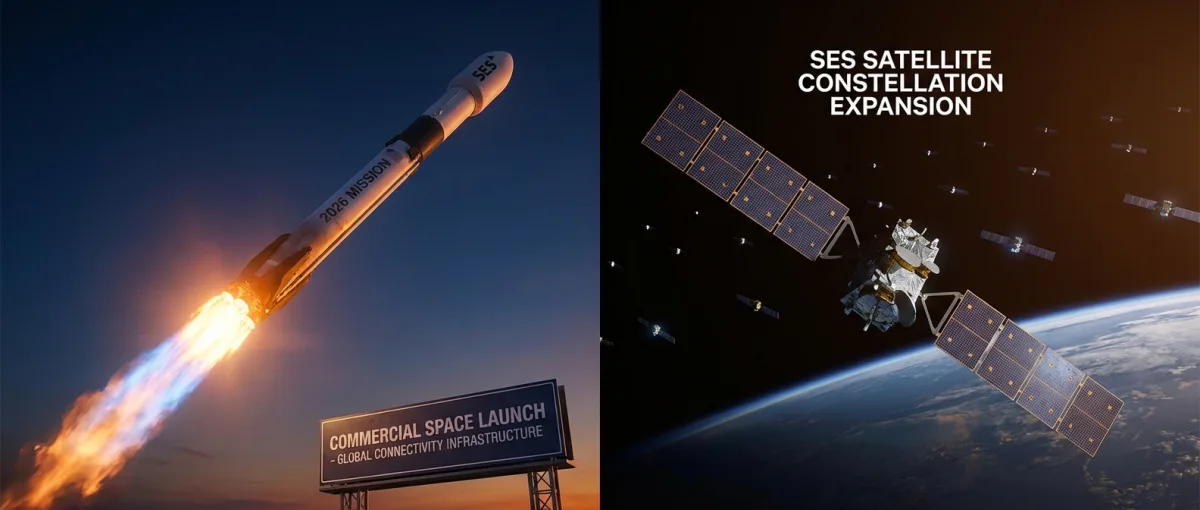
SES launched 4 new SES-17 mPOWER satellites in February 2026, reaching 11 in MEO (Medium Earth Orbit). The mPOWER satellites operate at 8,000km altitude — much lower than traditional GEO and higher than LEO (Starlink). This “golden middle” offers low latency (150ms) with wide coverage.
Each mPOWER satellite can create over 5,000 programmable beams, dynamically adjusting capacity based on demand. If an area suddenly needs more bandwidth — due to natural disaster or large event — the satellite automatically “steers” beams there.
📖 Read more: Nokia AI Network: A New Telecom Era
✈️ Applications: Beyond Internet
SES doesn't target individual users primarily. Key customers are airlines (in-flight WiFi), cruise ships, military forces, and governments. The O3b mPOWER (MEO constellation) is already used for government networking in the Pacific, healthcare facilities in Africa, and offshore oil platforms.
The new SES-Emirates Airlines deal will deliver 100 Mbps to every aircraft — enough for 4K streaming at 30,000 feet. 5G backhaul networks in rural areas and maritime connectivity complete the plan.
📖 Read more: AST SpaceMobile: Satellite Direct to Phone

⚔️ SES vs Starlink: Different Philosophy
While Starlink bets on thousands of small LEO satellites, SES uses fewer but much more powerful MEO satellites. Starlink advantage: ultra-low latency (20ms). SES advantage: stability, enterprise-grade reliability, and avoiding space debris issues. If Starlink is “budget airline,” SES is “business class.”
📖 Read more: Subsea Data Cables: 7 New Systems by 2027
💡 Interesting: SES has a fleet of 70+ GEO and 11 MEO satellites — but only the new-gen mPOWER ones count in the new era. The company is spending €3.5 billion for full modernization by 2028.
🔮 What Follows
By end of 2027, SES plans to complete the full mPOWER fleet (20 satellites). This will provide global MEO coverage without gaps. For Europeans, it means satellite broadband as backup/alternative to terrestrial networks — especially important during crises.