

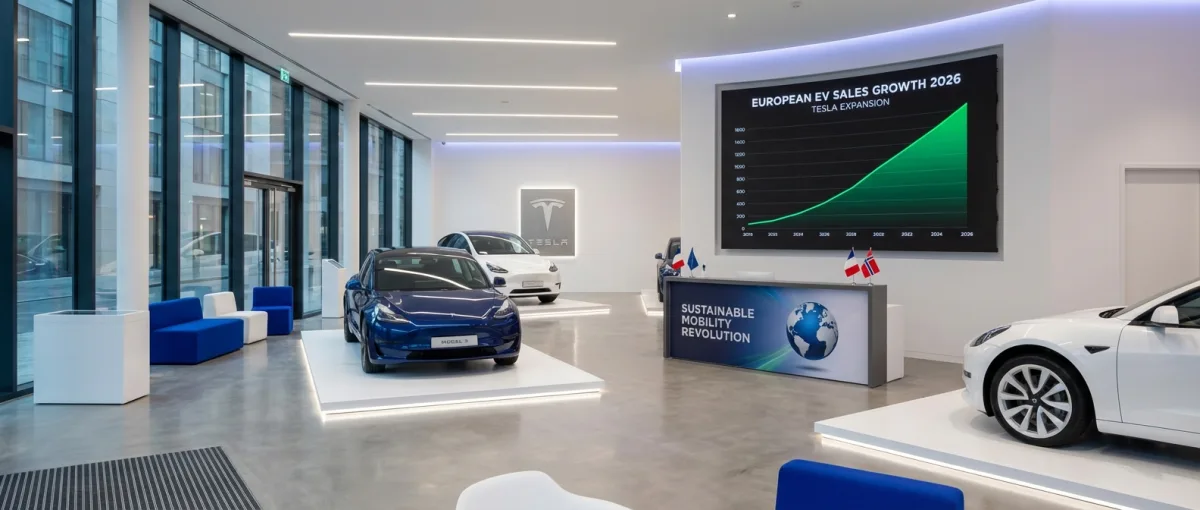
After two straight years of declining sales, Tesla is showing signs of recovery across Europe. February 2026 registration data reveals impressive gains in several markets — but the full picture is more complicated than the headlines suggest.
📖 Read more: eSIM in Europe: Why Switching Carriers Gets Easier in 2026
🔴 What the Numbers Show
In February 2026, Tesla posted registration gains across key European markets. According to official data reported by Reuters on March 2, 2026, here's how it broke down:
In France, registrations jumped 55% year-on-year — while most competitors actually sold fewer cars than a year ago. In Spain, the surge was even more dramatic: 73.7%, amounting to 1,595 vehicles in February alone. Over the January-February period, Tesla sales in Spain soared 72.9% compared to the same period in 2025, according to ANFAC data.
Portugal stood out even more — registrations there more than doubled compared to February 2024.
In Norway, a market with deep EV adoption, registrations rose 32%. Belgium saw a 14% bump. The trend seems clear — after the freefall of 2024-2025, Tesla is stabilizing.
📖 Read more: Amazon $21B Data Centers in Spain
📉 Not Every Market Tells the Same Story
The numbers, however, aren't uniformly positive. And that's where things get interesting.
In the Netherlands, Tesla registrations dropped 45%. Forty-five percent. In Denmark, the decline was 18%, and in Italy it was -7%. These aren't minor markets, and the fact that Tesla is losing ground there suggests the recovery is far from universal.
Data from Germany and the UK — Europe's two largest car markets — is expected later in March. Those numbers will determine whether this is a genuine turnaround or simply favorable optics from smaller markets.
📖 Read more: Apple Touchscreen MacBook: What We Know
⚠️ Key figure: Tesla's market share in the EU, UK, and EFTA slipped to 0.8% in January 2026, down from 1% in the same month of 2025. That's still far below its 1.8% share in 2025, 2.5% in 2024, and 2.9% in 2023 — when the Model Y was the world's best-selling car.

🔧 Why Are Sales Picking Up Now?
Three main factors explain this gradual comeback.
First, cheaper models. Last year, Tesla introduced more affordable versions of the Model Y and Model 3 in the US and Europe. Deliveries began in late 2025, and the impact is now showing up in the numbers. The base Model 3 in Europe now starts at around €38,000, making it significantly more competitive against the VW ID.3 and BYD Seal.
📖 Read more: Stablecoin Payments: Without Banks in 2026
Second, a refreshed lineup. The updated Model Y ("Juniper"), which rolled out in late 2025, brings an improved interior, longer range, and exterior design that addresses long-standing criticisms. For many European buyers who were waiting, this was the trigger.
Third, government incentives. Countries like France and Spain maintain strong EV purchase subsidies. Spain's MOVES III program offers up to €7,000 toward an EV, effectively cutting Tesla's sticker price by a significant margin.
🌍 Chinese Competition Isn't Slowing Down
Tesla's European recovery isn't happening in a vacuum. Chinese brands like BYD, MG (SAIC), and NIO are aggressively expanding their presence. BYD alone sold over 20,000 cars in Europe in January 2026, nearly tripling its 2024 figures.
📖 Read more: IRIS: New Limits & What They Mean for Professionals
The EU is also preparing “Made in EU” rules for vehicles, which could limit Chinese imports but also create compliance costs for Tesla's Gigafactory Berlin-Brandenburg output.
"Tesla gained market share in key European markets in February, signalling some stabilisation on the continent after two straight years of declining sales."
— Reuters, March 2, 2026🔮 What's Next
The coming months will reveal whether this recovery is real or a statistical artifact of low comparison baselines. Germany and UK data will be decisive.
Beyond new models, Tesla is expanding European manufacturing — the Gigafactory Berlin is ramping production, and battery expansion plans in Spain are in the works. But competition is fierce. Affordable Chinese EVs, VW's ID. lineup, and the new Renault 5 E-Tech all target the same buyer.
One thing is certain: the era when Tesla dominated Europe's EV conversation is over. Now it has to earn every sale. The February numbers suggest that, at least in some markets, it's doing exactly that.