

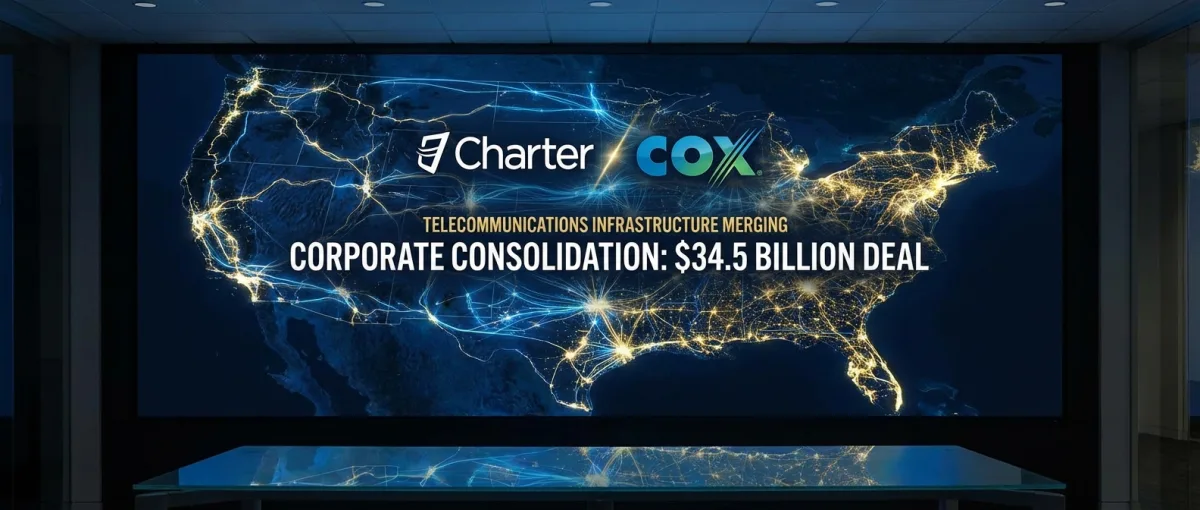
The American telecom market is preparing for its biggest shake-up in decades. Charter Communications and Cox Communications have announced a merger valued at $34.5 billion, creating a telecom giant serving over 35 million homes across the United States.
📖 Read more: Clean Hydrogen 2026: EU Invests €105M in Green Technologies
📡 What's Happening
Charter, the parent company of Spectrum, is acquiring Cox in a deal that reshapes the broadband landscape. Cox, a family-owned company for generations, was the fourth-largest cable internet provider in the US. After the merger, the new Charter will compete directly with AT&T, Comcast, and T-Mobile at the national level.
The deal includes Cox's fiber networks, mobile services, and commercial broadband operations across 18 states. For Cox subscribers, the change will be gradual — initially, nothing changes in day-to-day service.
📖 Read more: Cloud Security 2026: The 7 Settings You Must Check
💰 Why Now
The US broadband market faces pressure from multiple directions. Mobile carriers (T-Mobile, Verizon) offer 5G Home Internet at increasingly lower prices. Google Fiber is expanding into new cities. And Starlink brings broadband to areas where cables never reached.
For Charter, acquiring Cox means greater scale — economies of scale in bandwidth, equipment, and mobile sales. Cox, for its part, brought strong fiber networks in cities like Atlanta, Las Vegas, and San Diego.

🇪🇺 What It Means for Europe
The concentration of the American market into fewer players is closely watched by European regulators. The EU, having just passed the Digital Markets Act, fears that mega-merger models will inspire similar moves in the European market. Already, Vodafone and Three UK completed their own merger, while Orange and MasMovil united in Spain.
📖 Read more: Cyber Resilience Act: Greek Companies Affected in 2026
For European consumers, the story carries a lesson: in markets that consolidate, prices rarely fall. Greece, with four providers (Cosmote, Vodafone, Nova, Cyta), still lives in a relatively competitive landscape — but the global trend points toward fewer players.
⚖️ Approvals and Obstacles
The deal still needs regulatory approval from the FCC and the Department of Justice. Approval isn't guaranteed. The FCC is examining whether the consolidation will reduce competition at the local level. Rival providers have already raised concerns — particularly smaller companies that depend on Charter or Cox networks for wholesale access.
Analysts estimate the merger will close within 2026, if no serious regulatory objections arise. If approved, it would be the largest telecom deal in the US since the T-Mobile/Sprint merger in 2020.