

The Holy Grail of Wearable Technology
Non-invasive blood glucose monitoring via a smartwatch is perhaps the most anticipated health technology innovation. Apple has been working on it for over a decade. How close are we really in 2026?
📖 Read more: Apple Watch Redesign 2028: Why It's Delayed
Every year, the rumors resurface: “This year it will have blood sugar monitoring!” And every year, the Apple Watch gains new health features — but not that one. The truth is that non-invasive glucose monitoring is one of the most difficult technical challenges in modern biotechnology, and the solution isn't as close as many believe.
In this article, we examine: what exactly “non-invasive glucose monitoring” means, what technologies Apple is testing, where the competition stands, what the enormous challenges are, and when we can realistically expect this feature on our wrist.
Why It Matters So Much
Globally, 537 million people live with diabetes (IDF Atlas 2021), a number expected to reach 783 million by 2045. Today, to measure your blood glucose you need:
The Market in Numbers
The global CGM market is estimated at $15.2 billion (2025) and expected to reach $32 billion by 2030. The non-invasive market? If someone cracks it, estimates suggest it will exceed $50 billion. That's why Apple, Samsung, Google, and dozens of startups are investing enormous amounts.
Apple and "Project E5″
Apple has been working on non-invasive glucose monitoring since 2010, long before the first Apple Watch launched (2015). The journey has been full of pivots, setbacks, and important milestones:
The Beginning of Research
Steve Jobs, who was facing serious health issues, inspired the creation of a health-focused project. Apple begins exploring biosensors.
RareLight Acquisition
Apple acquires RareLight, a company specializing in Raman spectroscopy. The technology can theoretically detect glucose molecules through the skin.
Secret Team in Silicon Valley
Apple creates a secret team (200+ engineers) in a separate building. Tests with optical sensors, studies on hundreds of volunteers. The results? Mediocre accuracy, many interference factors.
🔬 Breakthrough — Proof of Concept
According to Mark Gurman (Bloomberg), Apple achieves a major milestone: a proof-of-concept system the size of an iPhone that can measure glucose without pricking the skin. The problem: it's still too large for a watch.
🏗️ Miniaturization — Chip-level Integration
Apple is working on shrinking the sensor to chip level. A new patent reveals a system with multiple short-wave infrared (SWIR) LEDs of various wavelengths, small enough to potentially fit inside a watch.
Clinical Trials — Phase I
Reports indicate Apple is launching pilot clinical trials on a small number of participants. Health VP Sumbul Desai states that these are “very important areas, but they require a lot of science behind them.”
Where We Stand Today
The Apple Watch Series 11, Ultra 3, and SE 3 do not include a glucose sensor. Apple continues internal testing, but commercial release remains years away — most likely after 2028.
The Technologies Behind the “Impossible”
Why can't you simply shine a light on the skin and measure glucose? The answer is that glucose exists in extremely low concentrations in the blood (normally 4–7 mmol/L) and its optical signals are “drowned out” by thousands of other molecules. The main technologies:
Optical Absorption Spectroscopy
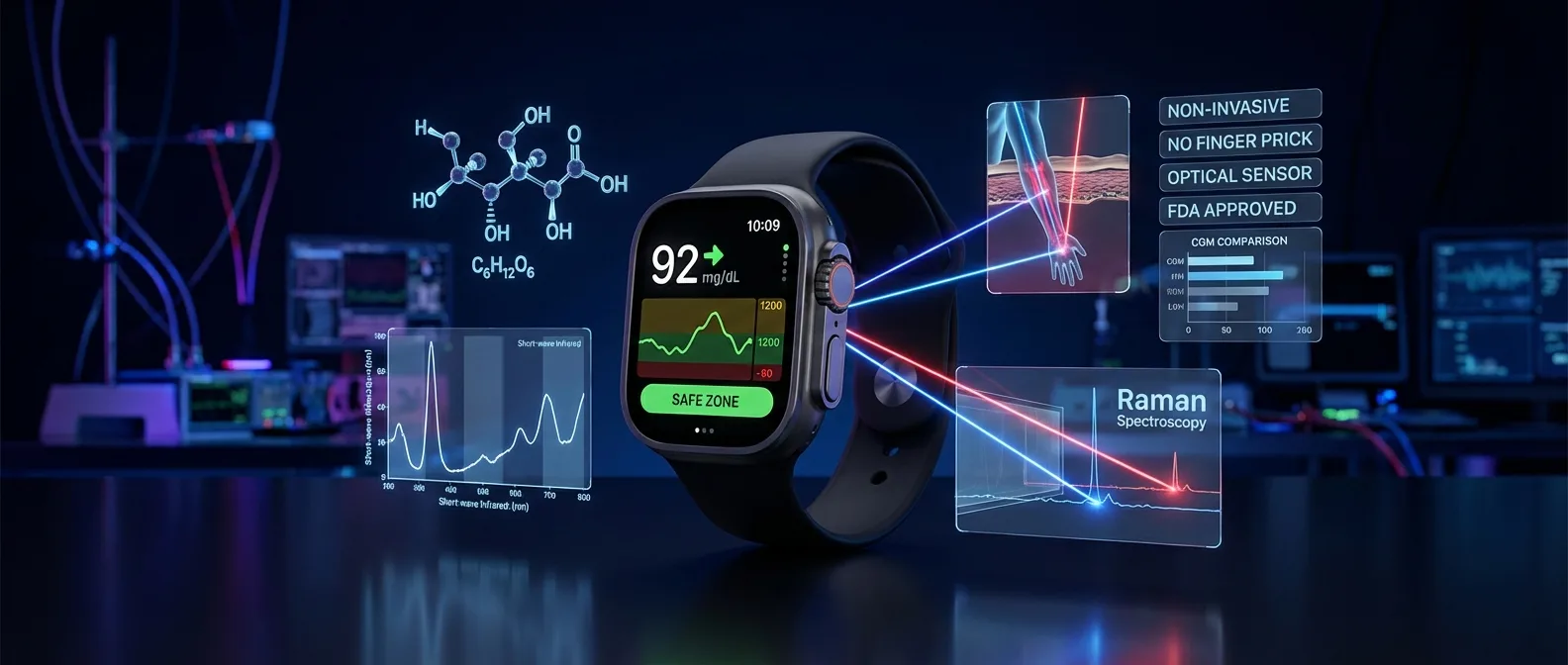
The most likely technology Apple is pursuing. Uses short-wave infrared (SWIR) light that passes through the skin. Glucose absorbs specific wavelengths (~1550–2300nm). Problem: water, hemoglobin, and fats absorb at similar wavelengths.
Raman Spectroscopy
Laser light scattering for identifying molecular “fingerprints.” Highly accurate in the lab, but requires a powerful laser and large detectors. Apple acquired RareLight (Raman specialists) in 2014. Miniaturization = enormous challenge.
Radio Frequencies (RF)
Radio frequency waves penetrate the skin and measure changes in the dielectric constant caused by glucose. Used by some startups. Advantage: smaller components. Disadvantage: lower accuracy.
Photoacoustic Spectroscopy
Light pulses heat glucose molecules → creating microscopic sound waves → detected by piezoelectric sensors. High accuracy in the lab, but requires an extremely quiet environment. Challenging on the wrist of a person in motion.
Sweat / Interstitial Fluid
Measuring glucose through sweat or interstitial fluid (without a needle). Uses microscopic microneedles or reverse iontophoresis. Samsung has a patent for this type. Decent accuracy, but a 10–15 minute lag compared to blood.
AI/ML Fusion
Combining multiple sensors (PPG, temperature, SpO2, accelerometer) + machine learning to “predict” glucose. Doesn't measure glucose directly, but recognizes patterns. Low accuracy, but already used in some wearables.
The Accuracy Problem
A glucose sensor is useless if it isn't accurate. In medicine, accuracy is measured using the Clarke Error Grid, which is divided into zones:
| Zone | Significance | FDA Requirement | Current CGMs | Non-invasive |
|---|---|---|---|---|
| Zone A | Clinically accurate (±20%) | ≥95% | 95-99% | 60-80% |
| Zone B | Clinically acceptable | ≥99% (A+B) | 99-100% | 85-95% |
| Zone C-E | Dangerous — wrong decisions | <1% | <1% | 5-15% |
Why Accuracy Is Critical
An incorrect reading could lead a diabetic to an incorrect insulin dose — with potentially fatal consequences (hypoglycemia). That's why the FDA demands extremely high accuracy, and why Apple isn't rushing: a flawed feature could literally kill people.
The 6 Biggest Challenges
🔴 Signal-to-Noise Ratio
Glucose makes up only 0.1% of molecules in the blood. Its optical signal is “drowned out” by water, hemoglobin, fats, and melanin. It's like trying to hear a whisper at a rock concert.
🔴 Skin Color
Melanin dramatically affects light transmission. A sensor must work equally accurately across all skin tones — something that hasn't been achieved satisfactorily.
🔴 Temperature & Sweat
Skin temperature changes the optical properties. Sweat creates interference. Dehydration alters the composition of interstitial fluid. Each factor = less accuracy.
🔴 Motion (motion artifacts)
A user who is running, writing, or simply moving their wrist creates artifacts in the optical signal. Current CGMs solve this by placing the sensor under the skin — a luxury a watch doesn't have.
🔴 FDA / CE Approval
Even if the technology works, regulatory approval requires 2–5 years of clinical trials. Apple must prove accuracy across thousands of patients, different demographics, over extended time periods.
🟢 Battery (solved)
SWIR LEDs consume significant energy. The new Apple Watch (Ultra 3) has enough battery for periodic measurements, but not for continuous monitoring. This is acceptable — even sporadic measurements would be revolutionary.
What the Competition Is Doing
Apple isn't the only one chasing this “Holy Grail.” Let's see where the major players stand:
Proof-of-concept (2023), miniaturization in progress, pilot clinical trials. Estimated release: 2028–2030. Technology: Optical SWIR absorption.
Partnership with MIT and Samsung Advanced Institute of Health Sciences. Raman spectroscopy on Galaxy Watch prototype. Patent for microneedle interstitial fluid sensor. Estimated release: 2027–2029.
Patents for bioimpedance glucose sensing. Google had abandoned its smart contact lens project (2018). Now focusing on a wrist-based sensor for Pixel Watch. Less advanced than Apple & Samsung.
The CGM giants. Abbott is preparing a “skin-worn patch” without a needle (Lingo). Dexcom is researching non-invasive. Their advantage: they already know the FDA regulatory process.
Welsh startup with a microscopic skin patch. RF-based glucose measurement. Clinical trials in progress. One of the most promising small companies in the field.
British company that partnered with Apple (rumored). Photonic chip with multiple biomarkers (glucose, lactate, alcohol). Facing financial difficulties, but its technology is considered very advanced.
What You Can Do Today with Apple Watch
The Apple Watch doesn't measure glucose, but it can already help with diabetes management:
Connect CGM via Apps
Apps like Dexcom G7, Abbott Libre 3, Sugarmate display CGM readings directly on your Apple Watch. Complications on the watch face, high/low glucose alerts, trends.
Heart Rate & HRV
Hypoglycemia causes elevated heart rate. The Apple Watch can detect anomalies in HR & HRV that correlate with glycemic changes.
Activity Tracking
Exercise affects glucose levels. Accurate activity tracking (intensity, duration, type) helps with blood sugar management in combination with CGM data.
Sleep Tracking
Poor sleep raises fasting glucose. Sleep tracking + Sleep Score (watchOS 26) helps identify patterns that affect glycemic regulation.
When Realistically? Our Predictions
Our Prediction
The most likely scenario: Apple will initially release a glucose trend feature (e.g., “your glucose is rising/falling/stable”) without an exact mg/dL number — a wellness feature, not a medical device. This doesn't require FDA approval as a medical device, but could be extremely useful for pre-diabetics and general health.
How It Will Change Our Lives
Nutritional Awareness
You'll be able to see how each meal affects your glucose in real time. Pizza vs. salad: the numbers don't lie. Millions of non-diabetics will learn how they actually eat.
Exercise Optimization
Every athlete wants to know when the “fuel” is running out. Real-time glucose during running or cycling = better energy timing, fewer bonking episodes.
Type 2 Diabetes Prevention
Pre-diabetes affects 1 in 3 adults. Early detection of glycemic abnormalities can lead to lifestyle changes before the disease manifests. Potentially millions of lives.
Sleep & Glucose
Nighttime glucose affects sleep quality. A measurement before sleep + during the night will reveal patterns we're completely unaware of today.
Frequently Asked Questions
Conclusion
Non-invasive glucose monitoring on the Apple Watch isn't a question of “if,” but “when.” Apple has achieved proof-of-concept, is working on miniaturization, and exploring regulatory pathways. But the physics (glucose is hard to measure optically), the medicine (accuracy must be perfect), and the regulatory process (the FDA doesn't rush) create a trifecta that can't be solved with money or willpower alone.
The OnOff.gr Assessment
Don't expect glucose monitoring on the Apple Watch 2026 or 2027. The most realistic estimate is 2028–2030 for an initial glucose trend feature, and after 2030 for clinically reliable numerical measurement. But when it arrives, it will change the lives of millions of people. It's worth the wait.