

The History of the Current Design
The Apple Watch Series 4, released in September 2018, introduced the design language Apple continues to use today. Larger displays (40mm and 44mm instead of 38mm and 42mm), thinner bezels, and rounded corners that follow the curvature of the case. It was the first generation to add ECG and Fall Detection, laying the foundation for a health-focused smartwatch.
Since then, every new generation has improved internally: a faster processor, a brighter display, new sensors (SpO2, wrist temperature, Double Tap gesture). But the fundamental form — a rounded rectangle with curved edges — has never changed. Each year, rumours surface about a flat-edge design matching the iPhone and iPad design language, yet Apple has never taken that step.
Flat-Edge Design: Why It Never Happened
The flat-edge Apple Watch rumour has been circulating since 2021. Renders showing flat sides, similar to the iPhone 12 and later, appeared everywhere. The reasons it never became reality are primarily practical.
First, the curved bezels ensure the OLED display wraps smoothly around the corners, creating a floating-screen effect that makes the device appear larger than it is. Second, rounded edges are more ergonomic on the wrist — a sharp-edged design would be less comfortable during sleep or intense exercise. Third, the change would break compatibility with millions of bands already on the market.
Band Compatibility
Apple has maintained the same band attachment mechanism across every Apple Watch generation, except for the Ultra line. A radical redesign that changes the size or connection mechanism would render millions of bands worth billions of euros useless — something Apple is eager to avoid.
Blood Pressure Sensor: Technical Challenges
Apple has been developing a blood pressure sensor for the Apple Watch for years. The technology requires optical sensors that measure the time it takes for a blood pulse to travel between two points on the wrist (pulse transit time). In theory, this can yield relative pressure readings.
In practice, however, achieving clinical accuracy in such a small device is an enormous challenge. Blood pressure is affected by body position, stress, temperature, and even how tightly the watch is worn. Samsung has offered a form of blood pressure monitoring on Galaxy Watch models, but it requires regular calibration with a traditional cuff — significantly reducing usability.
Apple appears to be targeting a solution that works autonomously, without calibration, and current evidence suggests this will not be ready before 2027 in even the most optimistic scenarios.
Non-Invasive Glucose Monitoring: The Holy Grail
Non-invasive blood glucose monitoring — measuring blood sugar without a needle — is the ultimate goal for every wearables company. Apple has been working on this for over a decade, using absorption spectroscopy technology that analyses how light interacts with glucose beneath the skin.
The challenge is the sheer complexity involved. Glucose levels in the interstitial fluid lag behind blood glucose levels. Accuracy so far does not approach clinical standards. Even current CGMs (Continuous Glucose Monitors) such as the Dexcom G7 and Abbott Libre, which use a subcutaneous sensor, are not 100% accurate. A wrist-worn device without an invasive sensor faces far greater difficulties.
MicroLED: The Unexpected Delay
MicroLED display technology was one of the biggest promises for the future of Apple Watch. Unlike OLED, MicroLED offers higher brightness, longer lifespan, better energy efficiency, and more vivid colours. Apple acquired LuxVue Technologies back in 2014 specifically to develop this technology.
But in 2025, reports indicated that Apple had delayed or possibly cancelled its MicroLED plans, at least for the Apple Watch. The primary reason is manufacturing cost — MicroLED requires transferring millions of microscopic LEDs onto a substrate with extremely precise technique (mass transfer), a process that remains expensive and yields poorly at mass production scale.
Why Incremental Updates Work
Apple's strategy of incremental updates is not a result of complacency — it is deliberate. There are several reasons why this approach succeeds:
- Proven form factor: The current design is ergonomic, recognisable, and demonstrably popular. Why change something that works?
- Band compatibility: Millions of users have invested in bands — some costing over €100
- Manufacturing efficiency: The same fundamental production line has been used for years, reducing per-unit cost
- Software-first approach: Apple focuses on new software features (watchOS) that do not require a hardware redesign
- Risk avoidance: A failed redesign would be catastrophic — there is no market pressure demanding change
How Often Do Competitors Redesign?
Samsung changes its design every 2-3 generations. Garmin rarely alters the fundamental form of its flagship watches (Fenix, Forerunner). Google has kept the same circular shape for Pixel Watch since generation one. The truth is that nobody redesigns without a compelling reason.
What a 2028 Redesign Might Include
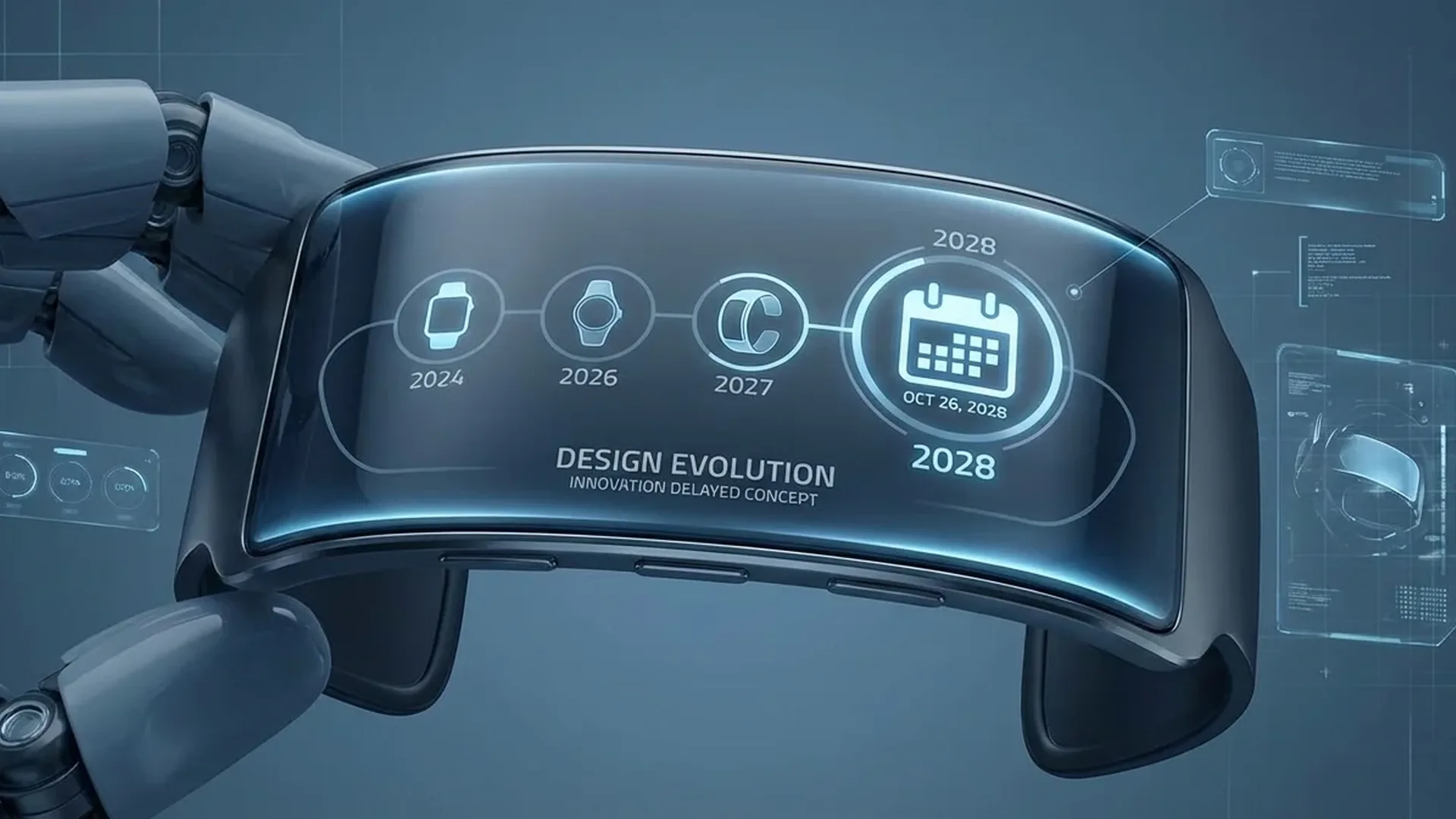
If Apple finally commits to a redesign — and many analysts believe 2028 is the most likely year — what changes might we see?
Thinner Bezels
The most certain change. Thinner bezels mean a larger display in the same case size or the same display in a smaller case. LTPO3 technology will allow even narrower frames while maintaining variable refresh rate capability.
New Sensor Array
Blood pressure monitoring (at least in a trend format rather than absolute values), an external temperature sensor, and improved SpO2 accuracy. Each new sensor justifies corresponding changes to the internal design layout.
Different Materials
The ceramic case could return. Alternatively, Apple may experiment with titanium alloys that are more scratch-resistant or even carbon fibre composites for a super lightweight edition.
Supply Chain and Manufacturing Challenges
Any redesign of a product selling < 50 million units annually requires enormous investment in new manufacturing tooling, new production lines, and years of reliability testing. Apple works with suppliers across China, Vietnam, and India, and the coordinated transition to a new design must be seamless — a supply chain failure can mean months of delay.
New materials such as ceramics require specialised sintering processes with extremely tight tolerances. The scrap rate for defective units can initially reach 30-40%, dramatically increasing cost. Apple wants to ensure it can produce millions of units without the quality issues that typically plague an entirely new design.
Apple's Strategy: Refinement Over Revolution
Apple historically favours refinement over revolution. The iPhone kept the notch design from 2017 to 2022 (Dynamic Island), and even then the change was evolutionary. The MacBook Air maintained its wedge shape for over a decade. The philosophy is clear: you only change when the new solution is unambiguously superior in every dimension.
For the Apple Watch, this means the redesign will arrive only when new sensors, new display technology, and new materials are mature enough to make the new watch indisputably superior in every respect. Until then, Apple will continue its incremental upgrades — and that is not necessarily a bad thing.
Frequently Asked Questions (FAQ)
Why hasn't Apple redesigned the Apple Watch?
Because the current design works exceptionally well: it is ergonomic, recognisable, compatible with millions of bands, and efficient to manufacture. There is no market pressure demanding a change.
When is the redesign expected?
The most reliable analysts estimate that 2028 is the most likely year, coinciding with 14 years of Apple Watch and potentially with new blood pressure sensor technology.
Will the band attachment mechanism change?
Possibly, but Apple would need to offer adapters or a transition period. A sudden change without backward compatibility would frustrate many loyal customers.
Will we see a flat-edge design like the iPhone?
The odds have been decreasing year after year. Wrist ergonomics matter more than design uniformity across products. A slightly more angular design without completely flat edges is more probable.
What about the blood pressure sensor?
The technology is advancing but is not yet accurate enough for clinical use without calibration. The most likely scenario is an initial trend-tracking function rather than absolute mmHg readings.
Will glucose monitoring ever come to the Apple Watch?
Yes, but probably not before 2030. Non-invasive glucose monitoring technology is still many years away from clinical accuracy in a wrist-worn form factor.