

Wearable AI: When Your Watch Becomes a Laboratory
Researchers are using Apple Watch data — heart rate, motion, sleep, SpO2 — to train AI models that detect diseases before symptoms appear. This is the story of the world's largest wearable health dataset.
The Apple Watch collects data every second you wear it: heart rate, steps, wrist temperature, SpO2, electrocardiogram, sleep movement, and standing postures. Individually, this data seems harmless. But when millions of users share it anonymously through research programs, something unprecedented emerges: a massive health dataset capable of training AI models that recognize patterns invisible to the human eye.
In this article, we analyze how researchers from MIT, Stanford, Apple, and dozens of universities are using wearable data for AI disease detection — what works, what doesn't, and what it means for the future of your health.
The Largest Wearable Health Dataset
Continuous monitoring
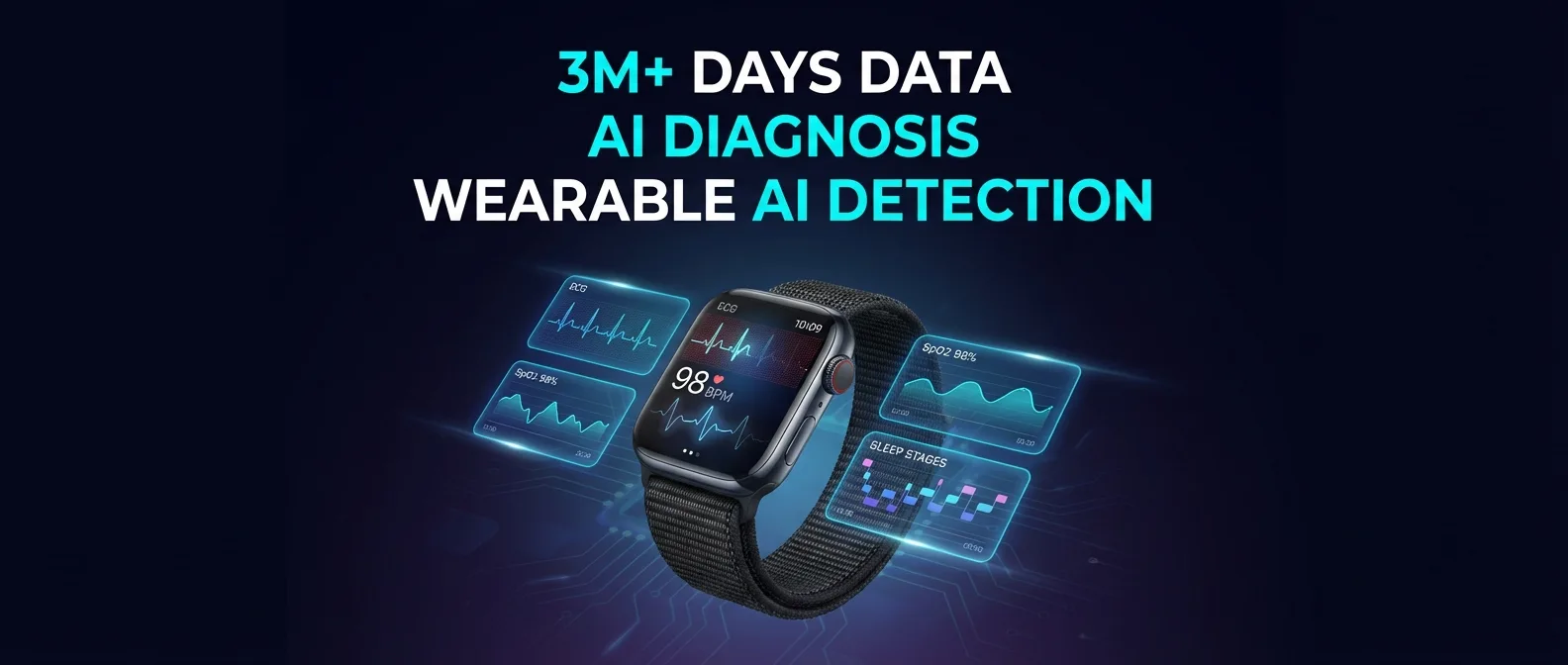
Over 3 million person-days of Apple Watch data have been collected through research studies.
Apple Heart & Movement Study
The largest health study using wearables in history, in collaboration with Brigham and Women's Hospital.
Billions of readings
Every Apple Watch measures HR every ~5 seconds. Multiply by millions of users × years.
Multi-modal data
HR, HRV, SpO2, ECG, temperature, accelerometer, gyroscope, barometer, ambient light, sleep stages.
Why the Apple Watch?
Three reasons: 1) Installed base — over 100 million active Apple Watches worldwide. 2) Consistency — same sensors, same OS, calibrated data. 3) ResearchKit/HealthKit — Apple provides frameworks that allow researchers to collect data ethically and anonymously. No other wearable offers this combination.
How It Works: From Wrist to Diagnosis
The process of converting raw sensor data into AI health predictions follows a 5-step pipeline:
Collection
Apple Watch sensors → raw data (HR, motion, SpO2, temp) every second
Anonymization
PII removal, differential privacy, hashing — cannot be reversed
Feature Extraction
HRV patterns, sleep architecture, gait analysis, circadian rhythm markers
AI Training
Transformer models, CNNs, LSTMs trained on millions of data points
Validation
Clinical trials, peer review, FDA clearance — before it reaches your wrist
Diseases Detected (or Soon to Be)
AI disease detection through wearables is at various stages — from FDA-approved to experimental:
Atrial Fibrillation (AFib)
The Apple Watch detects irregular rhythm via PPG sensor + ECG. FDA cleared since 2018. The Apple Heart Study (Stanford) with 419,000 participants demonstrated 84% PPV. Now with AI: AFib detection before symptoms begin.
Sleep Apnea
The Apple Watch Series 10/Ultra 3 detects sleep apnea notifications via SpO2 + accelerometer patterns during sleep. FDA De Novo authorization 2024. Requires 30 days of tracking.
Depression & Anxiety
MIT/Harvard researchers are using HRV patterns + sleep data + activity levels for depression detection. LLM-based analysis of wearable data shows 82% accuracy in pilot studies. Not yet FDA approved.
Parkinson's Disease
Tremor detection via accelerometer + gyroscope. Apple collaborates with the Movement Disorder Society. AI models recognize micro-tremors invisible to the eye — 2-3 years before diagnosis.
COVID-19 & Infections
Stanford/Scripps studies showed that changes in resting HR + HRV + SpO2 can predict infection 48 hours before symptoms appear. “Pre-symptomatic detection” with 80%+ sensitivity.
Type 2 Diabetes
Non-invasive glucose estimation via optical sensors + AI. Apple has been working on this for 10+ years. Motion, sleep, and HR data can already estimate insulin resistance patterns.
Health Foundation Models: The New Trend
The major development of 2025-2026 isn't individual disease detection, but Health Foundation Models — massive AI models trained on diverse wearable data that can perform multiple tasks simultaneously:
Pre-trained
Trained on millions of hours of generic health data. They learn “what's normal” before focusing on diseases.
Fine-tuned
Adapted to specific tasks — e.g., AFib detection, fall risk, sleep quality — with less labeled data.
Multi-task
A single model can simultaneously perform: HR anomaly detection + sleep staging + activity classification.
On-device
They run on the Apple Watch itself (Neural Engine) — no cloud needed. Data never leaves the device.
Why This Changes Everything
Until now, every health feature (AFib, SpO2, fall detection) required a separate model — separate research, separate FDA clearance. Foundation Models mean that a single "general" health AI model can perform dozens of tasks, improving one with data from another. Think of it as a “ChatGPT for health” — but trained exclusively on biometric data instead of text.
Apple Research Programs
Apple conducts three major studies through the Apple Research app:
| Study | Partner | Focus | Participants |
|---|---|---|---|
| Apple Heart & Movement | Brigham and Women's Hospital (Harvard) | AFib, cardiovascular health, movement & falls | 500.000+ |
| Apple Women's Health | Harvard T.H. Chan / NIH | Menstrual cycle, fertility, PCOS | 100.000+ |
| Apple Hearing Study | University of Michigan / WHO | Environmental noise, hearing loss | 200.000+ |
These programs are opt-in — no one participates without explicit consent. Data is anonymized, encrypted, and used exclusively for research. You can download the Apple Research app and participate now — availability varies by study and region (US Apple ID may be required).
Timeline: From Then to Now
2015 — ResearchKit
Apple launches the ResearchKit framework. It allows researchers to use iPhone/Watch for clinical studies. First-ever mass-scale health research via smartphone.
2017 — Apple Heart Study
The largest cardiovascular study in history launches in collaboration with Stanford. 419,000 participants. Proves that PPG can detect AFib.
2018 — ECG & FDA
Apple Watch Series 4: first consumer ECG with FDA De Novo clearance. A huge milestone — a gadget performing a medical examination.
2020 — COVID-19 detection
Stanford, Scripps, Mount Sinai publish studies: wearables detect infections 48 hours before symptoms. Apple Watch data a key contributor.
2022 — Temperature sensing
Apple Watch Series 8 introduces wrist temperature. Enables ovulation detection. A new data stream for AI models.
2024 — Sleep Apnea FDA
FDA approves sleep apnea detection on the Apple Watch. First time a wearable detects a sleep disorder. AI-powered algorithm.
2025-26 — Foundation Models
Health AI Foundation Models trained on multi-million day datasets. On-device inference. The dawn of “predictive health”.
What This Means for You
Let's translate the technology into practical benefits:
| Scenario | Today | Within the Next 2-3 Years |
|---|---|---|
| Cardiac arrhythmia | Irregular rhythm notification + ECG | Predictive alerts: “Increased AFib risk in the next 48 hours” |
| Mental health | Mindfulness reminders | AI depression/burnout detection based on HRV + sleep + activity |
| Infections | Manual logging | "Your vitals suggest the onset of an infection — take care" |
| Falls (elderly) | Fall detection after the fall | Predictive fall risk: “Today your fall risk is elevated” |
| Diabetes | Nothing | Non-invasive glucose trends + insulin resistance alerts |
| Neurological | Nothing | Early Parkinson's detection via micro-tremor analysis |
Ethical Issues & Privacy
AI health detection raises important questions:
⚠️ Concerns
Privacy: Who has access to your health data? Could your insurer or employer see it?
False positives: A false “disease alert” can cause panic and unnecessary tests.
Health anxiety: Constant monitoring can increase anxiety instead of reducing it.
Bias: AI models are primarily trained on data from white, affluent Americans — underrepresenting minorities.
✅ Apple's Solutions
On-device processing: Health AI models run on the Watch — data never goes to the cloud.
Differential privacy: Even in research programs, data is mathematically anonymized.
Opt-in only: No study collects data without explicit consent.
FDA oversight: Every health feature goes through clinical trials and regulatory approval before release.
Apple's Position
Apple consistently emphasizes: "Your health data is yours". It's stored encrypted on your iPhone, never sold, never shared without explicit consent. Even Siri doesn't have access to HealthKit data. This privacy-first philosophy is why Apple can ask for (and receive) consent from millions of users for research.
Apple vs the Competition in AI Health
| Company | Dataset | AI Focus | Advantage |
|---|---|---|---|
| Apple | 500K+ participants | Cardio, sleep, women's health | Privacy + FDA track record |
| Google (Fitbit) | 30M+ Fitbit users | Stress, AFib, skin temp | Cloud AI + DeepMind |
| Samsung | Galaxy Watch users | BIA, blood pressure | BP monitoring (Korea FDA) |
| Garmin | Athletes dataset | Training load, recovery | Performance analytics |
| Oura | Ring form factor | Sleep, readiness, temp | 24/7 comfort + sleep focus |
| Whoop | Athletes/pros | Recovery, strain, HRV | Elite athlete data |
Our take: Apple has the biggest advantage thanks to the combination of: massive installed base + FDA credibility + privacy-first approach + on-device Neural Engine. Google/Fitbit has stronger cloud AI but lower trust on privacy. Samsung leads in BP monitoring. The market will be multi-player, but Apple is in the lead.
What's Coming: 2026-2030
Predictive Health Alerts
Instead of “AFib detected,” you'll see: "Increased AFib risk in the next 72 hours". AI will transform alerts from reactive to proactive.
Non-invasive Glucose
Apple will launch glucose trend monitoring — not precise mg/dL, but trends and alerts for insulin resistance. A game-changer for 400 million diabetics worldwide.
Mental Health AI
On-device AI will recognize depression, anxiety, burnout patterns through multi-modal analysis (HRV + sleep + activity + social patterns). The first wearable “therapist.”
Personal Health Twin
An AI digital twin of you — trained on years of data — that can predict how your body will react to diet, exercise, and medication. Personalized medicine without lab tests.
Frequently Asked Questions
Conclusion
AI disease detection through the Apple Watch isn't science fiction — it's already happening. AFib detection, sleep apnea, fall detection — these are FDA-cleared AI health features running on your wrist right now. The question isn't if more will come, but when.
Data from 3+ million days, combined with health foundation models, means the next 5 years will bring: predictive alerts, glucose monitoring, mental health detection, and personalized health AI. The Apple Watch's role is gradually shifting: from fitness tracker to medical device — and that will change millions of lives.
The Significance
Apple Watch data is training AI models that will be able to predict diseases before they appear. Already 2 FDA-cleared features (AFib, sleep apnea) use AI. What's next: glucose, depression, Parkinson's, predictive alerts. Your watch doesn't just tell time — it tells you how your body feels.