

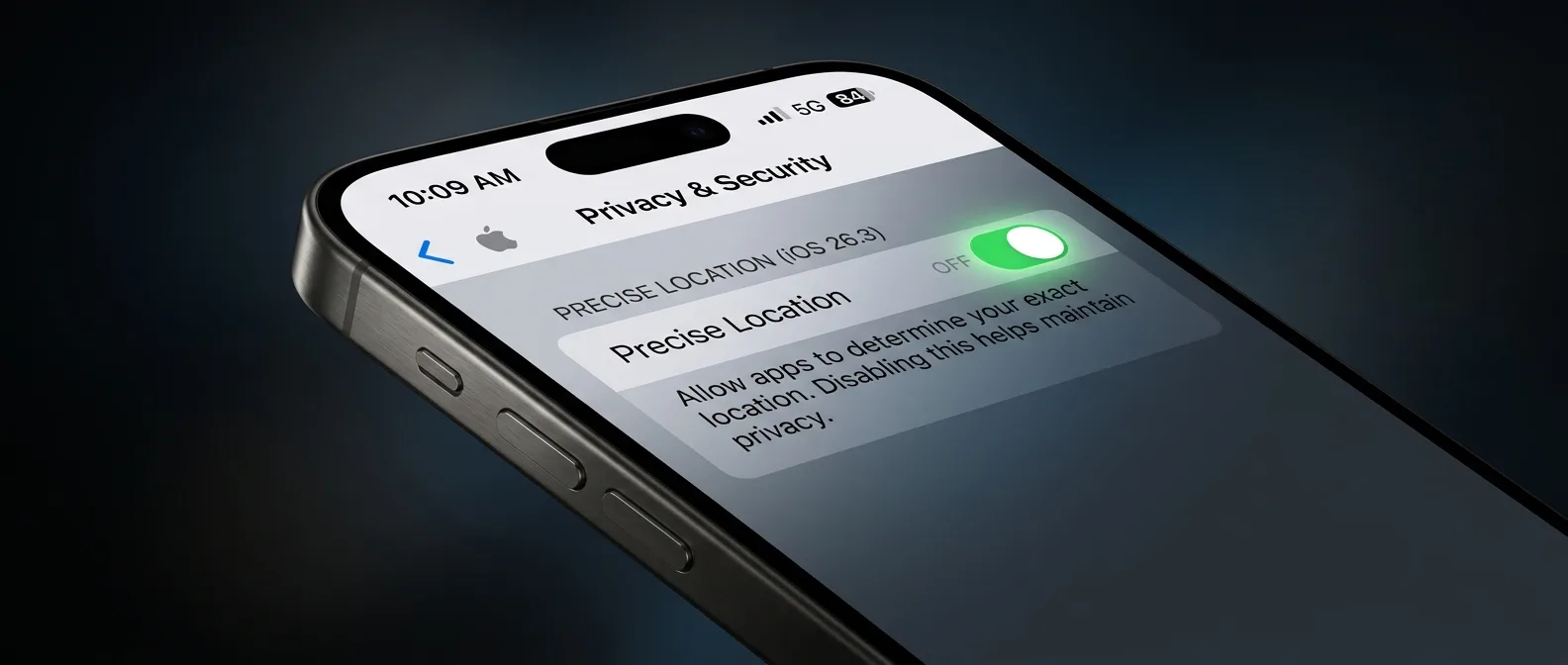
Six carriers across five countries — that's where this iPhone privacy shift begins. iOS 26.3 drops "Limit Precise Location" and this goes beyond Apple's usual privacy announcements.
We're talking about tech that fundamentally changes how cellular carriers track your movements. Not the typical Apple marketing spin — actual hardware-level privacy protection that's already working in iOS 26.3 beta builds. The catch? Your carrier needs to play ball.
📖 Read more: iOS 26.3 and 26.4: All the New Features in 5 Minutes
🔒 What Limit Precise Location Actually Does
Every time your iPhone connects to a cell tower, your carrier pinpoints your exact location. They can track you down to the street you're walking on.
iOS 26.3's new feature flips this equation. Instead of feeding precise coordinates to your carrier, your iPhone sends only general area data — roughly where you are, minus the street-level precision.
What does this mean practically? While your carrier used to know you were at 42 Skoufa Street in Kolonaki, now they only know you're somewhere in the Kolonaki neighborhood. That's a significant privacy upgrade.
Apple claims this change doesn't affect signal quality or user experience. Emergency calls still work perfectly — first responders get your exact location when it matters.
📱 Which iPhones Support Limit Precise Location
Here's where things get complicated. Limit Precise Location only works on iPhones with Apple's new C1 or C1X modem chips.
Supported devices include:
- iPhone Air
- iPhone 16e
- iPhone 17e
- iPad Pro with M5 chip (Wi-Fi + Cellular)
Older iPhones, even the iPhone 16 Pro Max, can't use this feature. Why? They run Qualcomm modems that lack the necessary privacy capabilities.
The C2 Chip Confusion
Despite references to a C2 chip, the feature actually relies on C1 and C1X modems. The C2 mention likely stems from confusion about future chip generations or misinformation circulating in tech coverage.
🌍 Carrier Support & Global Availability
Here's the big limitation. The feature works on just a handful of carriers globally:
- United States: Boost Mobile
- United Kingdom: EE, BT
- Germany: Telekom
- Thailand: AIS, True
- Denmark: YouSee
- Austria: A1
Bad news for Greece: Neither Cosmote, Vodafone, nor Wind support the feature yet. Even with an iPhone 17e, you can't enable Limit Precise Location.
Why such limited availability? Carriers must make technical infrastructure changes to support this privacy feature. As usual, telecom companies aren't rushing to implement features that reduce their data collection capabilities.
European Rollout Status
In Germany and the UK, only one carrier per country supports the feature. This suggests a gradual rollout rather than widespread adoption.
Apple will likely pressure more carriers to adopt the technology, but the process takes time. We might see Greek carrier support sometime in 2026.
⚙️ How to Enable Limit Precise Location
If you have a compatible iPhone and supported carrier, enabling the feature is straightforward:
- Open Settings
- Go to Cellular
- Select Cellular Data Options
- Enable Limit Precise Location
- Restart your iPhone
The restart is mandatory — without it, the change doesn't take effect. Every time you toggle the feature on or off, you need a fresh restart.
"The feature doesn't affect signal quality or user experience, and has no impact on location data you share with apps through Location Services."
Apple Support Documentation
What Doesn't Change
Critical clarification: Limit Precise Location doesn't affect the apps you use. Find My, Maps, social media apps — they all maintain the same precise location access.
Emergency calls remain unaffected. If you need to call 911, authorities still see exactly where you are.
🔬 Technical Details & How It Works
The privacy feature operates at the modem level. Apple's C1 and C1X modems have built-in capabilities that "blur" location data before sending it to carriers.
Privacy by Design
The modem processes data at hardware level, with no bypass capability from the operating system.
Carrier Integration
Carriers must support the protocol for the feature to work — it's not a unilateral change.
Only newer iPhones support the feature because of this hardware requirement. Qualcomm modems in older models lack these capabilities.
Precision Levels
According to technical documentation, the feature reduces accuracy from street-level precision (roughly 10-50 meters) to neighborhood-level (roughly 500-2000 meters).
This significantly hampers detailed tracking patterns without affecting network functionality.
🎯 Why This Matters in 2026
Limit Precise Location arrives as privacy becomes a battleground between tech giants and governments. Carriers collect massive amounts of location data, which they sell to data brokers.
In Europe, GDPR offers some protection, but in the US and other countries, this practice remains largely unregulated.
With iOS 26.3, Apple does what legislators haven't dared — gives users real control over location data that carriers collect.
Of course, there's business reasoning. Apple wants to differentiate from the Android ecosystem, and privacy features are a key selling point.
Industry Reaction
Carriers aren't thrilled. Location data represents significant revenue for many cellular companies. Apple essentially forces them to accept reduced income.
However, pressure from privacy advocates and public opinion makes refusing support difficult.
🚀 The Future of Location Privacy
iOS 26.3 is just the beginning. Apple is already developing the C1X modem's successor — the C2 chip referenced in this article's title.
The C2 is expected to bring even more privacy capabilities, including the ability to completely "anonymize" devices from carriers for limited time periods.
But those developments remain in design stages. For now, Limit Precise Location is the best we can get.
When Will Greece Get Support
Given that no Greek carrier currently supports the feature, we'll likely wait until at least late 2026.
Cosmote, as a Deutsche Telekom subsidiary, might be first to adopt the technology. But that's still speculation.
🎯 Frequently Asked Questions
Can I use the feature with any carrier?
No. The feature requires carrier support. In Greece, no carrier supports it yet. Even with an iPhone 17e, you can't enable the feature.
Does it affect internet speed or coverage?
No. Apple states the feature doesn't affect signal quality or overall user experience. It only changes the precision of location data sent to carriers.
What happens to apps that use location?
They're unaffected. Limit Precise Location only concerns data that carriers receive. Apps maintain the same precise location access through Location Services.
Limit Precise Location won't solve every privacy problem, but it reduces how much carriers can track your movements.
We'll see when Greek carriers decide to play along. Until then, iPhone 17e models sold in Greece will have the feature — but it'll be greyed out in settings.
Sources: