

In December 2023, The New York Times sued OpenAI and Microsoft — accusing them of training their models on millions of articles without permission. It was the first time a major news organization went head-to-head against the AI industry. Two years later, the battle over copyright in the age of artificial intelligence hasn't just escalated — it's become the defining legal fight of the decade.
📖 Read more: EU Deepfakes Law: What's Being Prepared
📌 Who owns an AI-created work?
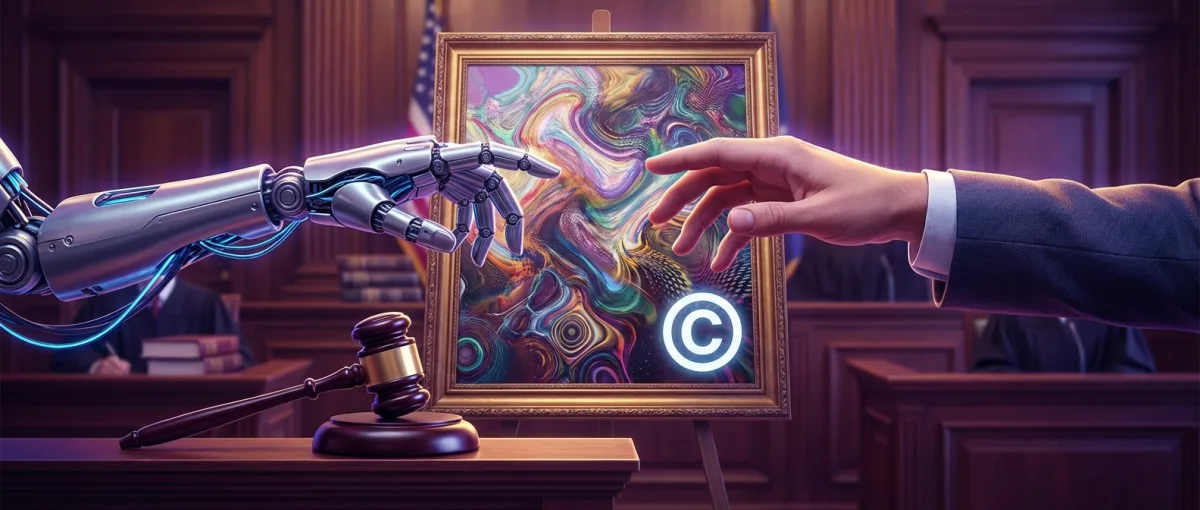
The answer — at least in the United States — is clear-cut: nobody, if the work was created entirely by AI. In Thaler v. Perlmutter (2023), a federal court ruled that artificial intelligence cannot be considered an “author” under the law. The US Copyright Office followed suit, declaring that only works with “sufficient human authorship” can be protected.
This creates a paradox. If you use Midjourney to generate an image from a simple prompt, you don't hold copyright. But if you extensively edit the result, add elements, reshape the composition — then you might. Where exactly that line falls, nobody can say for certain.
A telling example: the case of "Zarya of the Dawn," a comic book by Kris Kashtanova. The Copyright Office recognized copyright for the text and page layouts — but stripped protection from the images generated via Midjourney. In other words, the very same work can be partly protected and partly public domain. A legal first that raises more questions than it answers.
Key point: The US Copyright Office has stated it will evaluate each case individually, examining “the degree of human contribution” to the final work. This means every copyright application for AI-assisted works is essentially a gamble.
⚖️ The major courtroom battles
The New York Times lawsuit was just the opening salvo. A cascade of cases has flooded the courts:
NYT vs OpenAI & Microsoft: The Times is seeking billions in damages, arguing that ChatGPT and Bing Chat reproduce near-verbatim excerpts from published articles. OpenAI counters that AI training falls under “fair use.” The case is widely expected to reach the Supreme Court.
Artists vs Stability AI, Midjourney, DeviantArt: A class-action lawsuit from visual artists accuses AI image companies of training their models on billions of images without consent. Artists Sarah Andersen, Kelly McKernan, and Karla Ortiz became the faces of this fight.
Getty Images vs Stability AI: The photography giant sued Stability AI in both the US and the UK, alleging it used 12 million copyrighted images to train Stable Diffusion. Some AI-generated outputs even displayed Getty's watermark — a damning detail.
📖 Read more: AI Deathbots: Chatbots of Deceased Loved Ones
"AI doesn't create in a vacuum. It feeds on the work of real people — and those people never gave their permission."
— Karla Ortiz, visual artist & plaintiff against Stability AI
🟢 The music industry joins the fight
The RIAA (Recording Industry Association of America) filed lawsuits against Suno and Udio — two AI startups that generate music automatically. The charge: training on millions of copyrighted songs without licensing agreements.
The case echoes the early days of Napster — except this time, songs aren't being copied directly. Instead, entire musical styles, vocal patterns, and production techniques are being absorbed. If courts rule in favor of rights holders, AI music companies will be forced to negotiate licensing deals worth billions.
Worth noting: Universal Music Group, Sony Music, and Warner Music — the world's three largest record labels — have already opened their own legal front. They're seeking $150,000 per song used without authorization. With millions of tracks in the training set, the numbers become astronomical. The music industry, which already endured the pain of piracy during the Napster and LimeWire era, has no intention of losing that battle again.
🔎 Hollywood: The strike that rewrote the rules
The 2023 Hollywood writers' strike (WGA) wasn't just about pay. At its core was the use of AI in screenwriting. After 148 days on the picket line, writers secured contractual clauses banning the use of AI as a substitute for human labor and ensuring that AI-generated text cannot be treated as “source material” for scripts.
It was the first time a labor union won legally binding rules on AI use. Many see the agreement as a template for every creative industry going forward.

📖 Read more: Australia AI Law: App Store Crackdown
🇪🇺 What is Europe doing?
The European Union is moving on two fronts. The EU AI Act requires AI companies to disclose which copyrighted data they used for training — a groundbreaking provision that exists nowhere else in the world.
Meanwhile, Article 4 of the EU Copyright Directive provides an exception for “text and data mining” (TDM) — meaning companies can theoretically use copyrighted material for AI training, unless the creator has explicitly opted out. This creates a system where the burden falls on creators to act preemptively — something many consider unfair.
Around the world
Japan initially allowed unrestricted AI training on copyrighted material, but after pressure from the creative sector, it began reconsidering its policy. China now requires labeling on all AI-generated content — a regulation that sounds feasible in theory but remains difficult to enforce in practice.
In the UK, the government attempted to introduce a broad text-and-data-mining exception for commercial use, but faced fierce opposition from the creative sector and ultimately began reconsidering its position. In Canada, the concept of “fair dealing” — the local equivalent of fair use — is being tested in courts in relation to AI for the first time. Every country is charting its own course, creating a patchwork of rules that makes life even harder for companies and creators operating internationally.
ℹ️ What this means for creators and companies
For creators, the situation is uncertain. Their intellectual property rights theoretically exist, but enforcing them against billion-dollar corporations requires resources most individuals simply don't have. Class-action lawsuits remain the only realistic option — and even those come without guarantees.
For AI companies, the stakes are enormous. If courts determine that training on copyrighted material does NOT constitute “fair use,” entire business models will need to be rebuilt from scratch. OpenAI is already signing licensing deals with publishers — but these cover only a fraction of the material that was used.
What you can do now: If you're a creator, check whether the platforms you use offer an opt-out from AI training. Platforms like DeviantArt and ArtStation have already introduced such settings. In the US, the proposed COPIED Act aims to give creators more protection tools — if it passes.
📖 Read more: Block: Jack Dorsey Replaces Employees with AI
📝 The road ahead
Creative Commons is exploring new license categories specifically for AI training — a move that could fundamentally reshape the landscape. Instead of a binary choice (allowed or forbidden), creators could permit AI training under specific conditions — for example, non-commercial use only, or with mandatory attribution.
One thing is certain: the current legal uncertainty cannot last much longer. With over $2 billion in pending lawsuits, the first major legal precedents are expected sometime in 2026. And those rulings will set the rules for an entire generation of creators — human and otherwise.
The reality is that we're at the most critical crossroads for intellectual property in decades. The last time technology disrupted copyright this fundamentally was the era of the internet and digital downloading. Back then, it took nearly 15 years for the rules to stabilize. With AI, the pressure for swift solutions is immense — because every day that passes, billions of new works are being created in a legal vacuum.
Sources & Further Reading:
U.S. Copyright Office — copyright.gov/ai
The New York Times vs OpenAI — nytimes.com
EU AI Act & Copyright — europarl.europa.eu
AI Copyright Battles — wired.com