

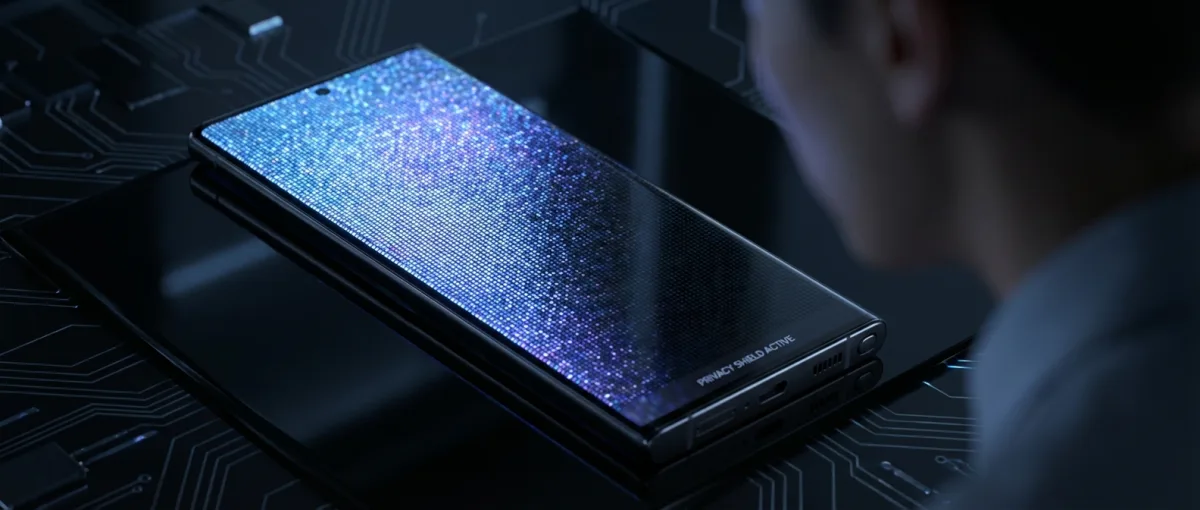
In February 2026, Samsung unveiled the Galaxy S26 lineup, and one feature drew more attention than anything else: a display that shields you from prying eyes. No screen protector. No clip-on filter. Just pixels doing what pixels haven't done before.
📖 Read more: Qualcomm X105 5G Modem: Next-Gen Speeds
🔒 How the Privacy Display Works
The technology relies on controlling the viewing angle at the sub-pixel level. When you activate the feature, sub-pixels shift their light emission angle. You see the screen normally. The person next to you on the subway? They see a black or blurred screen. Samsung hasn't published the exact patent details, but analysts estimate it uses directional OLED emission combined with software-driven pixel control.
The idea isn't new — privacy screen filters have existed for years. The difference? Here, the technology is built into the display and toggles on demand. No accessories needed, no brightness penalty when it's off, and the screen's touch feel doesn't change at all.
📖 Read more: Earthquake Detection: Sensor Networks & Early Alerts
📊 Galaxy S26 Ultra by the Numbers

🤔 Who Is This For
First thought: professionals. If you read company emails on a train or a plane, the privacy display isn't a luxury — it's a security tool. Second thought: anyone unlocking a banking app in public. Third: parents who don't want kids seeing their messages.
Samsung markets the feature as part of its Galaxy AI suite. Combined with the Knox security platform, the company wants to position the S26 as the most secure smartphone on the market.
📖 Read more: eRecipe: The New Digital Prescriptions
🛡️ Knox + Privacy Display: Samsung claims the combination creates “the most secure mobile work environment” — targeting large enterprises and government organizations.
💰 European Pricing
The S26 series follows expected pricing. The base Galaxy S26 (6.3 inches, 4,300 mAh) starts at around €899. The S26+ (6.7 inches, 4,900 mAh) lands at roughly €1,149. And the flagship S26 Ultra with its 6.9-inch Gorilla Armor 2 display and up to 1 TB storage starts at approximately €1,419. Privacy Display is available across all models, though it works best on the larger panels.
📖 Read more: EU Made in Europe: Cheaper Batteries

⚖️ Strengths and Limitations
The positives are obvious: privacy without accessories, one-tap activation, zero image quality loss in normal use. The limitations? In very bright conditions, effectiveness drops. Also, viewing from an extreme angle yourself may cause slight brightness loss.
In testing, the feature proved reliable indoors and in transit — exactly where you need it. Outdoors in direct sunlight, results become less consistent.
📖 Read more: Fiber 10Gbps Greece: When in Your Neighborhood
🔮 What Comes Next
If Samsung proves this technology works reliably in real-world conditions, we'll almost certainly see it in tablets, laptops, and possibly TVs. Apple is rumored to be preparing something similar for iPhone 18, but Samsung leads the way for now. Sometimes, innovation isn't the flashiest camera or the fastest chip. It's something as simple as stopping strangers from seeing what's on your screen.