

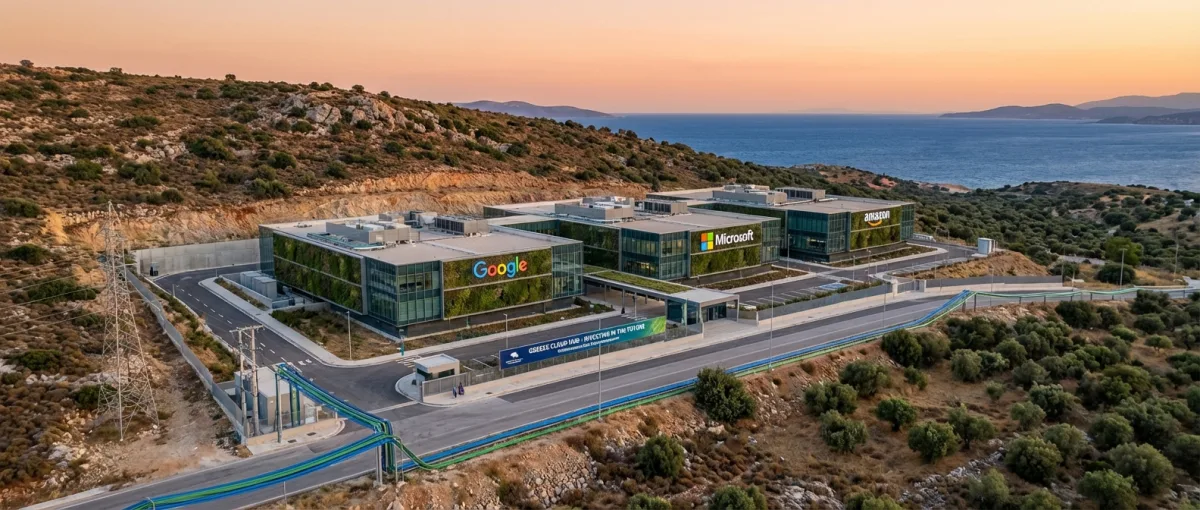
Microsoft is pouring over €1 billion into Greek data centers. AWS is building a full region in Athens. Google is reinforcing submarine cable connections through the country. Within less than two years, three of the world's biggest cloud players have turned their attention to Greece — and there's a very clear reason why.
❓ Why Greece Landed on the Hyperscaler Radar
Pull up a map. Greece sits at the exact crossroads of three continents: Europe, the Middle East, and Africa. That geographic advantage — leveraged for centuries in shipping — is now becoming a digital trump card.
More than 14 international submarine fiber-optic cables make landfall on Greek shores. From the Crete-to-Egypt cable to multiple Mediterranean interconnections, Greece already functions as a data transit point. It just didn't have the facilities to host that data locally — until now.
Why it matters: Every millisecond of latency costs businesses money. A data center in Athens delivers ultra-fast access to markets spanning 1.5 billion people across three continents — something very few locations on Earth can offer.
💰 The Big Investments, One by One
Microsoft: €1 Billion and an AI Academy
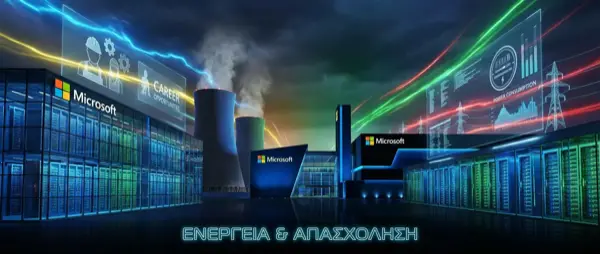
Microsoft's announcement hit like a shockwave. Over one billion euros for data center construction in the Attica region, in partnership with local authorities. Alongside the hardware, the company committed to an AI Academy, training thousands of Greeks in cloud computing and artificial intelligence. This isn't just about servers — it's an entire ecosystem taking shape.
Amazon Web Services: A Full Region in Greece
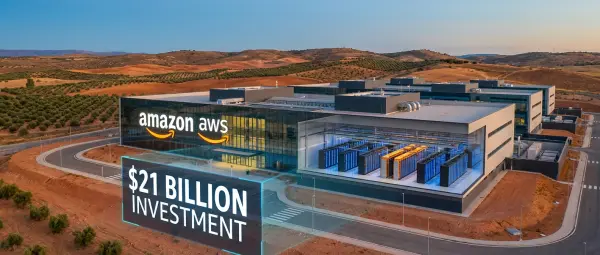
AWS followed with plans for a complete AWS Region in Greece. That means availability zones, edge locations, and the full service stack. For Greek businesses, this translates to data residency within national borders — critical for banks, healthcare providers, and government agencies that until now had to store sensitive data in Frankfurt or Dublin.
Google Cloud and Submarine Cables
Google hasn't announced a full region yet, but its presence is already tangible. Through submarine cables landing in Greece, the company is strengthening Europe-to-Asia connectivity. Greece's role as a transit point is being significantly upgraded, and many analysts expect a full Google Cloud region within the next few years.
"Greece is transforming into a digital gateway for three continents. It's no longer a question of whether it will become a cloud hub — but how fast."
— Southeast European Data Center Market Analysis, 2025
💰 The Greek Ecosystem Supporting These Investments
Submarine cables alone aren't enough. You need the right conditions on land, too.
Lamda Hellix — now part of Digital Realty, the world's largest data center provider — already operates Greece's biggest data center in Attica. The infrastructure exists, and the foundations weren't built yesterday. GRNET, the country's academic research network, provides backbone connectivity across Greece, while Athens and Thessaloniki are emerging as the primary hubs.
AI Factory "Pharos": Government-Backed AI Infrastructure
Under the National Documentation Centre (EKT), Greece launched Pharos — an AI Factory providing computational power for research institutions and startups. The move signals something important: the country isn't just waiting for foreign players to bring infrastructure. It's building its own.
Tax Incentives and the Recovery Fund
The Greek government is offering targeted tax incentives for data center investments, while significant capital from the EU Recovery Fund is flowing into digital infrastructure. Combined with falling energy costs driven by a renewable energy push — Greece now generates a substantial share of electricity from solar and wind — operating expenses are becoming competitive at a European level.
EU Data Act: Europe's push for digital sovereignty is forcing companies to host data within the EU. That's creating demand for regional data centers — and Greece is in an ideal position to capture it.
📊 What This Means for the Greek Market
Greece's data center market is growing at roughly 15% per year — well above the European average. But the numbers only tell part of the story.
Jobs: every major data center requires hundreds of technicians, network engineers, and security specialists. Skills: cloud infrastructure training has never been more valuable. Startups: Greek companies now get access to low-latency cloud without international routing overhead.
Challenges remain. Construction permitting hasn't been fully streamlined. Workforce training needs to accelerate. And power infrastructure in some areas requires upgrades to handle the enormous loads modern servers demand.
Still, the trajectory is unmistakable. Greece is no longer just a tourist destination on the digital map. It's becoming a hub — and at a pace few predicted.