

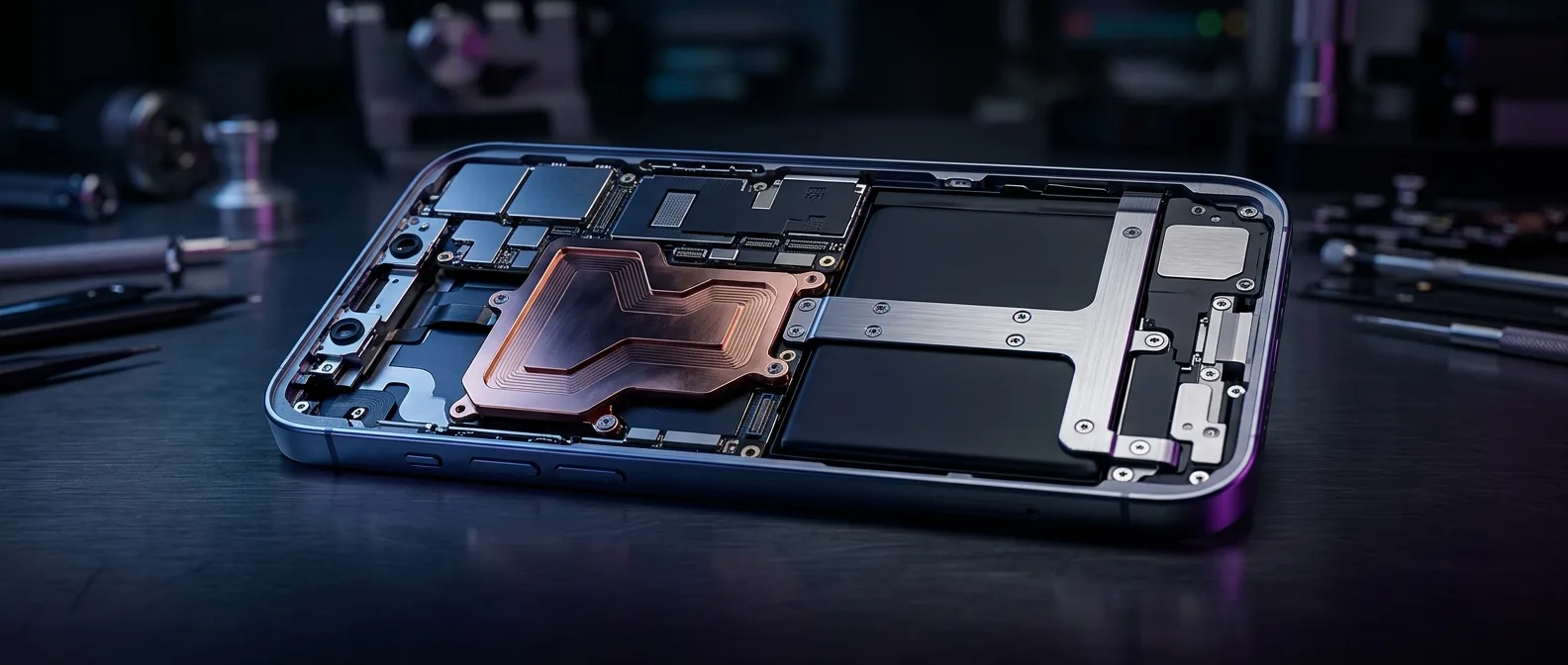
Fourteen Torx Plus screws hold the iPhone 17 Pro Max battery in place. Sounds technical, but it might be the breakthrough repair techs have waited years for. Apple ditched adhesive strips for the first time in iPhone history — no more praying those pull tabs don't snap mid-removal.
iFixit's teardown reveals a design philosophy pulling in two directions. The screwed-down battery and vapor chamber show Apple thinking about repairability. But losing dual-entry access takes a step backward. What does this mean for a world drowning in e-waste?
📖 Read more: G-Sync Pulsar: Gaming Monitors Hit 1000Hz Motion Clarity
🔧 The Battery Revolution: Screws Beat Strips
Anyone who's swapped an iPhone 16 Pro battery knows the drill. Pull those adhesive strips gently. Pray they don't tear. When they inevitably do, you're stuck prying with spudgers and acetone. That nightmare ends here.
The iPhone 17 Pro Max dumps pull tabs entirely. Instead, the battery sits in a metal tray secured by fourteen Torx Plus screws. Sounds complex? It's actually simpler than the old way.
Electrically Debonding Adhesive: Apple keeps the 12-volt tech that dissolves adhesive. Apply current, the glue weakens, and the battery lifts out cleanly. The tray stays pristine, ready for reuse.
Why so many screws? iFixit wonders if manufacturing tolerances were so tight that Apple needed compression at the micrometer level. Or maybe better thermal contact between battery and vapor chamber? Whatever the reason, the result works: no dangerous prying, no chemicals, no replacement adhesive strips.
Torx Plus: New Game, Old Rules
Torx Plus screws aren't random. They grip better than Phillips heads, reducing slip risk. But for repair shops, that's another screwdriver in the toolkit. The iPhone 17 Pro uses five different screw types: tri-point, Phillips, standoffs, Pentalobe, and Torx Plus. Every tool change costs time and increases error risk.
🧊 Vapor Chamber: When Physics Meets Practicality
Hidden beneath the battery tray sits another innovation: the vapor chamber. If you've watched your phone throttle during extended gaming sessions, you understand why this matters. Heat kills processor performance — proper cooling solves it.
Apple isn't first here. Samsung's been doing this for years. But Cupertino's implementation is smarter: the vapor chamber is modular, not permanently bonded to the chassis like Galaxy phones.
The difference looks small but matters for video processing or graphics-heavy tasks. The system works simply: the A19 Pro chip generates heat, water in the copper chamber boils and vaporizes, transfers heat to the aluminum frame, condenses, and returns. Closed loop, continuous solution.
Beautiful and Functional
Under magnification, the vapor chamber looks almost decorative — lattice structures and copper channels that help vapor return to liquid form. Beautiful and functional simultaneously, as iFixit describes it — and unlike the competition, modular.
📖 Read more: AI Reads Thoughts: New Technology
📱 Dual-Entry Design: Lost Opportunity
Here comes the biggest disappointment. Last year, every iPhone 16 had dual-entry design — repair access from front or back. Most fixes could happen through the rear panel, avoiding the fragile display. We loved it on the iPhone Air.
Now, goodbye to that. The iPhone 17 Pro's back panel is small, separate from the camera plateau, and only accesses the wireless charging assembly. It strongly resembles Apple Watch Ultra design, where access is extremely limited.
"Boo, hiss"
iFixit team reaction to losing dual-entry design
Want to replace a scratched camera plateau? There's no full-coverage back panel for you. This leads to the next issue: "scratchgate."
🔬 Scratchgate: When Chemistry Meets Aesthetics
The iPhone 17 Pro's new anodized aluminum finish looks gorgeous until it meets your keys. Or a coin rolling in your pocket. Several analysts already call it "scratchgate."
Apple replaced titanium with thermoformed aluminum this year, anodized for that rich finish. The problem? The anodized layer is brittle. On flat surfaces it holds up reasonably well, leaving surface scratches. On sharp edges though — like the camera frame — it flakes off.
Spalling Effect
Materials scientist David Niebuhr explains we're seeing "spalling" — the anodized layer doesn't bond uniformly to sharp edges and peels easily.
Ceramic Shield 2
The iPhone Air's camera plateau with Ceramic Shield 2 (5 on the Mohs scale) doesn't scratch as easily — no scratches or chips in the glass.
"Apple could have avoided this with smoother edge curves," Niebuhr says. Sharp corners are the anodized layer's weak point — exactly where it loses strength first.
📖 Read more: Amazon Buys Rivr: Stair-Climbing Robots Hit the Streets
🛠️ USB-C Port: Screw Nightmare
Want to replace the charging port? Prepare for patience. And a complete bit set. Apple used a remarkable variety of screws this year — just replacing the USB-C port requires dozens of screws.
Don't get me wrong — we love screws at iFixit (that's why our logo is a Phillips head). They beat adhesives. But we don't love constantly changing screwdrivers. Every tool change slows you down. And increases the risk of cross-threading by coming in with the wrong bit.
⚖️ The Verdict: 7/10 Repairability
The iPhone 17 Pro delivers mixed results. The screwed battery is an undeniable improvement, even if we don't know whether Apple will sell batteries alone or with the tray. Electrically debonding adhesive and the metal protective shell boost the picture positively.
Repairability Score: 7/10 — just slightly below the iPhone Air. Despite battery improvements, losing dual-entry design and USB-C port complexity keep the score at similar levels.
Apple seems to consider repair in design — day-one repair manuals and parts availability on the Self Service Repair site prove it. But aesthetic and functional priorities still win out.
If someone asked you to trade easier battery swaps for harder overall repairs in exchange for better daily performance, what would you choose? The answer says a lot about where technology's future is heading — and our relationship with it.