

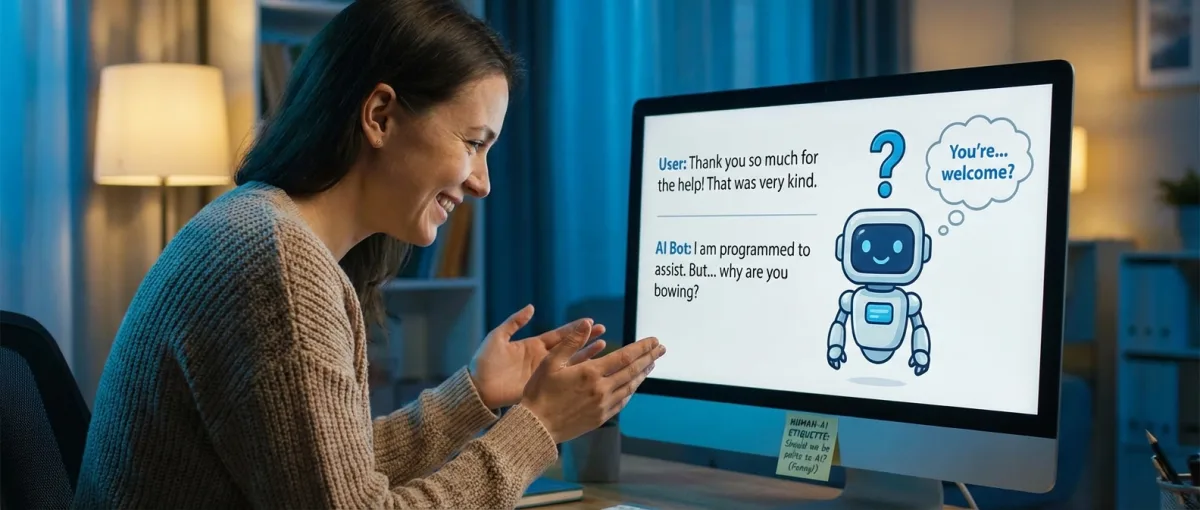
"Thank you, ChatGPT." “Please help me.” “Sorry to bother you.” We say these things to AI — but should we? The debate started as a joke on Twitter and became a genuine ethical question.
📖 Read more: ChatGPT Hacking: How Easy Is It?
🧠 Why We Say Thanks
It's not a technology issue — it's psychology. Humans treat talking objects as entities. We say “thank you” to Siri, pet our Roomba, name our cars. This is anthropomorphism — the tendency to attribute human traits to non-human things. And chatbots, designed to “respond like humans,” amplify this tendency to the maximum.
💬 The Counter Argument
Many say: “No need — it's a machine.” Technically correct. ChatGPT doesn't feel gratitude, doesn't get offended, has no emotions. Every “thank you” you type to AI consumes tokens (and by extension electricity) with zero practical result. One estimate went viral: “please” and “thank you” to ChatGPT cost OpenAI over $1 million per month in compute — it was a statement, but not without basis.
📖 Read more: ChatGPT Ads: End of Free Usage?

🤔 Why You Maybe Should
But there's a deeper perspective. How we speak to machines reflects who we are. If a child grows up giving orders to AI without “thank you,” without “please,” without courtesy — how will they speak to people? Politeness isn't about the medium — it's about the sender. You remain polite even if you're talking to yourself.
📖 Read more: EU Deepfakes Law: What's Being Prepared
"Politeness isn't about who we're talking to. It's about who's talking."
— Sherry Turkle, MIT📊 What Research Shows
A recent Stanford study shows polite AI users tend to get slightly more detailed responses — likely because polite prompts are more structured. A Pew Research survey shows 67% of AI users say thank you regularly. Gen Z is more likely not to (52%) compared to Baby Boomers (23%). Politeness is generational.
📖 Read more: Fed vs AI: How the Global Economy Is Changing
💭 My Take
Say thanks if it makes you feel good. Don't if you don't want to. But don't ridicule those who do — they're keeping a human quality alive in a digital age. And that's not weakness, it's character.