

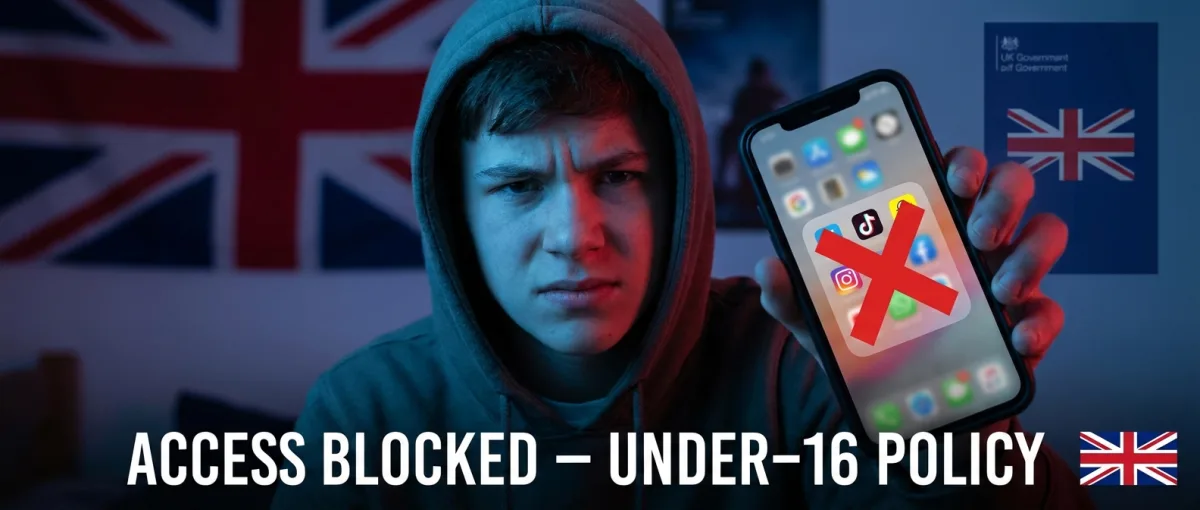
Britain decided to press the button no government dared to push until now: a complete ban on social media access for children under 16. The response was mixed — and the questions, many.
📖 Read more: TikTok Deal USA: How the App Was Saved
📜 What the Law Covers
The legislation, announced in early 2026 and expected to take effect by autumn, prohibits minors under 16 from creating accounts on social media platforms. The list includes Instagram, TikTok, Snapchat, Facebook, and X. Responsibility shifts to the platforms: if they cannot prove a user is over 16, they cannot grant access.
Australia served as the model, having passed a similar law in November 2024. The British version goes further, however: it provides for fines of up to 10% of a platform's annual turnover for violations. For a company like Meta, that means over $13 billion.
📖 Read more: Lab-Grown Coffee: Coffee Without a Plantation
🔐 How It Will Be Enforced
Here's the challenge. Online age verification is not straightforward. Until now, social media only asks for self-declaration — the user states they're over 13. Obviously, that doesn't work.
The British government is exploring AI-based age estimation technologies (real-time face scanning), connections to government IDs, or third-party identity providers. Each method has privacy concerns. The irony isn't lost: to protect children, you might need to install even greater surveillance.

🗣️ Reactions
Parents, for the most part, support the law. A YouGov poll showed that 77% of British parents consider social media “harmful” to their children. Tech companies are pushing back — Meta stated the law would “isolate” teenagers instead of protecting them. TikTok noted that a “global solution, not local patches” is needed.
📖 Read more: National Young Scientists Competition 2026: How to Apply
Digital rights experts express mixed feelings. They acknowledge that social media harms minors — but emphasize that blocking access can lead to opposite results, pushing children to unregulated platforms.
🇬🇷 What About Greece
Greece, through GDPR, sets a minimum age of 15 for online services (with parental consent below that). In practice, nobody enforces it. A British model could inspire Greece or the EU — but implementing it across 27 member states with different legal frameworks is far more complex.