

Just bought an Apple Watch and wondering whether you need a case or bumper? The answer is not as straightforward as you might think. It depends on your model, your lifestyle, and how willing you are to risk damage. In this guide, we break down everything about Apple Watch protection — from build materials to the best cases and alternative solutions.
📖 Read more: Apple Intelligence on Watch: What It Brings
Build Materials: Ion-X vs Sapphire Crystal
The first question you need to answer is: which Apple Watch model do you own? Aluminum models (Series, SE) use Ion-X glass, while stainless steel and titanium models feature Sapphire Crystal. This distinction has a significant impact on how vulnerable your watch is to scratches and impacts in everyday use.
Ion-X glass is a strengthened aluminosilicate glass. It handles impacts reasonably well but is relatively prone to scratches. If you wear your watch daily without a case, after a few months you may notice micro-scratches on the display, especially if you bump into walls or metal surfaces. It is not dramatic, but for those who value a pristine appearance, it matters.
Sapphire Crystal, on the other hand, ranks 9 on the Mohs hardness scale — only diamond is harder. This means virtually nothing in everyday life can scratch it. However, sapphire is more brittle: if it hits a hard surface with enough force, it can crack more easily than Ion-X glass. So both materials have trade-offs.
Quick Comparison
Ion-X Glass (aluminum): Better impact resistance, more vulnerable to scratches. Model pricing from <€449.
Sapphire Crystal (steel/titanium): Nearly impossible to scratch, more brittle under severe impacts. Model pricing from <€749.
Common Damage Scenarios
Before deciding whether you need a case, think about how you use your watch in daily life. The most common damage scenarios include:
- Doorframes and walls: The classic way to scratch or ding your Apple Watch. You walk through a doorway, your wrist brushes the frame, and immediately there is a mark or scuff on the casing.
- Gym equipment: Metal barbells, dumbbells, and weight machines are enemies of the Apple Watch. Heavy iron can cause serious damage to both the screen and the casing during exercises.
- Kitchen counters and granite: Granite contains quartz that can scratch even Ion-X glass. Be careful when cooking or washing dishes.
- Drops on hard flooring: If you take off your watch and it falls on tile or concrete, the chances of damage are significant. Even a drop from nightstand height can be enough.
- Outdoor sports activities: Hiking, climbing, or mountain biking expose your watch to rocks, branches, and unpredictable impacts at speed.
Types of Apple Watch Protection
If you decide you need protection, there are several categories of accessories available on the market. Each has its own advantages and drawbacks:
Bumper Cases
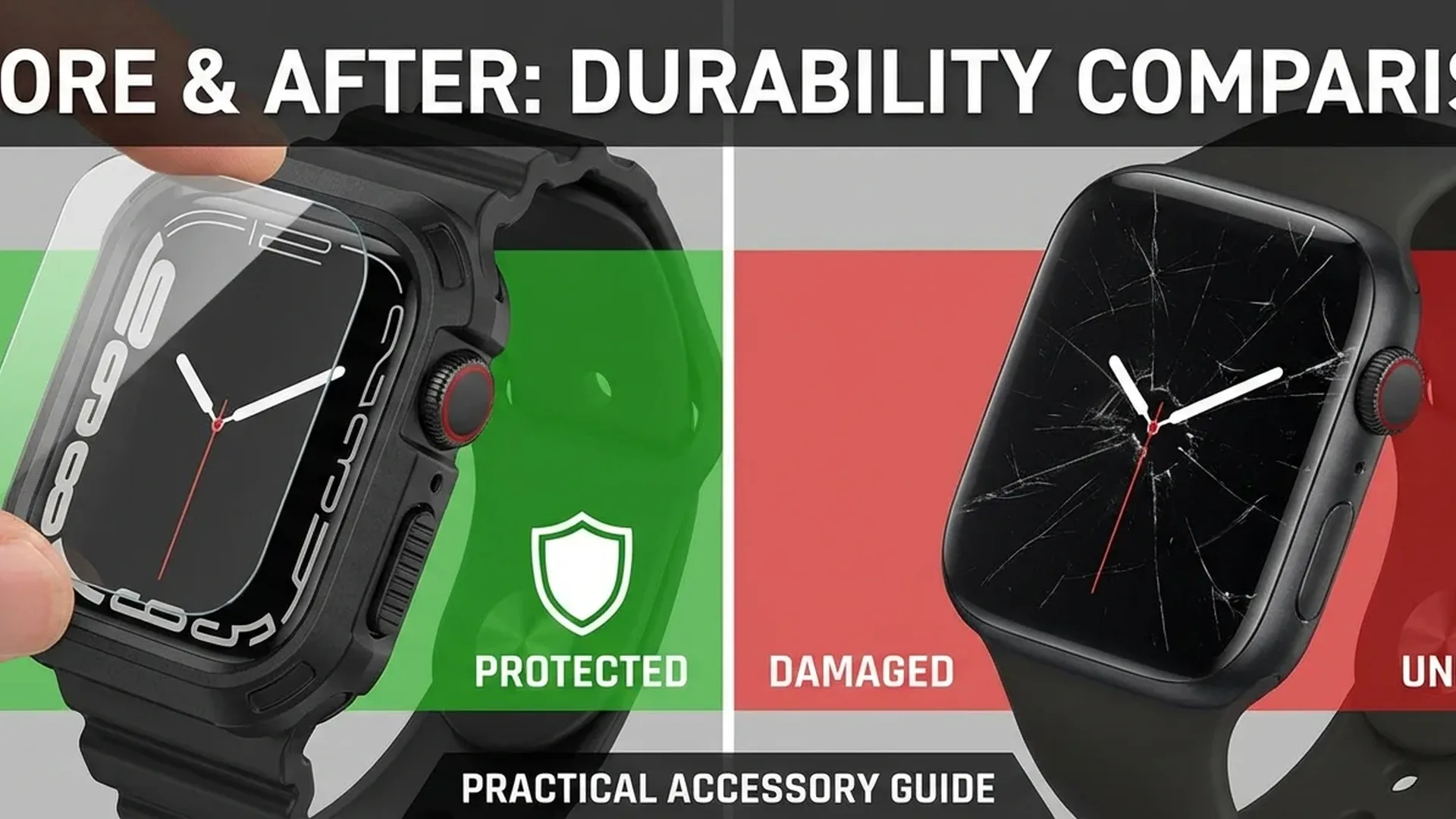
Bumper cases cover only the sides of the Apple Watch, leaving the screen exposed. They protect against knocks to the casing but do not prevent screen scratches. They are the most popular choice because they do not significantly affect the aesthetics of the watch and they leave the touchscreen fully accessible without any sensitivity loss.
Full Cases with Screen Protection
These cases cover the entire Apple Watch — sides and screen. They often feature built-in tempered glass or a plastic screen cover. They offer maximum protection but add considerable bulk and may reduce touch sensitivity. Some users find the plastic screen cover distracting due to slight reflections.
Screen Protectors
Thin films or tempered glass that stick directly onto the screen. They protect against scratches without adding significant bulk. However, application on the curved Apple Watch display can be tricky, and they often leave gaps at the edges where dust collects over time.
📖 Read more: Apple Watch and 5G: The New Era of Connectivity
Tempered Glass Protectors
Thicker and more durable than basic films, tempered glass offers better impact protection. If it breaks, it breaks instead of your screen. The downside is that it may slightly alter the brightness and clarity of the display, and it needs replacement after an impact.
Popular Case Brands
The Apple Watch accessories market is massive. However, certain brands stand out for their quality and reliability:
- Spigen Rugged Armor & Thin Fit: Top choice for value. Spigen cases are lightweight, fit accurately, and come in many colors. Priced from <€15.
- RhinoShield CrashGuard NX: Premium bumper case with military-grade drop certification. Withstands drops from <3 meters height. Priced around <€25.
- Catalyst Waterproof Case: For those who want absolute protection, even at great water depths. IP68 certified and rated for depths up to <100 meters. Priced from <€70.
The best case is one that does not make you forget you are wearing an Apple Watch. If the case annoys you, you will take it off — and then it is not protecting you at all.
— Advice from the r/AppleWatch communityPros of Using a Case
- Scratch and impact protection: The case acts as a shock absorber, dramatically reducing the chances of damage to both the casing and the screen.
- Peace of mind: You do not worry every time you brush against something hard or accidentally bump into a wall.
- Lower repair costs: Replacing a <€15 case costs far less than a <€300 screen repair at the Apple Store.
- Customization: Many cases come in unique colors and designs that completely change how the watch looks on your wrist.
Cons of Using a Case
- Added bulk: Even the slimmest cases increase the watch dimensions by <2-4 millimeters, which becomes noticeable on the wrist.
- Covers the design: Apple designs its watches with exceptional attention to detail. A case hides that craftsmanship and may make the watch look cheaper than it actually is.
- Potential sensor interference: Some cases may affect the heart rate sensor, SpO2 sensor, or charging functionality, especially if they do not fit precisely.
- Moisture trapping: If water or sweat gets under the case, it can cause sensor issues or even corrosion on the casing over time.
- Silicone yellowing: Cheap silicone cases tend to yellow within a few weeks, giving a worn-out and unappealing appearance.
Alternative: AppleCare+
If you do not want the extra bulk of a case, Apple offers AppleCare+ for Apple Watch. At a cost of approximately <€79 for 2 years, AppleCare+ covers accidental damage with a small fee per incident, screen replacement at a reduced cost, battery coverage if capacity drops below 80%, and priority technical support from Apple.
The philosophy behind AppleCare+ is different from a case: it does not prevent damage, but it drastically reduces the repair or replacement cost. For some users, this is preferable because they get to enjoy the watch design without fear while knowing they are covered financially.
Cost Comparison
Case: <€15-70 (one-time) — Prevents damage but adds bulk.
AppleCare+: <€79/2 years + <€69 per incident — Does not prevent damage but covers repair costs.
📖 Read more: Apple Watch Black Unity 2026: The New Braided Solo Loop Band
No protection: €0 — But if the screen breaks, repair costs <€300+.
Apple Watch Ultra: Does It Need a Case?
The Apple Watch Ultra is the most durable model in Apple's lineup. It features a titanium casing, flat sapphire crystal, and a raised bezel that shields the screen from every angle. Additionally, it holds MIL-STD-810H certification for extreme condition durability across temperature, humidity, and shock.
For most users, the Apple Watch Ultra does not need a case. Even during tough activities like mountain hiking, skiing, or diving, the Ultra holds up without additional protection. If, however, you perform extremely heavy-duty manual work or contact sports professionally, a bumper case can add an extra layer of safety without compromising functionality.
Tips for the Right Choice
- Avoid very cheap silicone cases: They yellow quickly, lose their shape, and look worn out after just a few weeks of use.
- Choose TPU or polycarbonate: More durable materials that stay clear and maintain their shape far longer than silicone.
- Remove the case regularly: Clean the watch and case from sweat, dust, and grime at least once a week to prevent buildup.
- Test before committing: Some cases interfere with the Digital Crown or side buttons, making operation difficult.
- Consider your usage: If you work in an office, you probably do not need a case. If you hit the gym regularly or perform manual labor, the investment is worth every cent.
Frequently Asked Questions (FAQ)
Does a case affect Apple Watch charging?
It depends on the case type. Most bumpers do not interfere with charging, but full cases may need to be removed before placing the watch on the charger. Look for cases with an open back design for easier charging without removal.
Can I use a screen protector along with a case?
Yes, but it is not always necessary. If your case has built-in screen protection, you do not need an additional screen protector. If you use a bumper without screen coverage, you can add a separate tempered glass for full protection.
Is a case worth it if I own the stainless steel model?
Models with Sapphire Crystal are far more scratch-resistant than aluminum ones. For most users, a case is not needed. If you work in an environment with heavy equipment or do calisthenics at the gym, a bumper can protect the casing from dents and scuff marks.
How often should I replace my case?
It is recommended to replace your case every <6-12 months, depending on wear and tear. If you notice yellowing, deformation, or a loose fit, it is time for a replacement. TPU cases tend to last longer than silicone ones.
What about insurance coverage?
Some insurance companies cover electronic devices, including smartwatches, through home insurance policies. Check your policy or ask your insurer. However, deductibles may be higher than the actual repair cost in many cases, making it less practical.
Case or AppleCare+ — which is better value?
If you are a careful user who mostly works indoors, a <€15 case may be sufficient. If you are active and risk damage frequently, AppleCare+ at <€79 for 2 years provides greater peace of mind. The ideal approach is combining both: a case for everyday protection and AppleCare+ for the unexpected.