

📖 Read more: iPhone 17 Pro: 10 Tips for Professional Photography
What iPhone 17 Pro Brings to the Table
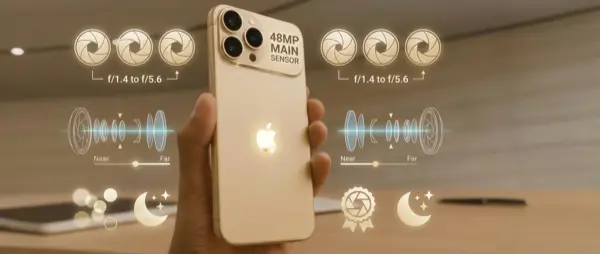
According to Apple's official specs, the iPhone 17 Pro features three rear 48MP cameras — the Pro Fusion camera system — with the following specifications:
The telephoto uses the next-generation tetraprism design with a 56% larger sensor, reaching an equivalent 200mm — the longest iPhone Telephoto ever. That means a 16x total optical zoom range (0.5x-8x), something unthinkable for a smartphone just a few years ago.
iPhone 17 Pro is also the first smartphone to support ProRes RAW — Apple's top-tier video codec — along with Apple Log 2, genlock, timecode support, and open gate recording. Essentially, it's a cinema camera that fits in your pocket.
Computational Photography: The Big Advantage
Where the iPhone surpasses every DSLR is in computational photography. The A19 Pro chip with Neural Accelerators integrated into every GPU core processes every photo in real time: Deep Fusion, Smart HDR, Night Mode, Photographic Styles.
According to PetaPixel, smartphones “merge multiple exposures” into a single image, achieving dynamic range that approaches — or in some cases exceeds — that of a DSLR in landscape photography. This means a casual iPhone shot comes out “perfect” without any post-processing.
Why this matters: A DSLR captures a single exposure per shot. To achieve comparable HDR, you need bracket exposures + post-processing in Lightroom. The iPhone does this automatically in milliseconds.
📖 Read more: Macro Photography iPhone: Capturing the Tiny World
Where DSLR Still Wins
Sensor Size
A DSLR's full-frame sensor (approximately 36×24mm) is about 30 times larger than the iPhone's sensor (approximately 9.8×7.3mm on the main lens). This translates to:
- Better dynamic range in extreme lighting conditions
- Less noise at high ISO — critical for nighttime photography without AI
- More natural, “creamy” bokeh — thanks to shallower depth of field
- Greater flexibility in post-processing — full-frame RAW files have enormous room for correction
Interchangeable Lenses
From 8mm fisheye to 600mm+ super-telephoto, a DSLR offers exactly the lens you need. The iPhone 17 Pro covers 13mm to 200mm, but a wildlife photographer needs 400-600mm, and an astrophotographer needs a dedicated tracking mount — things no smartphone can provide.
Ergonomics & Handling
Physical controls, optical viewfinder (OVF), the feel of a DSLR in hand — these can't be replicated. For all-day shoots, the ergonomics of an 800-1200g camera with proper grip are irreplaceable.
"Smartphones don't have as many lens options, but the ones they do provide are getting pretty good. The ability to take pictures and edit them on the phone before outputting them using cellular data is probably what makes smartphones so popular."
— Chris Niccolls, PetaPixelPortability vs Quality
The iPhone 17 Pro weighs 194 grams. A DSLR with lens weighs 1-2+ kilograms, needs a bag, and isn't always with you. As photographers say: “the best camera is the one you always have with you” — and in this regard, the iPhone wins without competition.
For street photography, the iPhone is ideal: silent, discreet, pocket-sized. For vlogging, the combination of optical + digital stabilization delivers steady footage even while walking.
📖 Read more: 10 iPhone Camera Tricks Nobody Knows About
Cost: The Big Comparison
The iPhone 17 Pro starts at ~€1,249 in Europe — and you get a camera, phone, computer, GPS, and editor in one device. An entry-level full-frame DSLR/mirrorless (e.g., Canon EOS R8, Nikon Z5) costs €1,300-1,800 for the body alone, and you need at least 2-3 lenses (€500-2,000 each) for comparable versatility.
The Final Verdict
🏆 iPhone Wins at: Everyday photography, social media, street photography, vlogging, instant sharing, casual night photography, computational HDR, travel photography, video for YouTube/TikTok.
📸 DSLR Wins at: Professional studio shoots, sports photography, wildlife, astrophotography, large-format prints, extreme bokeh, raw post-processing, all-day shoots.
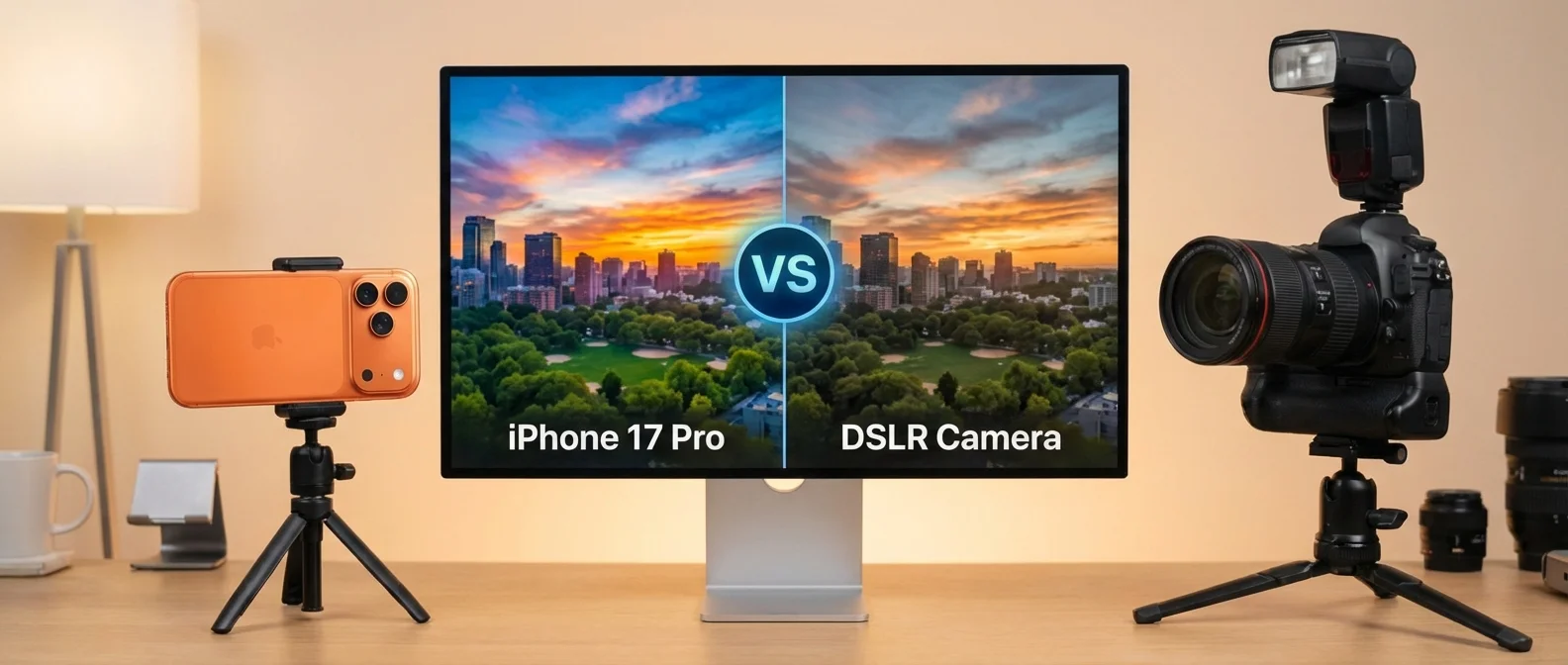
If you're not a professional photographer, the iPhone 17 Pro fully covers your needs — and in areas like computational photography and video, it actually surpasses cameras costing several times more. A DSLR is worth it only if you need interchangeable lenses, a larger sensor, or specialized use cases. For 90% of users, the camera in their pocket is now more than enough.
Sources:
Apple — iPhone 17 Pro — Camera System & Specs
PetaPixel — Smartphone vs Camera: The Best Camera is the One You Have With You