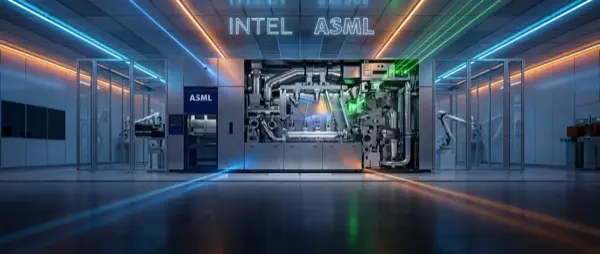


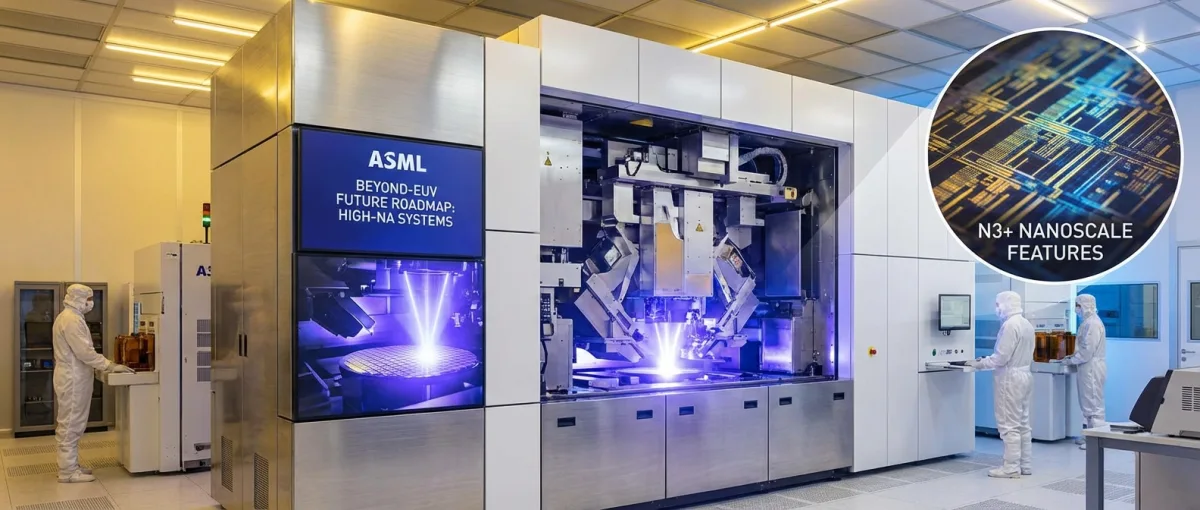
ASML, the Dutch company that holds a monopoly on lithography machine manufacturing, announced the next generation of technology: High-NA EUV. Microchips will become even smaller, faster, and more efficient. How does one company in Eindhoven control the future of all technology?
📖 Read more: Greece Is Building a Microchip Ecosystem: What Is the HCCC
🔬 What Is High-NA EUV
EUV (Extreme Ultraviolet) lithography is the technology that allows TSMC, Samsung, and Intel to manufacture chips at 3nm and 2nm. ASML is the only company in the world that makes EUV machines — each costs over $200 million and weighs 150 tons. The new generation, High-NA EUV, reaches $350 million per machine.
The difference? High-NA EUV can “draw” circuits at 8nm resolution — smaller than a single strand of DNA. This opens the path to 1.4nm chips and below, something that a few years ago was considered physically impossible.
🌍 Why One Company Controls Everything
ASML didn't achieve its monopoly by accident. EUV technology required over 30 years of development and billions in investment. No other company dared — or was able — to follow. The result: ASML is literally the most important technology company that the average consumer has never heard of.
The geopolitical significance is enormous. China cannot purchase EUV machines due to sanctions — which means it cannot make the most advanced chips. The Netherlands, USA, and Japan essentially control who can manufacture the world's most cutting-edge semiconductors.

💻 What This Means for Your Gadgets
Chips at 1.4nm mean smartphones with batteries lasting 3 days, laptops running AI locally without cloud, and GPUs rendering movies in minutes instead of hours. Apple is expected to be among the first to use High-NA EUV chips in iPhone, possibly in iPhone 20 (2028).
But the most important application is in AI. Current AI data centers consume enormous amounts of energy. Chips at 1.4nm will dramatically reduce this consumption, making AI more sustainable long-term.
💡 Interesting fact: An EUV machine produces light by hitting droplets of liquid tin with a laser 50,000 times per second. Each droplet converts to plasma that emits extreme ultraviolet radiation. It's literally a miniature sun inside a machine.
🔮 Beyond EUV
ASML is already working on what comes next. Hyper-NA technology, expected after 2030, could theoretically reach sub-5nm resolution. Meanwhile, the company is researching alternative approaches like multi-beam lithography and nanoimprint. Whatever comes next, ASML will almost certainly be the one building it.